

Audio By Carbonatix
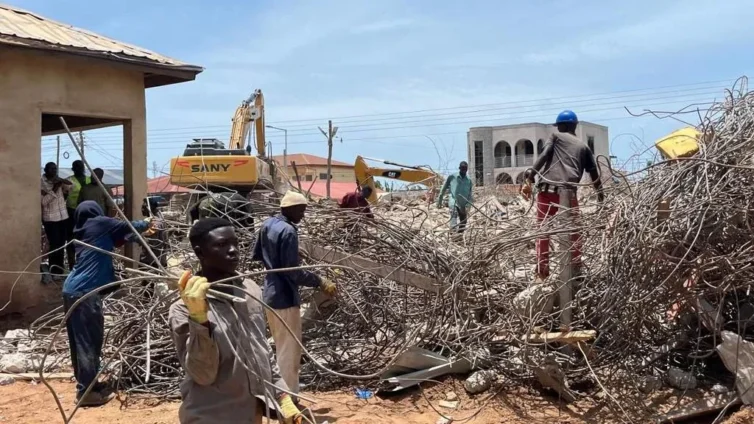
The tragic collapse of an abandoned structure at Accra New Town, with its reported loss of lives and severe injuries, is a painful and sobering reminder of a challenge we can no longer afford to ignore. This is not merely an unfortunate incident—it is a national wake-up call.
My deepest condolences go to the bereaved families, and my thoughts are with all those who have been affected. In moments like this, we must go beyond grief and ask the difficult, but necessary, questions that will help us prevent future occurrences.
This structure, believed to have been initiated over a decade ago as part of a public project, stood incomplete and unattended for years. Over time, it became accessible and was reportedly used for various activities. Its condition, visible to many, posed an obvious risk. The critical question is: how did we allow such a known hazard to persist in the heart of a community?
This is not about assigning blame. It is about confronting a systemic issue within our governance and development processes.
At the heart of this tragedy lies a breakdown in three key areas: accountability, monitoring, and enforcement.
First, every public project must have a clearly defined chain of responsibility—from initiation to completion. When projects stall, there must be designated institutions or officers accountable for securing or repurposing them. Infrastructure cannot be abandoned without consequence.
Second, local authorities must be adequately empowered and resourced to carry out routine inspections of buildings within their jurisdictions. District and municipal assemblies are the first line of defense in identifying structural risks. However, this responsibility must be matched with the necessary logistics, personnel, and legal backing to act decisively.
Third, enforcement of safety standards must be non-negotiable. Where structures pose a danger to human life, swift action must be taken—whether through rehabilitation, restriction of access, or demolition. Delayed action often comes at a far greater cost.
This incident also raises broader national concerns. Across our towns and cities, there are numerous abandoned or uncompleted structures—both public and private—that silently threaten the safety of our citizens. We must ask ourselves: must we always wait for disaster before we act?
As a nation, we must transition from reactive responses to proactive governance. Prevention must become the cornerstone of our development strategy.
To this end, I call for:
• A nationwide audit of all abandoned and uncompleted structures.
• Immediate risk assessments and safety interventions for identified sites.
• Strengthened institutional coordination between central government agencies and local authorities.
• A clear policy framework that ensures no project is left unattended without accountability.
Equally important is community awareness and participation. Residents must feel empowered to report unsafe structures, and authorities must respond promptly to such concerns. Safety is a shared responsibility.
Let me emphasize: this is not a political issue. It is a human issue. The loss of even one life due to preventable circumstances is unacceptable. We must rise above partisanship and focus on building systems that protect our people.
The Accra New Town tragedy must not fade into silence. Let it mark a turning point—a moment when we collectively decide that neglect will no longer be tolerated, and that public safety will always come first.
If we fail to act decisively now, we risk repeating this painful chapter elsewhere.
Let us choose responsibility. Let us choose action. Let us choose life.
By: Alfred Asiedu Adjei, President, National Association of Local Authorities of Ghana (NALAG)
Latest Stories
-
We will vet Mahama Ayariga fearlessly – Minority Leader
9 minutes -
Ayitey Powers arrested over alleged death threat against NSA Director-General
36 minutes -
Oppong Nkrumah heads back to Supreme Court over legal vacation ruling
46 minutes -
Thousands gather at OVO Arena Wembley for MOGmusic’s ‘Back to Basics’ worship
52 minutes -
23 lives lost to abandoned illegal mining pits in Ashanti Region – Regional Minister
59 minutes -
Catholic priest suspended after abandoning parish, Diocese says
1 hour -
Bagbin to admit Minority’s GoldBod motion but says debate must wait until after recall
1 hour -
Speaker refers two ministerial nominees to Appointments Committee
1 hour -
We’re seeking investigation, not conviction of Afenyo-Markin – Appiah Danquah defends ‘extortion’ petition
1 hour -
Ghana Institution of Surveyors, Roads Ministry agree to strengthen compensation process
1 hour -
‘While GoldBod cannot account for GH¢22bn, mining communities are paying with their kidneys and lungs’ – Afenyo-Markin
2 hours -
24-hour market: Who is actually in charge?
2 hours -
OSP’s swift response to extortion allegation doesn’t mean selective investigations – Senanu
2 hours -
Maradona’s ‘Hand of God’ ball sells for £2.5m
2 hours -
WAFU B WCLQ: Ampem Darkoa Ladies beat ASEC Mimosas in Group B opener
2 hours