

Audio By Carbonatix
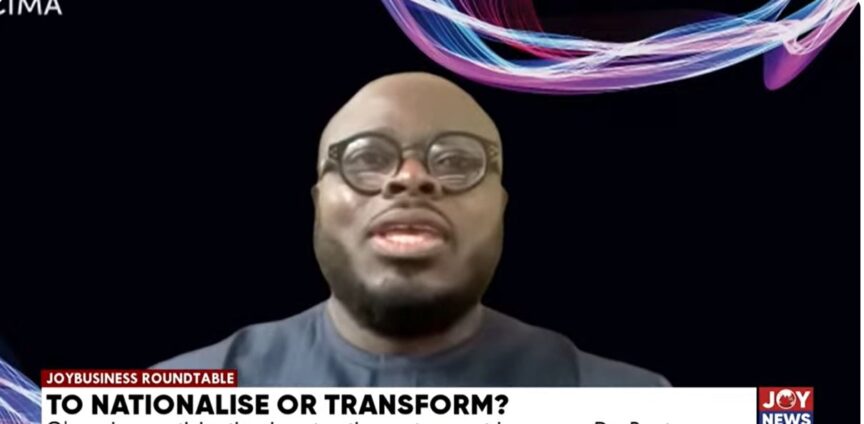
The Acting Director of the Institute of Mining Research and Governance (IMRIG) at the University of Mines and Technology, Dr. Frank Boateng, is calling for increased Ghanaian participation in the country’s extractive sector, arguing that broader local ownership is critical to ensuring that more citizens and mining communities benefit from Ghana’s natural resources.
Speaking during a JoyBusiness Roundtable discussion on rethinking Ghana’s approach to gold mining, oil and critical minerals, Dr. Boateng stressed the need for deliberate policies to expand indigenous participation in mining operations.
According to him, Ghana must move beyond limited state participation and create structures that allow ordinary citizens to own stakes in mining ventures through wider stock market participation.
“I still stand by my point where I feel that Ghanaian participation needs to increase,” he stated on Tuesday, May 26.
Dr. Boateng explained on JoyNews that increasing local ownership would not only improve national benefits from the extractive sector but also strengthen Ghana’s influence in major operational and strategic decisions within mining companies.
He suggested that the government could explore options such as converting portions of taxes owed by mining firms into equity stakes to increase Ghana’s shareholding beyond the constitutionally mandated 10 percent free carried interest.
According to him, increasing Ghana’s equity participation would also secure stronger representation on the boards of mining companies and ensure the country becomes part of key decision-making processes.
“Can we even defer some of our taxes to increase our equities in some of these mines, so that it pushes our ownership beyond the free carry of 10%?” he questioned.
Dr. Boateng further proposed that mining lease renewal negotiations should be used as opportunities to secure greater Ghanaian participation in mining operations.
“If mining companies are coming to lease renewal, we can renegotiate and increase our participation,” he said.
He, however, cautioned against concentrating ownership solely in the hands of government or political actors, stressing that broader citizen participation through stock ownership would be more beneficial and sustainable.
Dr. Boateng also warned that Ghana’s changing political landscape and policy reversals often create uncertainty within the mining sector and discourage long-term investment planning.
“Looking at the nature of our politics in this country, when government changes, things change dramatically, and sometimes decisions are reversed. This does not help,” he noted.
He further identified the artisanal and small-scale mining sector as a major opportunity for increasing Ghanaian ownership in the extractive industry.
According to him, supporting well-performing local small-scale mining operators with financing and technical assistance could help transform them into medium-scale mining companies capable of attracting larger investments.
He referenced the Minerals Income Investment Fund’s Small-Scale Incubation Project, which aimed to identify promising artisanal mining operators and provide support to help them scale up operations.
Dr. Boateng maintained that empowering Ghanaian-owned mining firms and expanding citizen participation in the extractive sector would ultimately lead to greater national benefits and stronger local economic development.
Latest Stories
-
Pay me by Sept. 11 or face the court – Kow Essuman demands salary, benefits from Finance Minister
11 minutes -
Bawumia’s destiny lies in the hands of God; not you – Muslim Forum for Peace and Unity replies Rev. Owusu Bempah
13 minutes -
NPP NEC meets today to discuss and approve party’s position paper on Constitution Review proposals
19 minutes -
Today’s frontpages: Thursday, September 10, 2026
27 minutes -
Ghana Garden and Flower Show returns on Sept 11 with focus on green jobs, business and wellbeing
27 minutes -
Titus-Glover camp says Mustapha Salam wasn’t pressured to withdraw from National Organiser race
29 minutes -
Ghana’s acclaimed Christian – Muslim unity bigger than Owusu Bempah’s hatred and bigotry – Muslim Forum for Peace and Unity
31 minutes -
Karpowership lights up young minds on International Literacy Day
41 minutes -
Banking sector NPLs fall to GH¢19.9bn as asset quality improves
45 minutes -
Republic Bank Ghana, UPSA sign strategic MoU to advance professional development and industry-academia collaboration
49 minutes -
MTN 30th Anniversary CEO Invitational Golf Tournament set to tee off at Achimota
53 minutes -
Ghana woos Australian investors into critical minerals
1 hour -
Akufo-Addo’s former legal counsel Kow Essuman, writes to Finance Minister to demand his ex-gratia payment
1 hour -
NSMQ Final: St Augustine’s get GH¢120,000 motivational package from old boys
1 hour -
AFCON 2027: Ghana has no business doing football if we can’t beat Somalia and The Gambia to qualify – George Afriyie
2 hours