

Audio By Carbonatix
A desert plant changed the life of Masapalli Venkatesh.
His 10-acre farm in Kandukur is on the Deccan Plateau, which covers a large part of southern and central India. There he grows tomatoes, peanuts and corn.
But in 2010, he was approached by traders looking for a very different crop - the cactus agave americana.
For him and his fellow farmers, the agave cactus was just a "stubborn, valueless weed" - planted as fencing to keep wild animals off their crops.
But it is also part of the agave family that feeds the $15bn (£11bn) global market for tequila and mezcal.
In Mexico, blue agave is farmed in the state of Jalisco to supply the tequila industry. Only plants from select areas of Jalisco can be used to make tequila.
Unlike in Mexico, where vast plantations dominate the landscape, nobody grows agave commercially in India - at least not yet.
Instead, Indian farmers and entrepreneurs collect and process wild-growing agave.
For some, like Venkatesh, it's a welcome source of extra income, earning it the name "blue gold".
These days, Venkatesh covers an area of 100km (60 miles), coordinating with villagers and farmers.
"By combining the yields of multiple farms, I ensure a steady, high-volume supply that distilleries are willing to pay a premium for," he says.
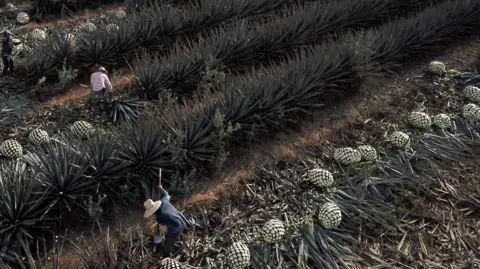
Harvesting agave plants is a skilled job.
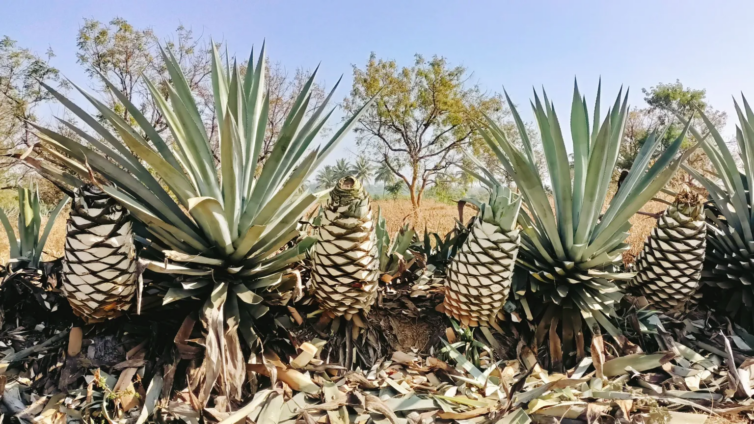
The most important part of the plant is the heart, known as the piña, because it resembles a giant pineapple.
Skilled workers reveal the heart by chopping off the spiky leaves. But getting the timing of the harvest right is crucial.
Once the plant decides to bloom, it channels its entire reserve of accumulated sugar upward into the stalk in a matter of days.
If the flower blooms, the sugar is completely depleted, making the piña useless for alcohol production.
"Gatherers must accurately identify the exact pre-blooming window to harvest the plant at its absolute peak sugar capacity, making the timing of the harvest incredibly narrow," says Rakshay Dhariwal, founder of the distiller Maya Pistola Agavepura.
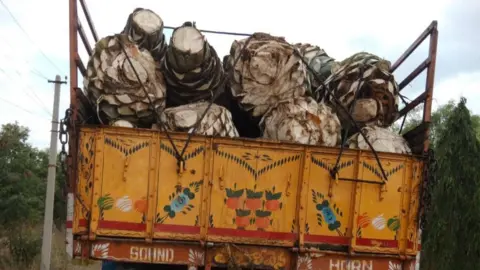
Once harvested, the clock starts ticking. The piñas must get to a pressure cooker within 24 hours, where the sugars can be extracted.
"Any transport delay can risk ruining the batch. If it takes longer than 24 hours, the internal sugars begin to rot and ferment unpredictably, destroying the delicate flavour profile needed for premium spirits," says Dhariwal.
And transportation is not straightforward, as agave suppliers are scattered across vast distances in states like Karnataka, Maharashtra, Rajasthan, and Andhra Pradesh.
"Brands like us cannot simply order from a centralised farming cooperative. We rely on networks of local aggregators to scout, negotiate for, and harvest individual patches of semi-wild agave growing on marginal lands or rural property boundaries," he says.
It's all helping to meet a rising demand for agave spirits. According to Dhariwal, the Indian market for agave spirits is growing at 31%.
"It's only been a few years now that India's finally caught the tequila bug," says Vikram Achanta, co-founder of 30 Best Bars India.
"Producers are beginning to experiment with it seriously, and there's a consumer base today that is far more open to exploring new spirits than before," he says.
Aqave drinks are unlikely to replace whisky, India's favourite spirit, he says, but they could carve out a market.
"New brands are interesting examples of early experimentation, especially in how they're working with wild agave from the Deccan Plateau and beginning to shape what an Indian agave identity could look like. It's still early days, but they're helping move the category from curiosity to something more credible," he adds.
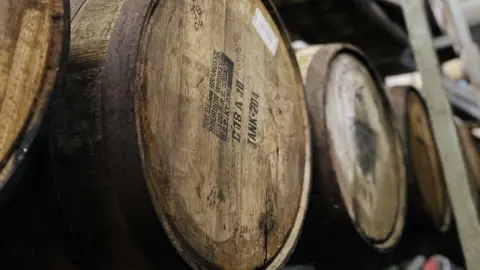
Desmond Nazareth is a pioneer in the Indian agave spirit industry. His company, Agave India, launched India's first homegrown agave spirit in 2011.
"What started as kitchen experiments eventually became India's first craft agave distillery after nearly 12 years of research and experimentation," he says.
"We were making Indian agave spirit long before the market was ready for it. It was a craft business way ahead of its time."
Now he's taking a scientific approach to developing the industry.
"We have taken satellite images of areas where agave already grows successfully, then matched those environmental patterns with nearby regions to identify more suitable land. That's important because agave takes 9–13 years to mature. If you plant in the wrong area, you lose a decade," he says.
With growing demand, is there a risk that India's wild agave supplies will become depleted? Not for at least five years, and probably longer, says agricultural expert Miguel Braganza.
He points out that India's domestic industry is still tiny, with just one plant for processing agave hearts, which is owned by Nazareth's Agave India.
Also, the wild agave plant is very good at propagating itself.
"When you look at a wild agave, you aren't just looking at a single plant. Beneath the soil, the mother agave is incredibly busy. Throughout her 10-to-20-year life, she secretly sends out long root-runners into the earth," says Braganza,
And those roots are the source of future plants.
"Every few feet, a mini-clone of herself pops out. Those baby plants grow their own roots and become independent plants, slowly forming large agave colonies over time. So one plant can naturally turn into dozens of plants across an area without any human help,"
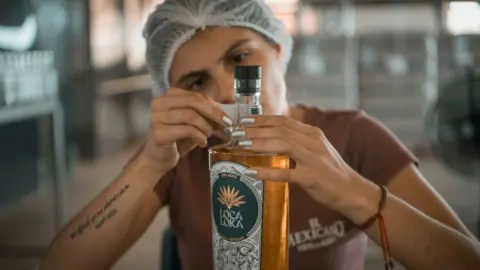
India's wild supply of cheap agave plants is far from ideal, as Indian entrepreneur Sree Harsha Vadlamudi points out.
Unlike farmed plants, the wild plants are "genetically inconsistent", he says.
"That means sugar yields fluctuate... and that means alcohol output changes. So standardising production becomes difficult. Mexico solved this over decades through selective breeding. India hasn't yet," he says.
Vadlamudi co-founded tequila brand Loca Loka. It uses Mexican blue agave from the tequila heartland of Jalisco.
"We wanted to leverage the rich, iron-heavy red soil left behind by ancient volcanic eruptions in Jalisco, Mexico. This unique terroir imparts a distinct flavour profile to the agave that cannot be replicated by growing the same seeds in Indian soil," Vadlamudi says.
Mexico's large, organised agave farms are a sharp contrast to India's informal system.
Those big, rich farms can afford hi-tech farming techniques. Some combine drones and AI systems to monitor their crops.
"Drones scan thousands of hectares to accurately count individual crops, assess plant health, spot early signs of disease, and monitor the growth of the piña to predict the absolutely perfect window for harvesting," Vadlamudi says.
Such investment is still a long way off for Indian producers.
Nazareth accepts that building a significant agave spirit industry will take time. But he's confident.
"India could absolutely become a major agave economy. The Deccan Plateau alone has millions of acres suitable for cultivation. We could theoretically rival Mexico if there's long-term vision and patience."
Latest Stories
-
President Mahama ends Resetting Ghana tour of Ahafo Region
2 minutes -
African negotiators seek delivery of climate commitments at COP31
3 minutes -
BoG develops AI rules for financial sector
5 minutes -
‘Big Push’: Government assures contractors of prompt payments
10 minutes -
Court fines miner for breaking into gold buying shop
20 minutes -
Tarkwa court jails labourer for three years over GH¢123,000 theft
1 hour -
GAEC must retain nuclear scientists for Ghana’s nuclear ambitions – Minister
2 hours -
Man reportedly mistaken for game and shot by hunter dead in forest
2 hours -
19-year-old mason jailed 15 years for defiling seven-year-old pupil
2 hours -
Ghana’s banking sector assets rise 20.47% to GH¢500.2bn – BoG Governor
2 hours -
22 injured as Sprinter bus overturns at Sege after tyre burst
2 hours -
UN housing expert urges Ghana to strengthen Rent Control Department amid housing affordability concerns
2 hours -
Delta-BCI partnership reaches 166,000 people with breast cancer education
2 hours -
Power restoration fault suspected in Kumasi Central Market fire
7 hours -
The 7-foot giant of Ngleshie Amanfro: Seven-foot Ghanaian Ephraim Saawa dreams of joining the national basketball team
8 hours