

Audio By Carbonatix
Artificial intelligence is set to revolutionize education. From personalized learning and instant grading to AI tutors and essay-writing algorithms, technology has the power to fundamentally change what students learn, how they learn, and who does the teaching.
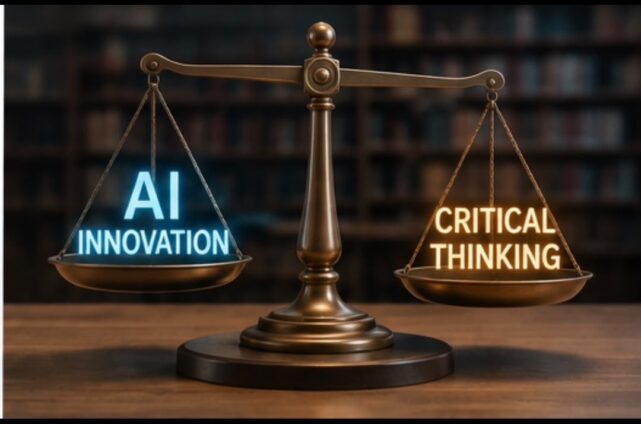
The rise of AI in education brings great promise to the classroom, but also presents one very important question: How can we integrate technology into the classroom while still ensuring that students develop critical thinking skills?
The answer to this question is complicated. But it should start with recognizing the value of using AI as a tool.
AI's Role in the Classroom
AI can be valuable to students and teachers. It is able to offer unique opportunities to enhance learning that couldn't have been possible before and can help to facilitate many time-consuming classroom tasks.
For students, AI can act as a brainstorming partner, tutor, writer, or research assistant. When done right, AI can make it much easier for students to learn, practice, and apply knowledge.
As for teachers, AI can help plan lessons, create practice exercises, organize information, design differentiated activities, and provide feedback. This could allow teachers to spend much less time on day-to-day activities, and more time discussing, creating, and interacting with students in the classroom.
But with all the benefits that generative AI could bring comes an equal amount of responsibility.
The Downfall of Thinking Skills
The main issue with AI in the classroom is that the thinking skills required to truly use it effectively can be bypassed.
If a computer is able to write an essay faster and more effectively than a student ever could, why should a student bother with the time consuming process of learning how to write a good essay?
This can allow for an artificial divide between using an AI algorithm to help a student think versus using an algorithm to do the thinking, and the latter is much more common than the former.
Education has traditionally revolved around teaching students to think critically, interpret, analyze, and creatively apply concepts.
If technology does too much of the thinking and problem solving for students, they might get much better grades while learning much less than before. Not only that, but students will be less likely to question or think critically about information that came directly from a computer.
AI's role in education could undermine the value of thinking skills, especially if students are overly reliant on it.
Furthermore, students also need to understand that just because a computer says something is true, doesn't mean that it is.
Students will need to become much more critical of the information given to them by artificial intelligence, especially given that it may not always be accurate.
Critical thinking is more important than ever in an age of AI
When given the choice between trusting an AI-generated fact and thinking critically about a situation, there are numerous important questions students should be able to ask themselves:
Is the information given true?
What are the sources that back this information up?
Did I phrase my question correctly so that the AI was able to understand and respond correctly?
Could there be any sort of bias or assumptions being made here?
What other information could there be?
How can I verify this information for myself?
This sort of questioning can be incorporated into education in a number of different ways, including by asking students to analyze AI-generated work for mistakes or biases or compare it to real information.
Instead of completely ruling out AI from education, critical thinking can also be integrated into teaching by teaching students to question the information that AI does provide.
How can Teachers Measure Learning?
The advent of generative AI introduces another major issue in education: assessment.
If a student is able to use AI to generate an essay, a mathematical proof, or even a lab report, how can teachers ensure that students are truly learning and applying the information they are being taught?
While it could be argued that essay writing, mathematical proofs, and lab reports have always been difficult tasks, their widespread use in education has become a limiting factor in the way that students are expected to learn.
Education should evolve to meet the needs of the times it's in, and if certain tasks can be made much easier and more efficient by AI, then it's important to ask whether or not these tasks should really matter that much.
It's not that these tasks have no place in education - clearly they do.
But with the advent of AI, it's important that education diversifies its assessment methods to incorporate not just written or mathematical tasks, but also oral presentations, project-based learning, or even in-class practice and writing exercises.
Assessments should also reflect how students reach conclusions as much as what those conclusions are. If students are able to cite their sources or show their work, it can become much more clear whether or not a student actually understood the material. Likewise, certain assignments should specifically encourage students to think through their work or show their reasoning. This includes reflective journal entries, drafting work, or even in-class or project-based assessments.
The Value of Teachers
While AI is set to revolutionize education, it's unlikely to fully replace the role of teachers.
Teachers provide students with the context and encouragement that many students need to become successful learners.
Additionally, teachers can often detect when a student is struggling with concepts or falling behind, which is much more difficult for AI-assisted practice exercises.
Furthermore, teachers can also act as discussion facilitators, encouraging students to collaborate and think through topics together.
The role of a teacher is also going to be much more important when it comes to teaching critical thinking.
While it may be easy to generate a well-written response from AI, teachers should encourage student questioning by making them explain their reasoning or what they've learned about a certain topic.
They can also ask students to defend their arguments or prove concepts by relying on what they've learned. The teacher can encourage critical thinking from students by asking more Socratic questions: Why do you think this? What would convince you otherwise? Can you prove this concept? What information haven't we considered?
Finally, it should be remembered that schools also have a responsibility to educate students on AI itself. The ways that AI works - including its limitations - should be explained to students.
Students should be informed of ethical issues such as bias, privacy, misinformation, and intellectual property. Students also need to be educated about proper uses of AI. A teacher could use it to brainstorm ideas with. But a student shouldn't use it to write an essay for them on an assignment that they're supposed to do themselves. Policies need to be clearly communicated to students so that they can take advantage of AI's educational benefits while avoiding its pitfalls.
The Importance of Equality
It's also important to note that while AI can have many educational benefits, it's only as useful as the person using it.
Students with access to the most resources will always be in a better position to benefit from education than others.
Schools must be aware that the introduction of AI could widen the existing achievement gap if certain students are more able to use AI than others.
It's important to make sure that technology is treated fairly in the classroom and doesn't become the reason why some students learn much more than others. At the same time, schools should protect students from any misuse of their personal information.
The Balance Between Learning and Technology
The issue of the balance between learning and technology is a fine line to walk.
Many argue that technology itself isn't inherently bad, but should also never be used at the expense of human skills such as critical thinking and learning. But how can we do both in the classroom while maximizing the benefits of both?
The answer lies in recognizing the balance between the two.
There's certainly a place in education for utilizing the potential of technology and maximizing its usefulness. But no matter how much technology is involved in education, critical thinking will always be the most valuable skill to learn.
Students need to learn how to think through and understand topics, especially when the information provided could be unreliable. They need to learn how to question information, research, organize, plan, and apply concepts. AI can help with all of these, but at the end of the day it's only a tool.
A student who uses AI to generate ten brainstorming ideas but then analyzes those ideas to find the best ones for an essay or speech is learning critical thinking. A student who uses AI to generate a fully formed research paper and turns it in as their own original work isn't really learning anything at all.
AI is becoming an increasingly prominent force in education, and its impact on the classroom is only set to grow.
Its potential to personalize learning, assist teachers, and provide instant feedback and practice opportunities is undeniably valuable.
But technology should never come at the cost of critical thinking, creativity, and learning.
Education should always be about building minds, challenging students, and encouraging them to think for themselves.
If AI is being introduced into the classroom, it needs to be done in a responsible way that doesn't compromise those values. The classroom of the future shouldn't be a race between human minds and artificial intelligence, but rather a collaboration that encourages learning from both.
Latest Stories
-
Ho Central Mosque reopens amid unresolved leadership dispute that led to closure
32 minutes -
Minority caucus questions GH¢16.4m in Ablakwa’s SA evacuation spending, demands independent audit
41 minutes -
Gender Ministry meets Nana Akua Addo’s husband over domestic violence after hospital discharge
2 hours -
UG Vice-Chancellor urges swift operationalisation of National Research Fund
2 hours -
Pope Leo to have surgery after lump found in lung
2 hours -
Joseph Cudjoe writes: Ghana must break free from the dangerous mindset that natural resources are the foundation for wealth
2 hours -
Children among 109 dead after boat capsizes off Djibouti, UN says
2 hours -
OmniBSIC Bank’s 11th health walk promotes fitness and business growth
3 hours -
2026 World Maritime Day: Danish Embassy organises “The Gulf of Guinea Speaks”
3 hours -
New Economy will tackle unemployment and restore hope – Ato Forson
3 hours -
IMMILAC president recounts personal losses as security women lead breast cancer awareness campaign in Wa
3 hours -
University of Ghana postpones October 12 reopening as GAUA strike persists
3 hours -
Bahass Foundation launches vocational skills training to support mental health recovery in Wa
4 hours -
NPP orders parliamentary aspirants and their supporters to suspend campaign activities
5 hours -
Techiman unites against child marriage: Joy Impact Makers Awardee leads charge on International Day of the Girl Child
5 hours