

Audio By Carbonatix
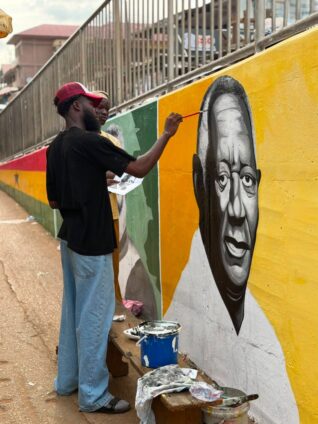
On a footbridge somewhere in Ghana, traffic moving below him, Bawaa the Artist stands with a brush in hand, filling in the lines of a face on a wall painted in red, gold, and green. A young apprentice stands just behind him holding up a reference photo, watching closely as the portrait comes together stroke by stroke. It's not a gallery. It's not even indoors. But it's exactly where Bawaa says the work is supposed to happen out where people can see it, not locked away waiting for a certificate to make it official.
For some young people, talent was never the problem. Finding somewhere to grow it, show it, and eventually get paid for it that's the hard part.
In Ghana, where many young people are still searching for steady employment, the creative industry is quietly opening up as an alternative. One person pushing that door wider is Bawaa the Artist, who paints murals on the streets of Kumasi and runs an art studio at SGM, teaching people to draw, paint, and just as importantly believe their work is worth something.
The studio is simple in concept. People come in, learn the fundamentals, sharpen what they already have, and eventually see their finished pieces put up for buyers to see and purchase.
But for Bawaa, this isn't just about producing pretty canvases.
"I started this to bring memories to life and encourage young artists not to kill their talent because of certification," he said.
It's a line that gets at something a lot of young creatives quietly carry the fear that without a certificate to back them up, their gift doesn't count as a real path forward.
Humu Adam knows that fear firsthand. She trained under Bawaa at the studio, and these days you'll find her exactly where he once sat parked in front of a canvas, headwrap on, palette balanced on a paint bucket, working through a fractured, geometric portrait in the same visual language the studio has become known for. She's doing exactly what Bawaa set out to prove was possible working with the skill she picked up, no certificate required, just practice and a space that took her seriously. Her progress is the kind of proof that's hard to argue with: talent, given room to grow, turns into capability.
Then there's Dr. Kwame Adjei Akrasi, one of the people who's actually put his money where his appreciation is. As a patron who has bought Bawaa's work, he represents the other half of the equation that makes this whole model function because talent without a buyer is still just a hobby. His support is a reminder that the market for this kind of work exists; it just needs to be found.
Between them, Humu and Dr. Akrasi tell the fuller story the studio is built around: one person coming up through the training, another walking in to support what comes out of it.
Beyond the income it can generate, there's something bigger at stake. Paintings and visual art hold memories, document lived experience, and say something about who Ghanaians are and how they see the world. That's not a small thing for a country still writing its cultural story in real time.
None of this is easy, though. Artists still struggle to get their hands on good materials, still hunt for customers, still chase funding, still need somewhere anywhere to actually exhibit what they've made. That's exactly why spaces like Bawaa's studio matter as much as they do. Training is one thing. A platform to be seen is another. You need both.
What's happening at SGM and out on the streets, on footbridges and walls where Bawaa's murals now live in public view is a small but telling example of what's possible when young people are given practical skills alongside a real shot at entrepreneurship. It also sits comfortably within Sustainable Development Goal 8 Decent Work and Economic Growth which is really just a formal way of saying what Bawaa is already doing: helping people build something they can actually live on.
His message, at the end of it, isn't complicated. A missing certificate shouldn't be the reason someone quietly gives up on what they're good at.
As more young Ghanaians look for ways to earn outside the usual routes, spaces like this one that train, support, and showcase creative talent are likely to become a bigger part of the conversation about work and opportunity in the country.
Art, in the end, is more than paint on canvas. For people like Humu, it's a skill turned into a livelihood. For people like Dr. Akrasi, it's something worth investing in. And for a growing number of young Ghanaians, it might just be the start of a career nobody handed them a certificate for.
Latest Stories
-
Afenyo-Markin’s lawsuit against Sammy Gyamfi takes focus away from development – Kpebu
5 minutes -
FWSC urges media to guard against misinformation in proposed IPEC transition
5 minutes -
MoMo Fest 2026: Shatta Wale to Rock Accra Stadium on October 17
7 minutes -
Zimbabwean author denies using AI to write award-winning story
27 minutes -
GTEC’s letter directing public universities to reopen by October 16 is unprofessional – GAUA
27 minutes -
Suspect in viral video assaulting wife jailed for 3 months
28 minutes -
GAUA insists strike will end only after Fair Wages addresses market premium issue
28 minutes -
Kpemka seeks compensation as he sues BOST over alleged unlawful termination
31 minutes -
GES asks applicants to check status of 2026 promotion applications on October 15
55 minutes -
Kobe Boujee joins Olympics.com team for Dakar 2026 Youth Olympic Games
1 hour -
Slaty egret’s shifting nesting sites offer clues to changing ecosystems
1 hour -
First phase of arrears for promoted teachers to be paid on Friday – Haruna Iddrisu announces
1 hour -
Caveman Watches partners with Mfantsipim School for 150th anniversary
2 hours -
We’ll pursue GH¢15m defamation suit against Sammy Gyamfi to its logical conclusion – Afenyo-Markin’s lawyers
2 hours -
Martin Kpebu urges Afenyo-Markin not to return to court over Sammy Gyamfi lawsuit
2 hours