

Audio By Carbonatix
In May 2024, in a ceremony at Jubilee House in Accra, Stevie Wonder received a Ghanaian passport on his 74th birthday. The President of Ghana handed him the certificate and said, " This is it, congratulations. Wonder, who had spoken for years about tracing his lineage to the continent, called it amazing.
Nearly two years later, in early 2026, Ghana's Foreign Ministry approved a Ghanaian passport for the 21-year-old streamer IShowSpeed after establishing what it called irrefutable ties to the country, describing him as a worthy ambassador.
Two very different people. Two generations apart. One pattern. And the pattern is not a celebrity story. It is a policy story, and it is one of the most significant economic signals coming out of West Africa right now.
Imaani Homes is the practical, investment-smart step after the passport, turning belonging into ownership in Accra's most prestigious address. Explore Regalia Residence or call +233 595 959595.
This Is Policy, Not Coincidence
Ghana has made a deliberate, sustained, decade-long decision to welcome the global African diaspora home. This is not a series of one-off gestures. It is a national strategy.
It began formally with the Right of Abode provisions and accelerated with the Year of Return in 2019, which marked 400 years since the first enslaved Africans were taken from the continent. That campaign drew more than a million visitors and over 3 billion dollars into the local economy. Ghana then launched Beyond the Return, a 10-year programme running to 2030 under the theme A Decade of African Renaissance, explicitly designed to convert visits into lasting connections, investment, and citizenship.
The citizenship numbers tell the story plainly. Since 2016, people able to prove African ancestry, largely descendants of those affected by the transatlantic slave trade, have been eligible for Ghanaian nationality. More than 1,000 diaspora members have obtained Ghanaian citizenship in recent years. Stevie Wonder is the most famous, but he is one of many, joining missionaries, doctors, lawyers, artists, and ordinary families who have chosen to make Ghana their legal home.
When a government structures its laws, ceremonies, and national branding around inviting an entire diaspora to return and belong, it is sending the clearest possible signal about the direction the country is heading. The smart money reads that signal.
Even the Pause Is a Signal of Commitment
Here is a detail that matters, and that an honest account has to include. In February 2026, Ghana temporarily paused new diaspora citizenship applications.
At first glance, that might sound like a retreat. It is the opposite. The pause was announced as a process overhaul, a deliberate effort to make the pathway more accessible and user-friendly after applicants complained that the existing process was too costly and too complicated, including a requirement to submit DNA evidence within an impractically short window. The government did not pause because it wants fewer diaspora citizens. It paused because it wants the process to work better for the many more it expects.
A country abandoning a policy does not invest in fixing the machinery behind it. The pause is a recalibration in service of the long-term mission, not a withdrawal from it. For anyone watching where Ghana is going, that is reassuring, not concerning.
While the citizenship process is refined, property ownership remains fully open to diaspora buyers today. Request the Regalia investment brochure or call +233 595 959595.
The Passport Is the Beginning. Property Is the Substance.
A passport establishes that you belong. Property is what makes that belonging permanent, physical, and financially productive.
This is the step that turns an emotional homecoming into a concrete one. A citizenship certificate is a profound symbol, but it sits in a drawer. A home in Accra is something you can stand inside, rent out, grow in value, and pass to your children. It converts the idea of return into an asset that works for you, whether you are living in Accra or watching from Atlanta, London, or Toronto.
And here, citizenship and property reinforce each other directly. A diaspora member who holds Ghanaian citizenship is entitled to a leasehold of up to 99 years, the strongest residential tenure available in the country, compared to the 50-year leasehold available to non-citizens. The passport does not just let you belong. It strengthens the terms on which you can own. For the full breakdown of how ownership and tenure work for overseas buyers, the guide on how Ghanaians abroad can buy property in Accra covers the documentation and legal structure in detail.
Why the Bet Makes Financial Sense, Not Just Emotional Sense
If the homecoming were only about feeling, it would still be meaningful. What makes 2026 extraordinary is that the financial case is independently compelling.
Ghana's economy has stabilised after years of turbulence. Inflation has fallen to a multi-year low. The Bank of Ghana has cut its policy rate from a peak of 30 per cent to 14 per cent. The cedi has strengthened, and foreign reserves have reached record levels. This is a recovering economy with improving fundamentals, which is precisely the environment in which property values rise.
For property specifically, the numbers are striking. Prime apartments in the Airport Residential Area deliver rental yields between 7 and 22 per cent, depending on whether they are let long-term or run as professionally managed short-lets, against the 3 to 5 per cent typical of property in most Western cities. Prime Accra real estate is priced and transacted in US dollars, so a diaspora buyer earning in foreign currency carries no exchange-rate risk. The asset is in the same currency as the income. For the detailed strategy comparison, the Imaani analysis of short-let versus long-let in Accra lays out the full picture.
This is why African Americans and diaspora Ghanaians are not just visiting or applying for passports. They are buying. The homecoming has moved from the heart to the balance sheet, and both are pointing the same way.
The Bridge Between Belonging and Ownership
This is exactly where Imaani Homes sits: as the practical, investment-smart bridge between the emotional fact of belonging and the financial fact of ownership.
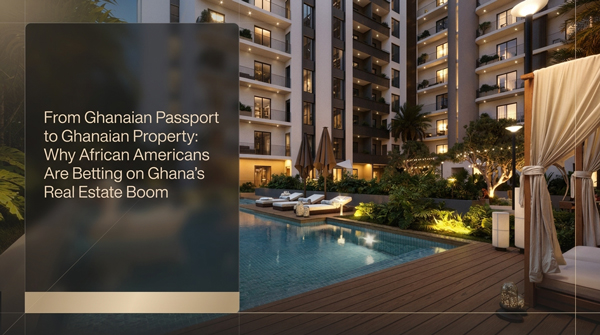
Imaani Homes is an Accra-based luxury developer focused on building investment-grade, design-forward homes in Ghana's most prestigious locations. Its flagship development, Regalia Residence in the Airport Residential Area, is built around a private landscaped courtyard with a rooftop infinity pool and concierge service. It offers five residence types, from studios well suited to short-let investment, through one and two bedroom units for corporate tenants and diaspora families, up to penthouses for a statement purchase. To understand how it compares within the neighbourhood, the Imaani guide to the top luxury apartments in Airport Residential Area sets out the landscape.
USD-denominated pricing protects your investment from currency risk. Flexible payment plans make it accessible for buyers earning abroad. Professional management means the property is secure, maintained, and able to earn income whether you are in Accra or not.
Ghana has spent a decade saying to the diaspora: come home. The passport is how the country says you belong. Property is how you make that belonging real, permanent, and productive. Imaani Homes is where the two meet.
Take the step from belonging to ownership at Regalia Residence by Imaani Homes, Airport Residential Area, Accra. Schedule a private viewing or call +233 595 959595.
Frequently Asked Questions
How can African Americans get Ghanaian citizenship?
Since 2016, people who can prove African ancestry have been eligible for Ghanaian citizenship, and more than 1,000 diaspora members have obtained it in recent years, including Stevie Wonder in 2024. Ghana also offers a Right of Abode granting people of African descent the right to live in Ghana indefinitely. In February 2026 Ghana paused new applications to overhaul and simplify the process, signalling commitment to making the pathway more accessible.
Can you own property in Ghana with diaspora or dual citizenship?
Yes. A diaspora member holding Ghanaian citizenship is entitled to a leasehold of up to 99 years, the strongest residential tenure, compared to up to 50 years for non-citizens. Citizenship and ownership are complementary: the passport establishes belonging, and property makes it permanent and financially productive.
Why are African Americans investing in Ghana real estate in 2026?
Deliberate government policy welcomes the diaspora, cultural belonging, and strong fundamentals. Inflation is at a multi-year low, the policy rate has fallen from 30 to 14 per cent, and prime Accra property is priced in US dollars, protecting against currency risk. Prime apartments yield 7 to 22 per cent, depending on strategy, far above the 3 to 5 per cent typical of Western markets.
Latest Stories
-
Be careful with cross-border lending, foreign currency exposures – BoG to financial institutions
43 minutes -
GPL 2026/27: Medeama go three clear as Hearts of Oak recover and Bechem stage stunning comeback
53 minutes -
Ntiamoah Foundation launches “BEYOND 20” anniversary campaign
1 hour -
Credit Risk Management Directive: BoG to begin implementation for banks, others from July 1, 2027
1 hour -
Ghana Brands Awards 2026: Leading brands, business trailblazers to shine on November 20
2 hours -
T-bills auction: Demand improves as government exceeds target by about 76%; interest rates soften
2 hours -
Ziope undertakes initiative to build a technologically inclined community, commissions self-help ICT lab
2 hours -
ECG announces power outage in parts of Tema, Central Region due to network fault, maintenance
3 hours -
When the Gospel Becomes a Weapon: The church, blackmail and the abuse of faith
3 hours -
JoyNews’ Jacqueline Ansomah Yeboah selected for UK Media Excellence for Emerging Technologies Fellowship
3 hours -
Mental Health Alliance urges government to operationalise Mental Health Fund
4 hours -
Ghana–Holy See agreement heads to Parliament after Cabinet approval
4 hours -
Luv FM Corporate Games 2026: Kumasi Central Prisons, Amanfiman Bank win big amid fun
4 hours -
WAFU B U17: Ghana top Group A after win over Togo
4 hours -
Ho Central Mosque reopens amid unresolved leadership dispute that led to closure
6 hours