

Audio By Carbonatix
A postdoctoral researcher at the University of Ghana's Institute for Environment and Sanitation Studies (IESS), Dr. Millicent Afi Sitsofe Kwawu, has warned that plastic pollution is now widespread throughout the Odaw River, with discarded plastic waste breaking down into tiny particles that are increasingly threatening ecosystems and public health.
Speaking during the second edition of the Loud and Green XSpace, organised by JoyNews and Beyond the Science (BTS) under the theme "Beyond Awareness: What's Stopping Ghana from Fixing its Plastic Waste Menace?", Dr. Kwawu shared findings from her PhD research on microplastic pollution in the Odaw River.
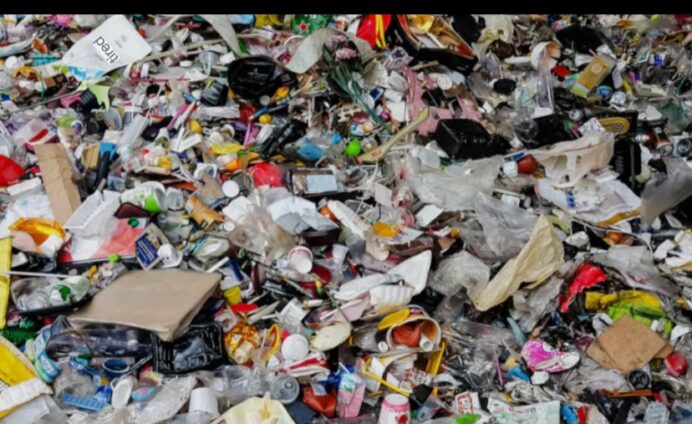
According to her, plastic waste discarded on the streets of Accra does not simply disappear after entering drains but eventually finds its way into the Odaw River, where it gradually breaks down into microscopic particles.
"There's plastic almost everywhere in the river," she said.
Her research traced plastic contamination from the river's source near Abokobi through Haatso and Achimota to the Korle Lagoon, where many of the microplastic particles accumulate before eventually reaching the sea.
Dr. Kwawu explained that larger plastic items gradually fragment into microplastics, some as small as a watermelon seed, which remain in the environment for long periods.
She warned that the particles are capable of carrying other harmful pollutants through aquatic ecosystems.
"These microplastics are able to carry along other pollutants like heavy metals," she explained. "The heavy metals stick onto the microplastics and they are transported into our seas."
The environmental scientist said her study identified microfibres from textiles as one of the most common forms of microplastics found in the river.
She also observed that while many Ghanaians are aware of the broader problem of plastic waste, public understanding of microplastics and their potential health impacts remains limited.
"We found that people are aware of plastics, but not so much microplastics and the impacts they have on our bodies," she said.
Dr. Kwawu noted that although microplastics are largely invisible to the naked eye, they pose growing environmental and public health concerns.
"The key message from my PhD is that microplastics are very small, but they do have impacts on our ecosystems, our livelihoods and our health," she said.
Her findings add to growing concerns about pollution in the Odaw River, which serves as the main drainage channel for more than 80 per cent of Accra before emptying into the Korle Lagoon and ultimately the Gulf of Guinea.
For Dr. Kwawu, the evidence points to a simple but urgent reality.
"Plastic pollution does not disappear," she said. "It only changes form."
Latest Stories
-
Paramount takes over Warner Bros in $110bn Hollywood merger
8 minutes -
Human resource practitioners asked to embrace digital revolution for efficiency in service delivery
13 minutes -
AMA intensifies enforcement to reclaim BRT bus shelters from traders
17 minutes -
TGMA controversy hasn’t affected my relationship with Diana Hamilton – Piesie Esther
22 minutes -
Cliff Cheqona to take TP Masterclass to Lagos and Abuja in 2027
25 minutes -
Bond market: Turnover rises 77% to GH¢2.76bn
26 minutes -
Be lovers of the environment – Archbishop Kwofie calls for stronger fight against environmental injustice
29 minutes -
BoG declares FX compliance “non-negotiable” as it moves to tighten rules
32 minutes -
Government to prioritise creation of decent jobs – Finance Minister
39 minutes -
Ghana’s ocean is not land under water: Why the Fisheries Commission is right to demand a proper assessment of offshore gold exploration
44 minutes -
Teacher unions maintain strike as FWSC, GES negotiations yield no deal
47 minutes -
Bond market turnover rises 77% to GH¢2.76bn
49 minutes -
Photos: Mahama Ayariga engages World Bank on sustainable cities development
52 minutes -
Foreign Affairs Minister warns embassies over long queues, ‘inhumane’ conditions for visa applicants
54 minutes -
Photos: AMA steps up enforcement to clear traders from BRT shelters
55 minutes