

Audio By Carbonatix
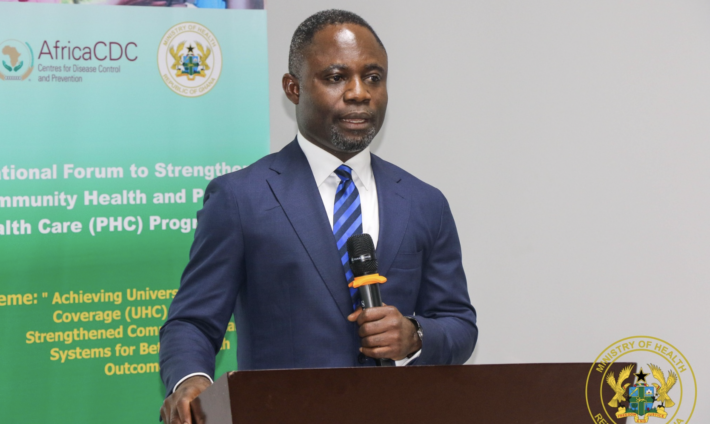
Government is considering a major shift in its strategy to operationalise stalled Agenda 111 hospitals, with Health Minister Kwabena Mintah Akandoh announcing plans to partner faith-based organisations to manage some of the facilities.
The move forms part of government's broader effort to accelerate access to healthcare while rolling out the Free Primary Healthcare programme.
Speaking at the 2026 Annual Conference of the Christian Health Association of Ghana (CHAG) in Koforidua, the Minister said government had identified 35 health facilities currently under construction as its immediate priority for completion and operationalisation.
However, he stressed that the remaining facilities must not be left idle.
"It is government policy to prioritise the completion and operationalisation of 35 health facilities that are currently under construction. Beyond these 35 facilities, we must develop strategies to ensure that every health facility is put to productive use," he said.
To achieve that, the minister disclosed that he has directed the ministry's chief director and other officials to begin discussions with churches and other faith-based organisations interested in managing some of the facilities.
"For this reason, I have directed the Chief Director and the relevant officials to engage the churches. Where there are facilities that faith-based organisations are willing and able to manage, we should work together to ensure they begin serving the people," Mr. Akandoh stated.
The announcement signals a significant policy shift in government's approach to completing and utilising the hundreds of millions of cedis invested in health infrastructure over the past four years.
Agenda 111 was launched in August 2021 by the Former President Akufo-Addo’s administration as an ambitious health infrastructure programme aimed at constructing 111 hospitals and related facilities across the country. The initiative was intended to bridge longstanding gaps in healthcare access exposed during the COVID-19 pandemic by providing district hospitals in underserved areas, regional hospitals and specialised health facilities.
While construction began on dozens of projects, many remain unfinished or yet to become operational because of funding constraints and implementation challenges.
Since assuming office, the President Mahama government has indicated that completing every outstanding project simultaneously would not be feasible, opting instead to prioritise facilities closest to completion while exploring alternative strategies for the rest.
The latest proposal suggests government is looking beyond traditional public-sector management by leveraging the experience of faith-based healthcare providers.
The Christian Health Association of Ghana (CHAG) already plays a central role in Ghana's health system.
Its network of 317 health facilities accounts for about 17 per cent of the country's health infrastructure but delivers between 13 and 14 per cent of healthcare services annually. Every year, CHAG facilities provide care to between eight and ten million patients, many of them in rural and hard-to-reach communities.
The Health Minister described CHAG as a natural partner because of its longstanding presence in underserved areas.
"What excites me most is CHAG's presence in the most remote parts of Ghana - where the roads end, where network coverage is weak, and where health services are needed the most," he said.
He observed that despite progress in expanding healthcare access, some districts still do not have a single medical doctor, underscoring the need to maximise existing health infrastructure.
The Minister also linked the proposed partnerships to government's newly launched Free Primary Healthcare programme, saying expanding access to functioning health facilities would be critical to the policy's success.
He stressed that government was focused not only on completing buildings but on ensuring they immediately begin delivering healthcare services to surrounding communities.
If implemented, the partnership could see faith-based organisations such as CHAG play an expanded role in managing selected health facilities, helping government bring long-delayed hospital projects into operation and improve healthcare access, particularly in underserved parts of the country.
Latest Stories
-
NSMQ 2026: Holy Child School storms back from two-year NSMQ absence to book One-Eighth ticket
5 minutes -
GNFS dismisses reports of unpaid 2025 rent allowance
1 hour -
Gordon Asare-Bediako steps down from NPP Communications Director race, backs Dennis Aboagye
1 hour -
GES dismisses requirement for newly promoted teachers to submit documents for salary adjustments
1 hour -
Meko Bono 2026: Vice President pledges agricultural revival as Atebubu hosts grand homecoming
3 hours -
Russian skydiver Sergey Boytcov sets world record with 11,551-metre stratosphere jump
3 hours -
Ablakwa-led committee submits five reports to Mahama ahead of 2027 AU chairmanship
3 hours -
Africa not seeking Western cash in reparations campaign – Ablakwa
3 hours -
Production decline, reserve depletion threaten Ghana’s upstream sector – Jinapor
3 hours -
Surveyors caution against treating compensation disputes as professional misconduct
3 hours -
Mahama calls for AU dialogue on migration after South Africa xenophobic tensions
3 hours -
I haven’t experienced any envy in the gospel music industry — Ohemaa Mercy
5 hours -
Prayer does not solve everything — Ohemaa Mercy
5 hours -
New PURC office symbolises stronger consumer protection – Dr Jinapor
5 hours -
Rev. Wengam re-elected Assemblies of God, Ghana General Superintendent
5 hours