


Audio By Carbonatix
Environment, Science, Technology and Innovation Minister, Prof. Kwabena Frimpong-Boateng says government is considering a ban on the use of some plastic items such as black polythene bags.
He said government is unhappy with the pollution caused by the haphazard dumping of plastic waste in the country and plans to take serious measures to address the challenge.
“There has to be a ban on some plastic, but how we are going to do it is something our plan will determine. We will have to start something. I can imagine the situation where we will start with carrier bags, straws, chewing gums, plastic cutlery and things like that …
“We will start with those things and when the water situation improves and we get alternatives for containers for fluids…palm oil and cooking oil in the market and so on,” he told Joy News’ Daniel Dadzie.
Prof Frimpong-Boateng is, however, calling for adequate education on the need for a ban because “we don’t want a situation where you ban things and people will flout the regulations but you can’t prosecute. We don’t want that.”
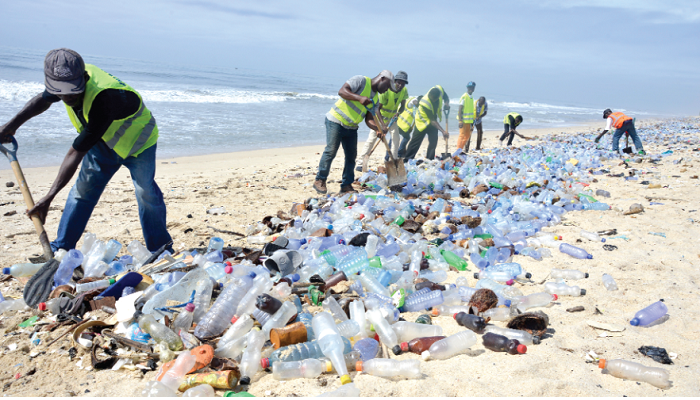 Plastics have taken over Ghana's beaches
Plastics belong to the chemical family of high polymers, consisting of a chain of molecules containing repeated units of carbon atoms. Because of this inbuilt molecular stability, plastics do not easily break down into simpler components.
Plastics do decompose, though not fully, over a very long period of time, on average 100 to 500 years according to research.
Commercially available plastics; polyolefins such as polyethylene, polypropylene have been further made resistant to decomposition by means of additional stabilisers such as antioxidants.
Ghana like countries around the world is struggling to deal with the mess plastic materials cause as most products are packaged in polyethylene. This forms about 70 percent of the plastic waste in the waste stream.

From the pollution of water bodies, littering of streets and chocking of drains anytime it rains, countries are moving to take stringent measures to deal with the situation.
Kenya has already banned the use of plastics.
Available records from the city authority, Accra Metropolitan Assembly as of 2016 indicate that over 2,500 tonnes of waste generated daily, 501,875 yearly.
Out of that figure, only1,125 tonnes representing 45 percent is collected. The remaining 55 percent remain in the system.
Latest Stories
-
David Beckles claims second J60 Accra title
6 minutes -
No France cocaine suspect linked to Mahama, Vice President’s security details – NACOC
13 minutes -
Anwelle Foundation launched in Jirapa to tackle poverty, youth unemployment
34 minutes -
Joy Sports Editor Fentuo Tahiru Fentuo to moderate inaugural Music Meets Football Summit in Zambia
39 minutes -
Court premises too volatile for Baffour Awuah’s attempted arrest by EOCO – Inusah Fuseini
46 minutes -
Drug bust: Under no circumstances will NACOC leadership be compromised – Twum-Barimah
47 minutes -
VIDEO: EOCO’s attempted arrest of Baffour Awuah was flawed beyond saving – Law Lecturer
47 minutes -
Genuine Ghanaian exporters may face heightened foreign inspections over drug busts – Lawyer
47 minutes -
Stakeholders demand action against foreign-led illegal mining in Ahafo Region
2 hours -
Ghana handed tricky draw at 2026 Amputee World Cup
3 hours -
2024 Nyankpala election violence: Youth group petitions authorities over slow probe
3 hours -
Ghana, UNICEF strengthen partnership to advance child protection
3 hours -
Day Two of 3rd Republic Bank-JoyNews Habitat Fair ends with great homeownership offers and financing solutions
3 hours -
Guinness Ghana DJ Awards 2026 Pub Fest celebrates Ghana’s DJ culture as Accra turns up the energy
3 hours -
10th woman found dead in South Africa’s string of killings
3 hours