

Audio By Carbonatix
According to UNESCO estimates, an additional 24.4 million primary school teachers and nearly 44 million secondary school teachers are needed to achieve the goal of universal basic education by 2030. Sub-Saharan Africa, which has the most overcrowded classrooms in the world, is also the region where teachers have the heaviest workload. Teacher shortages are also the most glaring: 90% of secondary schools suffer from severe staffing shortages. Adding to this issue is the attractiveness of the teaching profession, which exacerbates teacher shortages and contributes to the learning crisis.
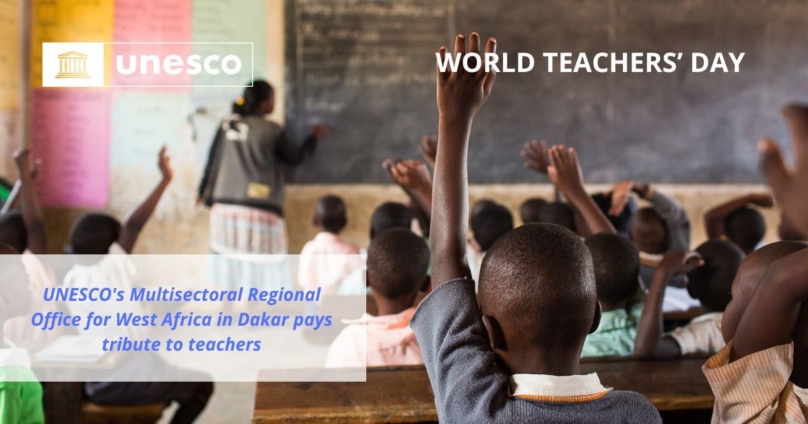
In response to these critical challenges, UNESCO Dakar celebrated World Teachers’ Day 2023 with a focus on teacher shortages, particularly the appeal of the teaching profession in West Africa. A webinar was organized on October 5, 2023, using the Zoom platform. It brought together more than a hundred participants, including experts, education professionals, and teachers, to discuss various aspects of the problem. These included teacher motivation, working conditions, teacher governance and management, the use of information and communication technologies, and recruitment policies.
The workshop began with a poem by Ms. Habibata Thienta, the head of the Teachings & Learning cluster. After expressing gratitude to all the participants, she emphasized the substantial impact of educational policies on teacher motivation and the quality of teaching, drawing from her own experience in the profession. Her remarks exposed the challenges teachers face, such as overcrowded classrooms, extended working hours, and disengaged students, resulting in a decline in the quality of teaching. Some teachers even left education to pursue informal jobs for financial support. This situation has led to a shortage of qualified teachers, and those still in the system often lack sufficient training to ensure quality education.
Mr. Dimitri Sanga, Director of the UNESCO Office in Dakar, paid tribute to teachers, acknowledging them as “the spearhead of the efforts of (their) respective countries’ efforts to address the learning crisis in the region”. He “appreciated (their) daily efforts to improve education systems” and highlighted their essential role in an increasingly technology-driven world. According to him, teachers are “experts capable of helping individuals navigate the growing volume of unverified information, data, and knowledge to make sense of it”.
The webinar’s success was attributed to the high-quality contributions of the expert speakers. Mr. Guillaume Husson, Head of the Education Sector at the UNESCO Dakar Office, provided insights into the teacher shortage in West Africa and presented the office’s projects and programs related to teachers. For Theme 1, “Motivation of teachers and quality of teaching,” Mr. Bagnikoue David Bazongo, Senior Manager of the project “Improving teaching in the Sahel region,” and Ms. Assétou Founè Samaké Migan, an expert in education sciences and a university professor in Mali, explored teacher motivation. Theme 2, “The quality and relevance of initial and continuing training,” was addressed by Mr. Saliou Sall, Senior Project Coordinator at IICBA-UNESCO (International Institute for Capacity Building in Africa), and Mr. Alain Patrick Nkengne Nkengne, Programme Manager and Senior Expert in Quality Management for UNESCO-IIPE Dakar. Mr. Guillaume Husson and Ms. Nebghouha Mohamed Vall, an expert in planning and education sciences in Mauritania, then focused on Theme 3, “Improving teacher management and governance.” Theme 4, “Teacher recruitment policy,” was covered by Mr. Moustapha Touré, an expert in education sciences from Senegal, and Ms. Afsata Paré-Kaboré, an expert and Professor of Universities in Burkina Faso. Finally, Mr. Abdoulaye Barry, an expert in education sciences and quality of teaching and learning, summarized the main conclusions of the webinar and discussed the strategy for implementing the recommendations.
The webinar concluded with remarks from Mr. Guillaume Husson, representing Mr. Dimitri Sanga. He expressed satisfaction and appreciation for the discussions, reactions, and interactions during the event. Based on the debates, he highlighted three key recommendations for shaping teacher policies:
- Consider emphasizing teacher motivation as a cross-cufling theme in the development of teacher policies.
- Encouraging the effective participation of teachers in these policies,
- Strengthening context-based initial training, valuing local practices and using reliable statistical data.
He extended his gratitude to all the speakers, participants, and the UNESCO team
The recording of the session is available here. To listen to the podcasts of teachers and education stakeholders, click here.
UNESCO, Regional Office for West and Central Africa
Latest Stories
-
GPL 2025/26: Asante Kotoko beat Young Apostles to go fourth
49 minutes -
T-bills auction: Interest rates fell sharply to 6.4%; government exceeds target by 170%
3 hours -
Weak consumption, high unemployment rate pose greater threat to economic recovery – Databank Research
4 hours -
Godfred Arthur nets late winner as GoldStars stun Heart of Lions
4 hours -
2025/26 GPL: Chelsea hold profligate Hearts in Accra
4 hours -
Number of jobs advertised decreased by 4% to 2,614 in 2025 – BoG
5 hours -
Passenger arrivals at airport, land borders declined in 2025 – BoG
5 hours -
Total revenue and grant misses target by 6.7% to GH¢187bn in 2025
5 hours -
Africa’s top editors converge in Nairobi to tackle media’s toughest challenges
6 hours -
Specialised courts, afternoon sittings to tackle case delays- Judicial Secretary
6 hours -
Specialised high court division to be staffed with trained Judges from court of appeal — Judicial Secretary
7 hours -
Special courts will deliver faster, fairer justice — Judicial Secretary
7 hours -
A decade of dance and a bold 10K dream as Vivies Academy marks 10 years
8 hours -
GCB’s Linus Kumi: Partnership with Ghana Sports Fund focused on building enduring systems
8 hours -
Sports is preventive healthcare and a wealth engine for Ghana – Dr David Kofi Wuaku
8 hours