

Audio By Carbonatix
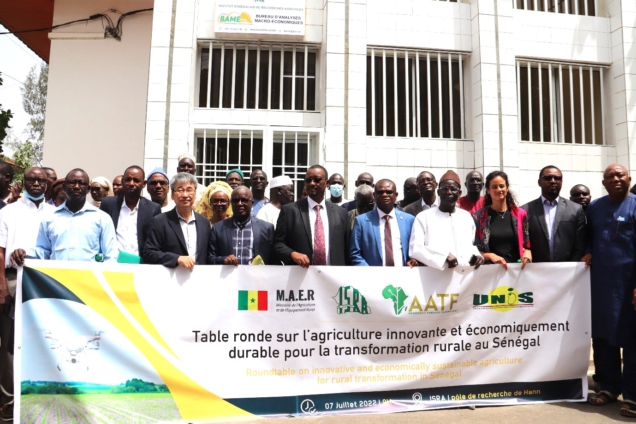
African Agricultural Technology Foundation (AATF) and the Government of Senegal, through the Institut Sénégalais de Recherches Agricoles (ISRA) and Union Nationale Interprofessionnelle des Semences du Sénégal (UNIS), have entered into a strategic partnership aimed at improving agricultural productivity in the West African nation.
The partnership targets priority crops such as rice, maise, groundnuts, and cassava that the government is working on to improve its productivity amidst vulnerabilities of climate change.
Speaking at the opening of a one-day high-level roundtable in Dakar on Innovative and Economically Sustainable Agriculture for Rural Transformation, Dr Moussa Baldé, Minister for Agriculture and Rural Equipment, said Senegal is an agrarian nation with a substantial percentage of the population engaged in subsistence farming.
“Senegal is a net food importer. The production of food crops does not meet Senegal's needs. The production of major staple food crops covers barely 30 per cent of consumption needs.
"The country imports almost 70 per cent of its food, and people go hungry even though 60 per cent of the workforce is engaged in food crop production.
"Yet only 65 per cent of Senegal’s 3.8 million hectares of arable land is farmed,” said the Minister, who Mr Ndao represented, Secretary to the Ministry of Agriculture and Rural Equipment.
The Minister is optimistic that the collaboration with AATF will bring practical interventions capable of steering the country's agricultural sector to the pathway to success.
Executive Director of AATF, Dr Canisius Kanangire, said that AATF used a public-private model to support technology transfer to benefit farmers most sustainably and affordably.
He was hopeful that AATF can do the same in Senegal through the partnership with the government.
“At AATF, we have managed to develop and release various technologies that address challenges impacting smallholder farmer productivity.
"It is my sincere hope that with appropriate information and deployment, farmers in Senegal will benefit from such technology,” he added.
Director General of ISRA, Dr Momar Talla Seck, said agriculture, an essential element for economic development, remained one of the sectors most affected by the effects of climate change.
“Faced with this reality exacerbated by the global security and health situation, which has a negative impact on the supply of agricultural products and their increase on the international market, it is more than necessary to support local agricultural production.”
He commended the partnership that brought the various sector players together, saying the objective of the partnership is to improve the performance of important value chains in Senegal based on the generation and dissemination of agricultural knowledge and technologies, as well as the strengthening of the capacities of the actors and their organisation.
“Indeed, in the face of the many challenges that threaten the development objectives of our States and have a negative impact on food security and our livelihoods, it is more than necessary to mobilise all our expertise for an appropriate response,” he said.
Latest Stories
-
Ghana explores centre of excellence for hearing, communication and cochlear implant care
10 minutes -
Schizophrenia-related disorders lead mental health cases recorded in Ghana
32 minutes -
Dutch authorities enlist Ghana in hunt for fugitive drug lord Bolle Jos
56 minutes -
Ghana housing finance conference adopts communiqué to improve affordable housing access
5 hours -
Special Initiatives Minister urges Wa Technical Institute to enrol more girls as EU-backed solar training lab opens
6 hours -
In the matter of my first year at the Bar
6 hours -
ActionAid Ghana calls for an end to child marriage, greater investment in girls’ rights
6 hours -
Newsfile to tackle World Cup visa scandal, beach demolitions, education strikes, BRICS bid
6 hours -
UK-Ghana Trade & Investment Summit: Trade Resource Centre to help businesses maximise UK-Ghana trade opportunities
7 hours -
Embassy of Denmark celebrates World Maritime Day
7 hours -
Linking LEAP to productive inclusion could cut extreme poverty by 2030 – UNICEF
8 hours -
Trade Ministry backs use of creative arts to rehabilitate prison inmates
8 hours -
Negotiations with government to continue despite strike suspension – GNAT
8 hours -
‘Ghana cannot afford to waste public resources; every cedi has a job’ – Ato Forson
8 hours -
Ghana expects economic boost as World Assemblies of God Congress brings 10,000 delegates to Accra
8 hours