

Audio By Carbonatix
The Ministry of Health is to embark on a validation exercise to ensure that medical doctors who declined postings to deprived areas are removed from the government payroll.
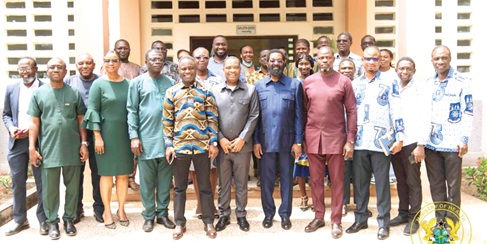
Giving the directive during a working visit to the University of Ghana Medical School last Friday, the Minister of Health, Kwabena Mintah Akandoh, said the exercise had become necessary in order to remove doctors who had declined posting to deprived communities from the national payroll.
He said doctors who failed to report to their duty posts at the end of February would be removed from the payroll.
He said the directive was necessary to address the persistent shortage and uneven distribution of medical doctors across the country, particularly in deprived districts.
“By the end of February, we will do validation. If you have not reported, your name will be taken off the payroll and the slots will be opened for those who are willing to go,” he stated.
Over 700 medical doctors were posted to some deprived areas in the country last year.
Genuine concerns
Mr Akandoh said while the government acknowledged genuine concerns such as accommodation and working conditions in remote areas, a situation where trained doctors declined postings to districts with no medical officers was worrying.
“There are districts in this country without a single medical doctor. We cannot govern like that,” he said.
He stressed that postings issued by the government were binding and not optional, adding that failure to honour postings undermined healthcare.
Policies
During the visit, which was to build a closer working relationship with the school and gain first-hand information of the challenges confronting medical education and training in the country, Mr Akandoh outlined policy interventions, including the Ghana Medical Trust Fund (GMTF), which he said, was backed by legislation and had a board and secretariat to support patients referred by specialists.
On equipment and logistics, he said the government had plans to deepen private sector participation through hospital equipment placement arrangements.
He said under the model, private providers would install equipment, including dialysis machines in health facilities across the country and be paid per use through public health financing mechanisms, such as the National Health Insurance Scheme (NHIS).
“This way, government does not have to cough money upfront to buy expensive equipment while facilities still get the services they need,” he explained.
For stalled Agenda 111 hospital projects, Mr Akandoh acknowledged that completing more than 100 facilities within a short timeframe was not feasible under the current financial constraints.
He said the government was engaging corporate Ghana to support the completion of selected projects in exchange for tax incentives, whereby the completed facilities would revert to the state after an agreed period.
Faculty support
The Provost of the College of Health Sciences, University of Ghana, Professor Alfred Edwin Yawson, appealed for support to address the growing shortage of faculty, warning that the challenge posed a major threat to the training of future medical specialists and health professionals in the country.
He said the institution’s most pressing challenge was not student numbers but the dwindling pool of academic staff, many of whom were aging, retired or nearing retirement.
“Our key challenge is faculty. We are having very aged staff, and many of our most experienced faculty members are either retired or retiring, and they are not being replaced,” he said.
Simulation centre
Beyond staffing, Prof. Yawson called for the expansion of its simulation-based training to address infrastructure limitations, particularly congestion in hospital wards used for clinical training.
“When we are congested in the wards, not all students need to be trained on real patients. We can use simulators.
“If we expand our simulation centre with more mannequins and specialised simulators, it will have an immediate impact and help us increase student numbers,” he said.
Latest Stories
-
‘They can’t control the team’ – Ernest Thompson doubts local coaches for Black Stars role
38 minutes -
Ghana-born midfielder Seidu realises ‘dream’ with Atlético Madrid debut
45 minutes -
GPL 2025/26: Bubakari strikes late to hand All Blacks vital win over Dreams FC
45 minutes -
Fatal crash on Kintampo–Tamale highway claims four lives
50 minutes -
2025–26 FA Cup Semifinal Draw: Chelsea, Man City Learn Wembley Opponents
1 hour -
GPL 25/26: Gold Stars back on top after beating Nations FC
2 hours -
GPL 2025/26: Heart of Lions roar back with victory over Vision FC in Kpando
3 hours -
Solomon Agbasi: Hearts keeper in stable condition after concussion
3 hours -
GPL 2025/26: Late Salim Adams penalty earns Medeama draw at Bechem
3 hours -
Hearts pip Young Apostles 1-0 to end 5-game winless run
3 hours -
Boakye Agyarko marks Easter Sunday with a call for Godly leadership ahead of nationwide campaign tour
4 hours -
Pepsi withdraws as UK festival sponsor after Kanye West backlash
4 hours -
Pope Leo calls for global leaders to choose peace in his first Easter Mass
4 hours -
Kpando MP highlights progress on road projects
5 hours -
Government secures $92m for Engineering and Agriculture University
5 hours