
Audio By Carbonatix
A five-member investigative committee appointed by President John Dramani Mahama has submitted its comprehensive report on the 2023 Akosombo Dam spillage, delivering critical recommendations to improve disaster response and provide relief to affected communities.
The committee, which presented its findings on Wednesday, May 7, 2025, identified systemic gaps in flood mitigation and called for policy reforms to prevent future crises.
The Volta River Authority (VRA) had initiated controlled spillage from the Akosombo and Kpong dams between September 15 and October 30, 2023, citing rising water levels that threatened the structural integrity of the dams.
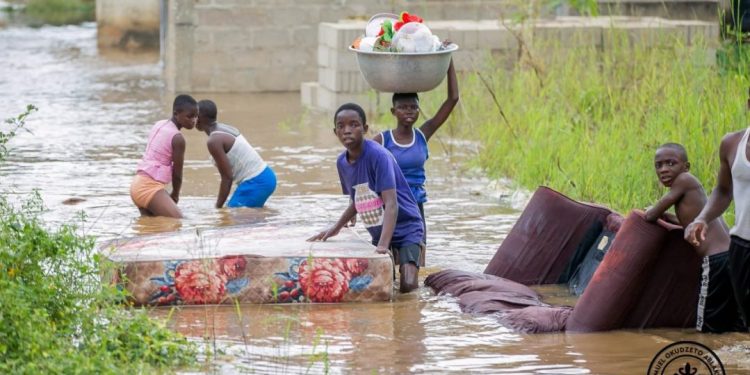
This resulted in widespread flooding and the displacement of communities along the Volta River.
The spillage, while necessary to protect the dam, caused significant disruption to livelihoods, properties, and infrastructure.
An estimated 38,624 people were displaced, losing homes, belongings, and livelihoods, with Mepe, Battor, Sogakope Mafi, Adidome, Kpong and Ada being significantly impacted.
The government provided relief items and supported rescue efforts, with VRA and NADMO coordinating the response.
READ ALSO: Akosombo Dam Spillage: Mahama orders flood plan, threatens VRA leadership
Two years on, President Mahama addressed the nation as part of his 120-day social contract progress update, confirming that compensation for victims is being processed, with initial payments expected soon.
The government is expected to release a detailed action plan based on the committee’s findings, with a focus on preventive policies and victim support.
The spillage exposed vulnerabilities in Ghana’s disaster response. This report marks a crucial step toward accountability and reform, ensuring better protection for vulnerable communities.
The investigation revealed several key findings regarding the spillage detailed below:
1. Factors that determine water spillage from the dam include reservoir elevation, rainfall and energy output from the power plant.
2. The Akosombo Dam recorded a maximum water inflow of 477,984 cubic feet per second (cfs) on September 18, 2023, at the Akosombo hydrometric station.
3. The 2023 Spill occurred between September 15 and October 30, 2023. The total volume of water discharged from the spillway was approximately 8 Million Acre Feet (MAF) for 46 days.
4. Historical spillage exercises have shown that in 1968, the volume was 5 times the volume spilled in 2023, indicating that there could be larger volumes of spill in the future due to climate change uncertainties.
5. Examination of Events Leading to Spillage: The spillage was primarily caused by releasing approximately 8 MAF volumes of water from the Akosombo Dam to prevent the dam's destruction (overtopping) due to high reservoir water levels. Other contributing factors included unprecedented rainfall due to climate change and human activities exacerbating flood risks. Breaching the dam could have resulted in a catastrophic chain of events in the country.
6. VRA’s Emergency Preparedness Plan (EPP): The EPP specifies the roles and responsibilities of all stakeholders, including VRA, NADMO, District Assemblies, Security Agencies, etc., when an emergency occurs. The EPP was used to manage the disaster caused by the spillage and was the most technical document to be understood by various non-technical stakeholders. While VRA had socialised the document with all stakeholders and conducted a simulation exercise for some selected communities before the spill, high turnout and divisions amongst some District Chief Executives (DCEs)/Metropolitan Chief Executives (MCEs) and Members of Parliament (MPs) could have derailed clear communication lines for implementing the plan and distribution of relief items.
7. Assessment of Actions Taken: The response involved various government agencies, including the Volta River Authority (VRA) and the National Disaster
Management Organisation (NADMO). While there were efforts to provide immediate assistance, gaps in communication, resource allocation, and community engagement were identified.
8. Challenges Encountered: The Committee noted operational challenges, such as a lack of local disaster preparedness plans and inadequate evacuation resources, that hampered the emergency response process. Communication breakdowns and skepticism among community members regarding the information provided by authorities further complicated response efforts.
9. Community Challenges: The Committee also noted that land tenure attachment by the people, economic reliance on location, fear of unpredictability, insufficient financial resources and support from Authorities, restricted housing options, historical precedence of spillage and cultural resistance were factors that made most affected people unwilling to relocate during the spill event.
10. Temporal accommodation: The Committee noted with concern that some affected persons were still housed in tents, at the mercy of the weather, refusing to relocate to temporary accommodation built by VRA. They cited a lack of privacy as families were required to share rooms.
11. Resettlement: Some Government-initiated resettlement projects are far from the people's previous abode. The people lament that their opinions were not sought in selecting the sites for the resettlement, and therefore, have refused to relocate and are requesting that the resettlement project be halted as the objective is not served.
12. Compensation: Since the spillage occurred, in communities upstream and downstream, the affected people in these communities have not been adequately compensated for the devastating impact the floods had on their properties and source of livelihoods. Some also expressed displeasure that though they suffered and continue to suffer the direct effects of the dam, they were not compensated when the Akosombo dam was built.
13. Evaluation of Strategies: The strategies employed to manage the situation revealed short-term and long-term effectiveness. However, improvements were necessary in community education and disaster management protocols.
14. Proposals for Additional Measures: To mitigate future risks, recommendations were made for enhancing emergency response protocols, improving community engagement, and implementing stricter land use regulations.
15. Communities Upstream: Several communities located upstream of the dam experienced significant flooding, resulting in the submersion of homes and
farmland. The rising water levels inundated large portions of agricultural land, leading to the loss of crops and threatening the livelihoods of affected farmers.
Latest Stories
-
Jinijini–Sampa road to be completed by 2027 — Mahama
57 minutes -
Afroman wins legal battle over songs mocking US police
1 hour -
MTN Ghana deepens role in national growth with record tax contributions and expanded investments
1 hour -
Kevin Spacey and accusers settle before civil trial
1 hour -
Premier League extends £30 cap on away tickets
2 hours -
Oyarifa Police arrest pastor over alleged sexual abuse of 9-year-old stepdaughter
2 hours -
Haaland invests in new global chess tour
2 hours -
Denounce ‘abject’ Afcon decision – senior CAF member
2 hours -
Ashanti Police arrest 12 suspects in robbery, link 3 to Kusasi Chief murder at Asawase
2 hours -
Uefa calls leagues to summit over ‘microscopic’ VAR
2 hours -
Ghana’s Ambassador to US meets White House Task Force over 2026 World Cup
2 hours -
Fifa rules women’s teams must have female coaches
2 hours -
Mahama engages Bono residents, outlines key projects under Resetting Ghana tour
2 hours -
Former CDS General Thomas Oppong‑Peprah honoured by France
2 hours -
President Mahama urges MMDCEs to ignore enemies of progress, focus on performance
3 hours