

Audio By Carbonatix
As the MV Hondius cruise ship approaches Tenerife, the people of the Spanish island await it with a mixture of uncertainty and, in some cases, anger.
The Spanish government has agreed with the World Health Organization (WHO) that the passengers of the vessel, which has seen an outbreak of the hantavirus, should be allowed to disembark there this weekend. It has travelled from Cape Verde, where three people were evacuated due to illness.
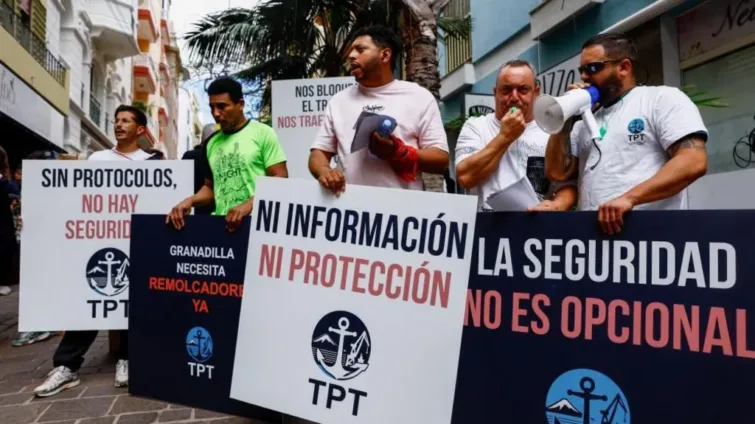
On Friday, some Tenerife dock workers gathered outside the Canary Islands' parliament building in the town of Santa Cruz, to voice concerns that the imminent arrival could pose a health risk for them.
They blew whistles, sounded vuvuzelas and brandished banners.
"We're unhappy at the idea of being allowed to work in a port without special safety measures or information when an infected boat is approaching," said Joana Batista, of a local port workers' union, who was taking part.
Some of her colleagues have threatened to block the arrival of the cruise ship if their demands are not met.
"If the boat is going to stop here, then it can do so, but with the necessary measures in place," she said. "Local people need to be told how this will affect them, how the passengers will be transported. We need reassurance above all."
Nearby, watching the protest, was nutritionist María de la Luz Sedeño, who agreed with much of what the demonstrators were demanding and could barely contain her fury.
"This is the last straw when it comes to everything the people of the Canary Islands have to put up with," she said - an apparent reference to the continuing arrival of thousands of undocumented migrants in boats from North and West Africa.
For some Canary islanders, hosting migrants is a source of pride - while for others, like Sedeño, it is a cause of frustration.
But they all seem to agree that migration makes their territory the focus of an international drama.
More than 3,000 people died in 2025 trying to reach the Canary Islands, often in makeshift dinghies, according to NGO Caminando Fronteras. Pope Leo is due to visit in June and meet migrants and organisations dedicated to helping them.
María de la Luz Sedeño cited the fact that the central government had disregarded staunch opposition to the cruise ship's arrival voiced by the president of the Canary Islands region, Fernando Clavijo.
"The people here are not being listened to."
The Socialist-led central government has responded to the accusations of high-handedness and lack of transparency by providing details of the boat's arrival this weekend.
It will not dock directly in Tenerife but will instead anchor out at sea and its passengers will be ferried to the vast industrial port of Granadilla, in the south-east of the island, well away from residential areas. Soon after their arrival they will be repatriated, or, in the case of the 14 Spaniards aboard, taken to Madrid to be quarantined.
The authorities insist there will be no contact between passengers and local residents who "will be absolutely and completely protected", according to Virginia Barcones, head of Spain's civil protection agency.
The government's efforts have won over at least some islanders.
"Now I'm a bit calmer because there's more information," says Marialaina Retina Fernández, a pensioner, who describes the local healthcare facilities as "the best there is". She appears resigned to the idea of briefly sharing her island with the boat's passengers.
"It's not ideal that they all end up coming here," she explains. "But if [the authorities] say they'll do everything possible to make sure nobody gets infected, let's hope that's how it is."
MV Hondius is arriving with the agreement of Madrid, but this has not prevented the far-right Vox party from trying to capitalise on the issue, drawing a comparison with the arrival of illegal migrants.
The WHO and the Spanish government have been at pains to play down epidemiological comparisons between the current situation and the Covid pandemic. However, for many Canary islanders, the cruise ship, with its multi-national passengers, is an unwanted reminder of the early days of Covid: a German tourist on the island of La Gomera was the first identified case in Spain, and its detection was soon followed by the confinement of around 1,000 guests and staff in a Tenerife hotel.
Retina Fernández puts a positive spin on the islands' habit of hitting the headlines due to international crises.
"We're used to all sorts of problems arriving here," she says. "You can see that we're good at managing these situations."
Latest Stories
-
Wealth Over Water: How Galamsey Is Threatening Ghana’s Water Security
15 minutes -
LA 2028: Black Queens pumped up for second leg of Mauritius tie
22 minutes -
LA 2028: Black Queens hold final training session ahead of second leg against Mauritius
56 minutes -
Standards are not Seasonal: What the EC appointments teach both sides
1 hour -
King Mohammed VI urges private sector to create youth jobs and spread benefits of growth
1 hour -
KGL U17 Colts 2026: Greater Accra win title after penalties win over Western Region
1 hour -
UK Investment Roadshow opens in London to advance UK-Ghana growth partnership
1 hour -
Assemblies of God requires pastors to resign before entering partisan politics – Rev. Wengam
2 hours -
Ghana targets 20% annual reduction in maternal deaths – Health Minister
2 hours -
Cyber attacks in Africa grow faster than global rate, report finds
2 hours -
Ghana signs UAE deal to create 5,000 overseas jobs
2 hours -
One Million Coders Programme targets 100,000 digital jobs in two years – Sam George
2 hours -
John Jinapor, Italian Ambassador explore opportunities for energy sector investment
2 hours -
NHIA seeks legal reforms to support Free Primary Healthcare
2 hours -
Beatrice Annan defends Afi Agbenyo’s EC appointment, cites record of gender advocacy
2 hours