

Audio By Carbonatix
A senior Huawei (https://e.Huawei.com) executive says the integration of the digital and energy worlds will improve energy efficiency and resource allocation worldwide.
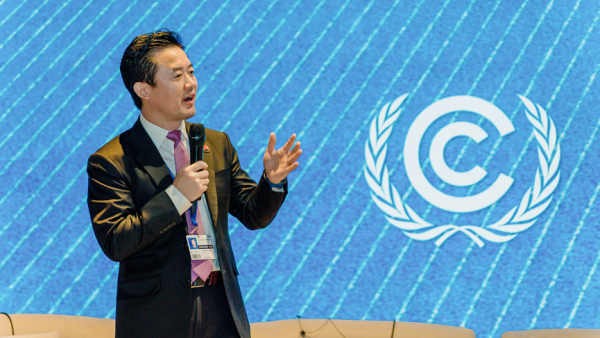
Addressing a session of the Global Innovation Hub (UGIH) of the United Nations Framework Convention on Climate Change (UNFCCC) at the 28th Conference of the Parties (COP28), hosted by the UAE, Charles Yang, Senior Vice President at Huawei, said opportunities brought about by carbon neutrality will trigger revolutionary technological and socioeconomic change.
“We’re working to not just enhance the ICT sector via technological innovations, but also build innovative systems to help achieve the common goal of carbon neutrality,” he said.
Yang spoke at a UNFCCC UGIH session entitled “Innovative, Digitally Enabled Green Transition.” The panel sought to shed light on new ways of thinking and doing in the green transition, as well as new cases that have emerged and opportunities for collaboration that could be leveraged.
Yang cited several Huawei innovations that lowered ICT’s carbon footprint. These included fully liquid-cooled supercharging terminals that are able to charge EVs at the rate of one kilometer per second; the world’s second-largest PV plant in Qinghai, China where Huawei helped complete grid connection; and Huawei’s contribution to powering the world’s first 100 percent renewables-powered city as part of the Red Sea Energy Storage project in Saudi Arabia.
Mobile operators will also be able to lend a hand in producing energy, he said. “If they could leverage the 10 million mobile base stations globally and become energy producers, that will significantly reduce carbon emissions.”
For Jeffrey Sachs, President of the UN Sustainable Development Solutions Network and Director of the Center for Sustainable Development at Columbia University, cooperation is key to enable the green transition and sustainable development.
“We need cooperative approaches, we need great companies like Huawei that provide the technologies, and then we need solutions to scale them up,” Sachs said.
Referring to the UN Sustainable Development Goals (SDGs), Mohan Munasinghe, former Vice Chair of the UN Intergovernmental Panel on Climate Change and co-recipient of the 2007 Nobel Peace Prize, said digital technology is both part of SDG 9 (Industry, innovation and infrastructure) and the key to SDG 13 (Climate action).
“All of the goals have to be dealt with in an integrated way. You cannot deal with carbon neutrality and climate by itself,” Munasinghe said, adding: “Digital technology supports inclusive green technologies, promotes industrial infrastructure that increases economic activity… and will lead us to eco-civilization in the 21st Century.”
Alexandre Reis Siqueira Freire, a Commissioner of Brazil’s telecoms regulator Anatel, provided a case in point. Speaking at the same panel, he introduced the sustainable and integrated Amazon program, or PICE, which consists of 11 fluvial optical fiber backbone networks with nearly 9,000 km of extension.
The program has benefited more than four million inhabitants in Brazil, Freire noted, adding that “the development of advanced telecommunication infrastructure in the Amazon region shall promote the integration of the communities and digital economy.”
Distributed by APO Group on behalf of Huawei Enterprise.
For more information, please visit Huawei online at:
www.Huawei.com
https://e.Huawei.com/ae/
Or follow us on:
LinkedIn (Huawei): https://apo-opa.co/4ae0Lhk
LinkedIn (Huawei Enterprise): https://apo-opa.co/4ae0sTI
Twitter: https://apo-opa.co/4ae0tXM
Facebook: https://apo-opa.co/41j0GES
YouTube: https://apo-opa.co/3tjnlnW
Middle East:
Facebook: https://apo-opa.co/3Tk21JA
Twitter: https://apo-opa.co/3GCyhQP
About Huawei:
Founded in 1987, Huawei is a leading global provider of information and communications technology (ICT) infrastructure and smart devices. We have more than 207,000 employees, and we operate in more than 170 countries and regions, serving more than three billion people around the world.
Our Vision and mission is to bring digital to every person, home and organization for a fully connected, intelligent world. To this end, we will drive ubiquitous connectivity and promote equal access to networks; bring cloud and artificial intelligence to all four corners of the earth to provide superior computing power where you need it, when you need it; build digital platforms to help all industries and organizations become more agile, efficient, and dynamic; redefine user experience with AI, making it more personalized for people in all aspects of their life, whether they're at home, in the office, or on the go.
Latest Stories
-
New York Times executive fatally shot allegedly by elderly in-laws
24 minutes -
Teacher Payment Crisis: GES races to protect academic calendar
33 minutes -
US prosecutors reopen case of alleged gang rape at Cornell University
50 minutes -
Journalist to be crowned king in Uganda after bitter succession dispute
60 minutes -
OpenAI scraps rollout of new model over safety concerns
1 hour -
Nigerian attempts to break world record by dancing non-stop for seven days
1 hour -
GES urges government agencies to end blame game over teacher payments
3 hours -
GES sets Oct. 5 deadline to resolve teachers’ payment dispute
3 hours -
GES working around the clock to get teachers back to class, says Daniel Fenyi
4 hours -
French PM warns against escalation of school protests after 164 arrested
4 hours -
UK tries to stop Trump’s diesel export ban
4 hours -
Late Olise goal gives France win over Belgium
4 hours -
Mancini enjoys first win since return as Italy boss
5 hours -
Interest payments to average a high 20% of government revenue over next 4 years
5 hours -
Anthropic warns AI may pose ‘existential risks to humanity’ in IPO filing
5 hours