

Audio By Carbonatix
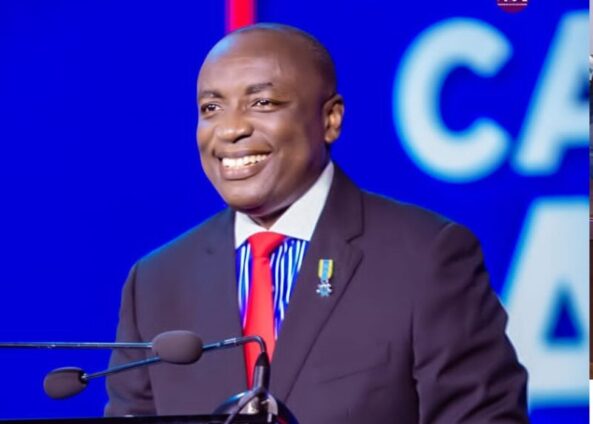
New Patriotic Party (NPP) presidential aspirant Kwabena Agyepong says campaigning to become the party’s flagbearer has become far more demanding than at any other time in the party’s history.
Speaking on Joy News’ PM Express on Monday, the engineer described the current race as challenging, expensive, and physically draining, largely due to the dramatic expansion of the party’s Electoral College.
“It is different,” he said. “In 2007, when I did my first stint, the Electoral College was very small, just the ten executives in each of the 230 constituencies.”
That system, he noted, has since changed significantly.
“Now we’ve had an expansion using five polling station executives in the 40,000 polling stations around the country, and now we’ve added former executives, so we’re looking at something around 220,000 delegates,” he explained.
According to Mr Agyepong, the sheer size of the Electoral College has made outreach extremely difficult, especially for aspirants without deep financial backing.
“It’s a big field, and it’s been very challenging, especially for some of us. Even the most challenging part is just reaching out to them,” he said.
He pointed to the growing financial expectations at the constituency level as a major burden.
“You go to a constituency, some of them are as many as 1,500 delegates. What has become the in thing now is that you need to provide a little transport,” he said.
He added that even modest support quickly becomes overwhelming.
“Even if you can manage a modest hundred cedis, that amounts to ¢150,000 in one constituency. You multiply that by 276, and it is really huge,” he said.
Mr Agyepong said the demands of constant travel across the country have also taken a toll.
“It’s not very simple. It’s a difficult one. The travelling around the country and all that. It’s very stressful,” he admitted.
Despite the challenges, he said the experience is not new to him. “But it’s something I’ve done since 1992, so I’m used to it,” he noted.
He also acknowledged that the expanded Electoral College has had some positive effects on internal party democracy.
“This is the largest Electoral College. I do believe it makes people a bit more appreciative of the process,” he said.
According to him, the system allows aspirants to connect directly with the grassroots.
“It gives us an opportunity to go down to the base of our party and express ourselves and communicate with them,” he added.
Latest Stories
-
President Mahama ends Resetting Ghana tour of Ahafo Region
50 minutes -
African negotiators seek delivery of climate commitments at COP31
52 minutes -
BoG develops AI rules for financial sector
54 minutes -
‘Big Push’: Government assures contractors of prompt payments
58 minutes -
Court fines miner for breaking into gold buying shop
1 hour -
Tarkwa court jails labourer for three years over GH¢123,000 theft
2 hours -
GAEC must retain nuclear scientists for Ghana’s nuclear ambitions – Minister
3 hours -
Man reportedly mistaken for game and shot by hunter dead in forest
3 hours -
19-year-old mason jailed 15 years for defiling seven-year-old pupil
3 hours -
Ghana’s banking sector assets rise 20.47% to GH¢500.2bn – BoG Governor
3 hours -
22 injured as Sprinter bus overturns at Sege after tyre burst
3 hours -
UN housing expert urges Ghana to strengthen Rent Control Department amid housing affordability concerns
3 hours -
Delta-BCI partnership reaches 166,000 people with breast cancer education
3 hours -
Power restoration fault suspected in Kumasi Central Market fire
8 hours -
The 7-foot giant of Ngleshie Amanfro: Seven-foot Ghanaian Ephraim Saawa dreams of joining the national basketball team
9 hours