


Audio By Carbonatix
Germany's top intensive care expert has said hospitals need to make sure they have enough resources to treat an expected influx of Covid-19 patients.
German ICUs have added nearly 2,000 Covid-19 patients in four weeks.
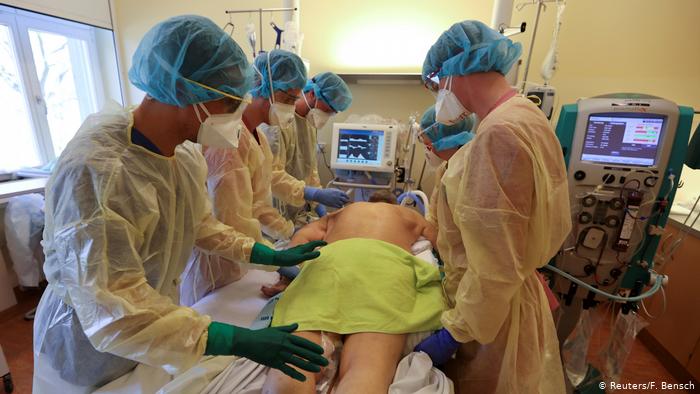
As the number of Covid-19 cases continues to surge across Germany, hospitals are under pressure to prepare for treating severely ill patients.
Staff in many hospitals in Germany are currently "working at the limits of their capacity," Uwe Janssens, President of the Interdisciplinary Association for Intensive Care and Emergency Medicine (DIVI), told a press conference on Tuesday.
Speaking alongside German Health Minister Jens Spahn, Mr. Janssens urged hospitals in regions with high infection numbers to "end normal operations as soon as possible."
"Where it is medically justified, procedures must be halted and postponed," Janssens said, adding hospitals need to conserve resources.
Although Germany currently has enough beds and ventilators available nationwide, Janssens said a "key problem" would be the lack of medical personnel to treat patients needing treatment like anesthesia and ventilation.
More coronavirus patients in intensive care
According to the latest numbers from DIVI's register of intensive care beds in Germany, there are currently around 7,230 free intensive care beds across Germany out of a total of more than 28,700.
On November 3, there were 2,388 Covid-19 patients receiving intensive care treatment in Germany, with that number currently rising every day, and adding nearly 2,000 patients since October 3. More than half of those cases are receiving invasive ventilation, according to DAVI.
A nationwide partial lockdown began Monday in Germany. On Tuesday, Germany added over 15,350 Covid-19 cases, according to the Robert Koch Institute.
Regional differences
Spahn, who recently recovered from a Covid-19 infection, said the situation in Germany was "serious," albeit with large regional differences.
The percentage of Covid-19 patients occupying intensive care beds ranges from 18% in Berlin to less than 3% in Saxony-Anhalt and Schleswig-Holstein, according to DAVI.
During the first wave of coronavirus in the spring, the German government ordered hospitals to delay non-emergency procedures and operations. Such a blanket order has not yet been reissued, and Spahn said Tuesday that a decision requiring hospitals to redirect resources rests with the leaders of Germany's 16 federal states.
Spahn added that he agreed with Janssens that it was "very important" to delay operations when medically possible, adding that Berlin would provide hospitals with support to deal with the crisis.
"No clinic should be economically disadvantaged because of the coronavirus," he said.
Latest Stories
-
Missing service member rescued by US forces after jet downed in Iran, Trump announces
7 minutes -
Gomoa Easter Carnival: Sarkodie, Kuami Eugene, Tinny, set festival ablaze as Day 3 ends on high note
32 minutes -
“Feels amazing” – Antoine Semenyo reveals after Manchester City dismantle Liverpool
58 minutes -
Mahama calls for emergency cabinet meeting over rising fuel prices
2 hours -
Asante Gold reports US$345million loss for 2025
3 hours -
Gov’t making progress in clearing $1.7bn power debt – Mahama
3 hours -
Justice is the engine of growth – Chief Justice
4 hours -
Meet us halfway – Trade Minister tasks private sector with AfCFTA success
5 hours -
After more than 14 years at Atletico Madrid, what next for Simeone?
5 hours -
Conquering the World – Building on the foundations laid by Otto Addo
5 hours -
[Playback] Sarkodie, Kwami Eugene, Tinny, Keche and others thrill fans at Gomoa Easter Carnival
5 hours -
Gomoa Easter Carnival: Experts charge indigenes to own festival to ensure sustainability
6 hours -
Gomoa Easter Carnival: Edem Agbana and Joy Prime fans shower festival with huge endorsements
8 hours -
Gathering of Royals 2026: Empowering women, boosting tomato production
8 hours -
Gov’t to overhaul free zones into manufacturing hubs for local production – Trade Minister
9 hours