

Audio By Carbonatix
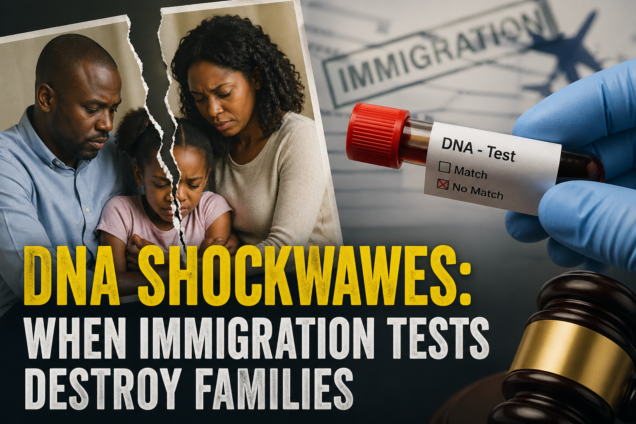
A test meant to unite families is instead tearing them apart one result at a time.
It begins with hope.
A father, working tirelessly in Canada, files documents to reunite with his wife and child. Forms are completed, fees are paid, and dreams are carefully rebuilt across continents. Then comes one final requirement from the immigration authorities, “a Deoxyribonucleic Acid “DNA” test to prove paternity.”
It sounds simple. Scientific. Routine.
But for many families, it has become a moment of irreversible destruction.
Across Canada’s immigration system, DNA testing required by Immigration, Refugees and Citizenship Canada (IRCC) is increasingly exposing a silent and painful reality, hidden paternity. What was once buried under trust, distance, or assumption is now being revealed with 99.8% scientific certainty.
And the consequences are devastating.
Data trends paint a troubling picture. Between 2010 and 2014, approximately 1,200 family sponsorship applications were refused due to issues tied to the “excluded family member” rule, with over 50% involving children. Thousands of DNA tests are conducted annually, and while over 90% confirm biological relationships, it is the remaining fraction, the negative results, that are shattering lives.
Because one negative result is enough to collapse an entire family.
Case Study 1: The Phone Call That Ended a Family
It took just one phone call.
A man, after undergoing a required DNA test during an immigration process, called his wife with words no family should ever hear: “The child is not mine.” The woman, stunned, insisted on her truth, “The child is yours. I have not been with anyone else.”
But science had already spoken.
That single moment fractured a marriage, separated a mother from her partner across borders, and left a child questioning identity and belonging. As reported by investigative journalist Jamal Osman, this was not an isolated case; it was part of a growing pattern where immigration procedures are unintentionally exposing deeply personal secrets.
DNA testing, presented as neutral and objective, became the trigger for emotional devastation.
Case Study 2: A Father’s Collapse
In another heartbreaking case, a Ghanaian-born Canadian man married a woman with two children and later had two more with her. Confident in his role as a father of four, he applied to sponsor the entire family to Canada.
Immigration authorities requested DNA testing for the two children believed to be biologically his.
The results came back.
One child was not his.
The shock was too much. The man reportedly suffered a cardiac arrest and has since lived with the effects of a stroke. His sponsorship application was denied, leaving his wife and children stranded, separated not only by borders but by a truth no one anticipated.
A family, once united in love, was dismantled by a laboratory result.
Case Study 3: Too Late for Truth
In a third case, a Ghanaian woman became pregnant, believing a man to be the father. The man denied responsibility and later migrated to Canada. After the woman’s passing, he returned to claim the child and sought to sponsor him abroad.
A DNA test was conducted.
The result: “no biological connection.”
The child was denied entry. The man, confronted with a truth he never expected, has since passed away. What remains is a story marked by missed responsibility, delayed truth, and irreversible consequences.
A System That Reveals but Does Not Repair
DNA testing in immigration processes serves a clear purpose: to prevent fraud and ensure integrity. The IRCC requires highly stringent standards, with parentage tests needing at least 99.8% accuracy. Even a 96% probability can result in refusal.
But while the system verifies truth, it does not heal the damage that truth can cause.
Families are not prepared for these outcomes. Children are caught in the middle. Marriages collapse. Health crises emerge. And in many cases, the emotional fallout far outweighs the administrative objective.
The question must now be asked, “Why are these truths only discovered so late?”
The Case for Mandatory DNA Testing at Birth
If DNA testing during immigration is exposing hidden paternity years later, then perhaps the real solution lies at the beginning or at birth.
Making DNA testing compulsory at childbirth would establish biological truth from day one. It would eliminate doubt, prevent future disputes, and protect all parties involved, especially fathers, mothers, and most importantly, children.
Such a policy would:
- Protect men from unknowingly assuming lifelong responsibilities under false paternity
- Ensure children grow up with a clear identity and an accurate family history
- Reduce legal and immigration conflicts tied to disputed parentage
- Preserve marriages by addressing the truth early rather than years later
- Strengthen accountability within relationships
Critics may argue that compulsory DNA testing raises privacy concerns or undermines trust. But the reality is this: the absence of truth has already caused far greater harm.
Silence has consequences. Delay has consequences. And as these cases show, the cost of hidden paternity is too high.
A Call to the Judiciary
It is time for bold action.
We call on the judiciary, lawmakers, and policymakers both in Ghana and across jurisdictions to begin serious consideration of legislation that would make DNA testing at birth a standard requirement.
This is not about punishment. It is about prevention.
It is about ensuring that no man builds his life on uncertainty. That no child grows up in confusion. That no family is destroyed by a truth that could have been known from the very beginning.
Because the science already exists.
The question is whether society is ready to use it wisely.
The Final Truth
DNA does not lie.
But when truth comes too late, it does more than reveal; it destroys.
If families are to be protected, if trust is to be preserved, and if justice is to be served, then the time to act is not after the damage is done.
It is at the very beginning.
Because in the end, the greatest tragedy is not discovering the truth.
It is discovering it too late.
Latest Stories
-
Power restoration fault suspected in Kumasi Central Market fire
5 hours -
The 7-foot giant of Ngleshie Amanfro: Seven-foot Ghanaian Ephraim Saawa dreams of joining the national basketball team
5 hours -
Government promises support for Kumasi Central Market fire victims
5 hours -
Vibes The Movie: Big Ghun’s Ghanaian film earns five nominations at 2026 REFFA
6 hours -
MamaCare CEO warns unresolved conflicts among health workers could undermine maternal and neonatal care
6 hours -
Health professionals urged to translate medical knowledge into practice to save mothers
6 hours -
Retired judge Justice Francis Korbieh charges 1,568 new lawyers to uphold integrity
8 hours -
Conflicts among care providers linked to maternal, neonatal deaths – Expert
8 hours -
GIS marks 10th TIME conference, champions improved teaching practices
8 hours -
BRICS Or Balance? What Ghana’s bid really means
9 hours -
GPRTU wants full TRAFFITECH-GH implementation to start in 2027
9 hours -
How 10-mile walks for basic education birthed a 50-year legal career for Justice Korbieh
9 hours -
Mahama announces plans to import electric wheelchairs for PWDs
9 hours -
KGL U17 Colts 2026: Western beat Prempeh Elite Academy to set up final final with Greater Accra Region
9 hours -
Late Solanke strike salvages 10-man Spurs draw at Man United
9 hours