

Audio By Carbonatix
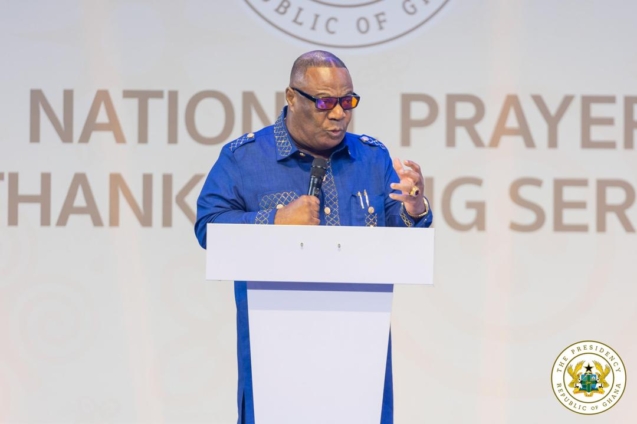
Nicholas Duncan-Williams, Founder and General Overseer of Action Chapel International (ACI), has weighed in on the growing controversy over prophecies linked to political elections, calling for deeper scriptural understanding when addressing such matters.
His comments follow a public apology by Bernard Elbernard Nelson-Eshun, an Accra-based preacher, whose widely circulated prediction that Kennedy Ohene Agyapong would emerge victorious in a recent internal party contest proved false.
The unexpected outcome reignited discussions about the role of prophetic declarations in competitive democratic politics.
Archbishop Duncan-Williams addressed the intense public reactions that surfaced before, during and after the primaries, during which several prophecies were publicly shared regarding the eventual winner.
Responding to a question about how spiritual leaders should navigate public scrutiny when prophetic words intersect with politics, he stressed the importance of distinguishing between Old Testament and New Testament prophecy.
According to him, in the Old Testament era, individuals were guided by prophets because the Spirit of God came upon selected persons but did not dwell permanently within them.
In contrast, he explained that under the New Testament dispensation, believers are led by the indwelling Holy Spirit.
Quoting Revelation 19:10, he stated that “the spirit of prophecy is the testimony of Jesus,” emphasising that authentic prophecy must ultimately affirm the Lordship of Christ.
He also cited Hebrews 1:1–2, noting that while God spoke through prophets in earlier times, He now speaks through His Son, Jesus Christ, who promised the Holy Spirit as the Spirit of truth.
The Archbishop suggested that many disputes surrounding election-related prophecies stem from limited biblical grounding rather than a lack of secular education.
He pointed out that prophets in ancient Israel addressed kings installed by God within a theocratic framework — a system fundamentally different from modern democratic governance.
He spoke on Channel One TV.
“Our countries and nations are secular. They are not the state of Israel,” he remarked, urging caution and discernment when applying biblical prophetic models to contemporary political contests.
While affirming that God continues to speak today, Archbishop Duncan-Williams maintained that prophetic ministry, especially in politically sensitive contexts, must be exercised with theological depth, wisdom and responsibility.
Latest Stories
-
[Watch Live] Shatta Wale, Kofi Kinaata, and others ignite the grand finale of Gomoa Easter Carnival
2 hours -
Berekum Chelsea edge Aduana FC in Bono derby to boost survival hopes
5 hours -
‘They can’t control the team’ – Ernest Thompson doubts local coaches for Black Stars role
6 hours -
Ghana-born midfielder Seidu realises ‘dream’ with Atlético Madrid debut
6 hours -
GPL 2025/26: Bubakari strikes late to hand All Blacks vital win over Dreams FC
6 hours -
Fatal crash on Kintampo–Tamale highway claims four lives
6 hours -
2025–26 FA Cup Semifinal Draw: Chelsea, Man City Learn Wembley Opponents
6 hours -
GPL 25/26: Gold Stars back on top after beating Nations FC
7 hours -
GPL 2025/26: Heart of Lions roar back with victory over Vision FC in Kpando
8 hours -
Solomon Agbasi: Hearts keeper in stable condition after concussion
8 hours -
GPL 2025/26: Late Salim Adams penalty earns Medeama draw at Bechem
8 hours -
Hearts pip Young Apostles 1-0 to end 5-game winless run
8 hours -
Boakye Agyarko marks Easter Sunday with a call for Godly leadership ahead of nationwide campaign tour
9 hours -
Pepsi withdraws as UK festival sponsor after Kanye West backlash
9 hours -
Pope Leo calls for global leaders to choose peace in his first Easter Mass
9 hours