

Audio By Carbonatix
Ghana’s foundational learning system is poised for a major overhaul, with the Ministry of Education announcing plans to integrate cutting-edge subjects like Artificial Intelligence (AI), coding, and financial literacy into the basic school curriculum.
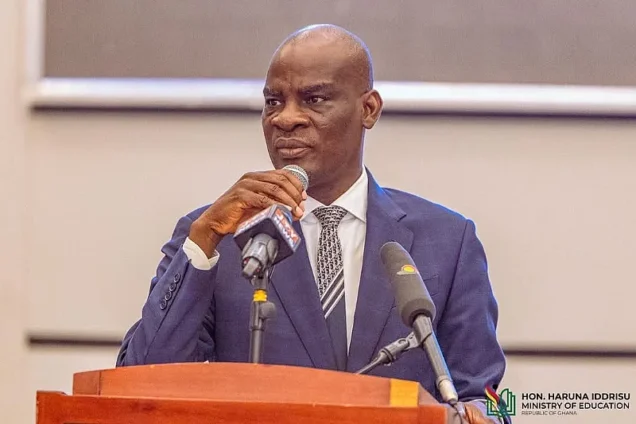
The announcement was made by Haruna Iddrisu, the Minister of Education, at a national stakeholders' convening focused on the state of public basic education and social inclusion.
"We are reviewing the curriculum currently, and I intend to introduce three significant things to foundational learning, which are financial literacy skills, ethical integrity, electronics, artificial intelligence, coding, and robotics," he revealed.
Despite the ambitious curriculum upgrade, the minister flagged a deeply entrenched problem: the presence of approximately 5,000 schools currently operating under trees, a situation he vehemently described as "unacceptable".
Strengthening the Foundation: The Key to Success
Mr Iddrisu emphasised that the success of Ghana's entire education system hinges on fixing the deficiencies at the basic level.
"My focus at the ministry is to strengthen foundational learning, which holds the key to the success of secondary education. We must increase investment and support for basic education," he said.
To achieve this foundational strength, the minister revealed three significant additions planned for the curriculum review:
- Life Skills: Financial literacy skills and ethical integrity.
- Digital Skills: Electronics, Artificial Intelligence (AI), coding, and robotics.
- Inclusivity: Expanding the number of official Ghanaian languages taught from 9 to 13, explicitly including sign language, to promote inclusive quality education.
The North-South Disparity and Funding Woes
The convening, organized by School for Life (SfL) as part of the Citizen-Led Actions for Educational Accountability and Responsiveness (CLEAR) Project, highlighted the severe resource disparities plaguing the sector.
The minister acknowledged that the gap between the North and the South, as well as urban and rural areas, is dangerously widening.
He expressed his willingness to collaborate closely with School for Life and other civil society organisations (CSOs) to address this systemic inequality.
Madam Wedad Sayibu, Director of School for Life, underscored the threat posed by chronic underinvestment:
"Major studies, including the MoE's Sector Performance Report (ESPR) of basic education financing, reveal chronic underinvestment in early childhood and primary education, where learning deficits begin," she said.
SfL noted their own successful efforts to mitigate this crisis, disclosing that their Complementary Basic Education (CBE) programme has helped over 456,500 children in underserved communities, particularly in Northern Ghana, gain access to quality basic education.
Calls for Action and Investment
While commending the government for demonstrating commitment—citing the uncapping of the Ghana Education Trust Fund (GETFund) and specific funding allocations for desks, teacher accommodation, and classroom infrastructure—Madam Sayibu made a targeted plea. She urged the Minister to pay particular attention to budgetary allocation to complementary education programming and ensure critical support for the CBE programme.
School for Life’s final call for national action focused on a comprehensive strategy, urging the government to:
- Make Gender Equality and Social Inclusion (GESI) a school governance priority.
- Invest in dignity-enhancing, accessible school infrastructure.
- Transform the teaching workforce through professional development.
- Mobilize communities as partners in education.
- Fix existing data and financing gaps.
The planned curriculum overhaul is seen as a necessary step to future-proof Ghana's youth, but its success will heavily depend on addressing the infrastructural and resource deficits that currently leave thousands of children studying in rudimentary, "unacceptable" conditions.
Latest Stories
-
Berekum Chelsea edge Aduana FC in Bono derby to boost survival hopes
42 minutes -
‘They can’t control the team’ – Ernest Thompson doubts local coaches for Black Stars role
1 hour -
Ghana-born midfielder Seidu realises ‘dream’ with Atlético Madrid debut
2 hours -
GPL 2025/26: Bubakari strikes late to hand All Blacks vital win over Dreams FC
2 hours -
Fatal crash on Kintampo–Tamale highway claims four lives
2 hours -
2025–26 FA Cup Semifinal Draw: Chelsea, Man City Learn Wembley Opponents
2 hours -
GPL 25/26: Gold Stars back on top after beating Nations FC
3 hours -
GPL 2025/26: Heart of Lions roar back with victory over Vision FC in Kpando
3 hours -
Solomon Agbasi: Hearts keeper in stable condition after concussion
3 hours -
GPL 2025/26: Late Salim Adams penalty earns Medeama draw at Bechem
4 hours -
Hearts pip Young Apostles 1-0 to end 5-game winless run
4 hours -
Boakye Agyarko marks Easter Sunday with a call for Godly leadership ahead of nationwide campaign tour
5 hours -
Pepsi withdraws as UK festival sponsor after Kanye West backlash
5 hours -
Pope Leo calls for global leaders to choose peace in his first Easter Mass
5 hours -
Kpando MP highlights progress on road projects
5 hours