

Audio By Carbonatix
On 28 February 2026, I marked one year since completing my term as Deputy Governor of the Bank of Ghana.
Between February 2018 and February 2025, I had the privilege of serving Ghana during a period defined by successive and overlapping shocks, punctuated by only brief intervals of calm: banking sector instability, fund management industry disruptions, AML/CFT grey- and black-listing pressures, the COVID-19 pandemic, commodity price volatility, geopolitical spillovers, and ultimately, a severe macroeconomic and sovereign debt crisis culminating in comprehensive domestic and external restructuring under an IMF-supported programme.
Some crises are inherited; others emerge just as recovery begins. Both require leadership. But when they unfold within tight political-economy constraints, compressed timelines, and heightened stakes, leadership becomes less about control and more about calibrated judgment, acting decisively while fully aware that consequences will extend far beyond the moment. It was a period that tested not only policy and regulatory frameworks, but the limits of institutions and the endurance of leadership itself. It reshaped my understanding of leadership in ways only lived experience can.
Distance does what proximity rarely permits. It sharpens insight. It separates urgency from importance, and it clarifies what leadership truly is and what it is not. Looking back on those eventful seven years with the luxury of hindsight, seven key lessons stand out for me:
- Crisis Management is Political Economy in Motion
Crisis response is never purely technical. It unfolds within institutional mandates, legal constraints, incentive structures, public expectations, and credibility dynamics. Every policy decision carries distributional consequences. Every reform interacts with power, history, and trust. Technical analysis may inform decisions, but political economy determines their feasibility and sustainability. Understanding that distinction and navigating it without compromising institutional integrity lie at the heart of economic governance.
- Polycrisis Demands System Thinking
When shocks overlap, vulnerabilities interact in nonlinear ways. A banking clean-up affects fiscal space, where safety nets do not exist or are inadequate. Fiscal stress pressures monetary credibility. External shocks constrain exchange rate management. Market sentiments magnify structural weaknesses. In a polycrisis, policy tools are not merely limited. They are interdependent. Leadership in such contexts requires systems thinking like never before: seeing linkages, anticipating spillovers, and acting with full awareness that no decision exists in isolation.
- External Architecture Matters More Than We Admit
Domestic policy-making does not operate in a vacuum. Supply-chain disruptions, price shocks, international financial architecture, conditionality frameworks, market access, correspondent banking relationships, and reputational standing shape domestic room for manoeuvre. External confidence and domestic trust are intertwined assets. Both are hard-won. Both are easily eroded. In stable periods, there is a temptation to attribute calm to superior judgment. But in small open economies, external shocks are perennial and rarely announce themselves in advance. Stability is only as durable as the next shock. When the sun is shining, it is difficult to test whether the roof truly holds. Only the next storm reveals the strength of prior repairs. Periods of calm require leadership humility and courage to invest in resilience before urgency forces action.
- Trust is a Policy Institution’s Most Valuable Currency
Public trust and international confidence are not abstract virtues; they are operational assets. When trust weakens, transmission mechanisms do too. When credibility is questioned, policy costs rise. Institutional strength is not revealed in calm periods. It is revealed under stress. Trust is built slowly, tested constantly, and rebuilt at great cost once damaged. Leadership decisions, therefore, carry reputational and governance consequences alongside technical ones. Rigorous debate, space for dissent, avoiding groupthink, and adopting clear and simple communication go a long way to safeguard credibility.
- Leadership Under Uncertainty Requires Intellectual Humility and Courageous Conviction
In crisis environments, certainty is a luxury. Decisions are rarely about optimising a single objective. They are about balancing inflation and growth; stability and liquidity; discipline and flexibility; domestic priorities and external constraints. Judgment becomes paramount. Stability is rarely born of definitive clarity; it emerges from navigating ambiguity with care and resolve. The most consequential decisions are often made when data is incomplete, risks are fluid, and consequences are far-reaching. In such moments, clarity of purpose, a steady conviction about the public good, anchors leadership.
- Institutions Are Simultaneously Fragile and Resilient
From the outside, institutions appear solid. From within, one sees how much depends on culture, incentives, professional integrity, and quiet dedication. Systems survive not because they are invulnerable, but because committed individuals sustain them through strain. Institutional credibility rests on invisible foundations: institutional memory, disciplined processes, internal dissent, and collective wisdom. Crises are not prevented by frameworks alone. Leadership shapes outcomes: who is in the room, who is heard, and how decisions are made. Leadership is less about authority than stewardship, protecting institutional capital for the long-term.
- Leadership Has Human Limits
This is the lesson least discussed in public life. Sustained crisis leadership carries cognitive, emotional, and physical weight. The responsibility of decisions affecting millions is not theoretical; it is lived. Leadership discourse often celebrates stoicism and endurance. Less frequently acknowledged are vulnerability, fatigue, and limits. In many contexts, unused leave days are worn as a badge of dedication, and those who dare to take time off are seen as weak and selfish. Yet rest and renewal are not indulgences; they are part of critical leadership maintenance.
For women in high-stakes public policy roles, these pressures often carry additional layers: navigating institutional politics and power dynamics while managing societal expectations and disproportionate care responsibilities. Personal needs are often the first casualty of public duty. It takes courage to recognise limits. It takes humility to pause and recalibrate. And sometimes, it takes strength to step aside in the public interest.
When Dame Jacinda Ardern stepped down as New Zealand’s Prime Minister in 2023, speaking candidly about the human limits of leadership, it resonated globally because it articulated what many privately understand: leadership is exercised not by abstract offices, but by human beings operating under sustained pressure. In her own words, “I believe that leading a country is the most privileged job anyone could ever have, but also one of the more challenging. You cannot, and should not do it unless you have a full tank, plus a bit in reserve for those unexpected challenges.” She underscored an important truth for me: acknowledging limits is not a retreat from leadership. It is often an expression of it. Strength and vulnerability are not opposites. They are intertwined.
A Final Reflection
Reflecting on those seven years in public office, navigating complex institutions, engaging stakeholders with divergent interests, and making consequential decisions that sought to balance multiple public policy objectives in the public interest, I recall the quiet weight that accompanied each Monetary Policy Committee meeting and every pivotal moment in policy, regulation, supervision, or crisis management. The tight knot in my stomach was a reminder of the magnitude of responsibility borne collectively by my colleagues and me in leadership at the time: decisions that, in one direction or another, would shape the lives of millions of Ghanaians and reverberate far beyond our borders. In those moments, it became unmistakably clear that public office is less about power than about burden, the burden of trade-offs; the burden of guiding others through uncertainty; and the burden of stewardship over institutions entrusted to one’s care.
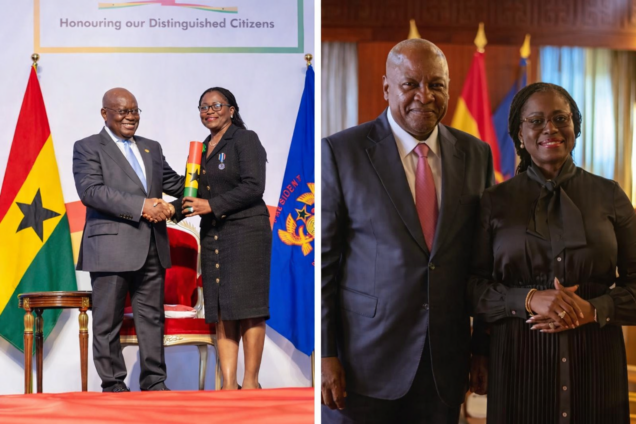
And yet, what a profound privilege to have served. I remain deeply grateful for the opportunity! I am grateful to President Akufo-Addo, who appointed me, and to President John Mahama, under whose government I served for two months towards the close of my term, for the confidence they reposed in me. I am grateful to the extraordinary professionals who laboured at odd hours, often unseen, to keep systems functioning under extraordinary strain.
And with distance, my conviction has strengthened: leadership is not defined by the moments of applause, but by the weight one is willing to carry in service of others. Leadership is not about imprinting oneself on institutions, but about leaving them steadier, stronger, and more credible than one found them. And so, with gratitude and humility, I carry forward not the title I once held, but the lessons it required me to learn. I remain eternally grateful to colleagues, family, friends, mentors, and mentees, on whose strength and wisdom I leaned when I needed more than my own. Here’s to us all and here’s to continued growth and service in diverse ways!
Latest Stories
-
Interior Ministry releases funds to settle 2025 rent allowance arrears for security services
2 minutes -
Ghana evacuates diplomatic staff from Iran; embassy shut indefinitely — Ablakwa
4 minutes -
France to boost nuclear arsenal and extend deterrence to European allies
23 minutes -
Chinese community in Ghana marks ‘Year of the Horse’ with grand new year festival
27 minutes -
When regional instability becomes national risk: Ghanaian tomato traders killings
44 minutes -
Photos: President Mahama meets Tanzania President Suluhu Hassan
57 minutes -
Mahama calls for cessation of Iran-US-Israel conflict, urging return to dialogue
1 hour -
Fuel prices could rise if Middle East conflict escalates – ACEP Boss
1 hour -
Elsie Addo Awadzi: Leadership reflections, one year on; 7 lessons from 7 years in public office
2 hours -
Finance Minister announces expiration of DDEP-induced restrictions on domestic bond issuance
2 hours -
Gov’t urged to aid private nursing training colleges to ease burden on public ones
2 hours -
Kumasi Mayor vows to keep Kejetia Market free from highly inflammable materials
2 hours -
Ghana safe from fuel supply disruptions amid Middle East tensions – Dr Oppong
2 hours -
Ghana Development Awards 2026 set to celebrate excellence in nation-building and economic recovery
3 hours -
IMANI opens applications for 12th SYPALA summer seminar
3 hours