

Audio By Carbonatix
The former chief executive of Google is worried Artificial Intelligence (AI) could be used by terrorists or "rogue states" to "harm innocent people."
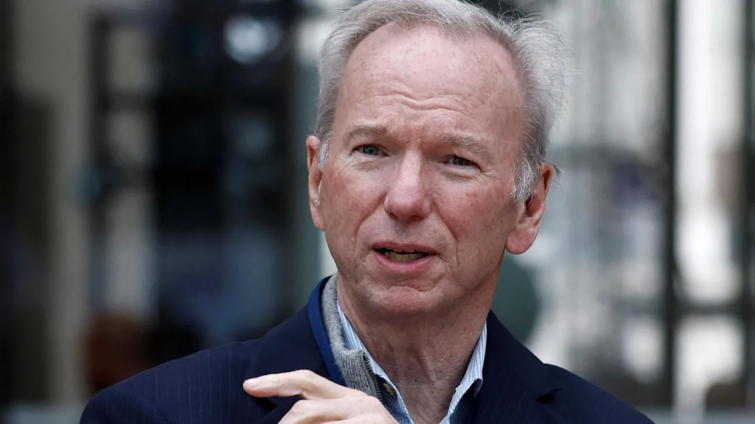
Eric Schmidt told the BBC: "The real fears that I have are not the ones that most people talk about AI - I talk about extreme risk."
The tech billionaire, who held senior posts at Google from 2001 to 2017, told the Today programme "North Korea, Iran, or even Russia" could adopt and misuse the technology to create biological weapons.
He called for government oversight on private tech companies which are developing AI models but warned that over-regulation could stifle innovation.
Mr Schmidt agreed with US export controls on powerful microchips which power the most advanced AI systems.
Before he left office, former US President Joe Biden restricted the export of microchips to all but 18 countries, in order to slow adversaries' progress on AI research.
The decision could still be reversed by Donald Trump.
"Think about North Korea, or Iran, or even Russia, who have some evil goal," Mr Schmidt said.
"This technology is fast enough for them to adopt that they could misuse it and do real harm," he told Today presenter Amol Rajan.
He added AI systems, in the wrong hands, could be used to develop weapons to create "a bad biological attack from some evil person."
"I'm always worried about the 'Osama bin Laden' scenario, where you have some truly evil person who takes over some aspect of our modern life and uses it to harm innocent people," he said.
Bin Laden orchestrated the 9/11 attacks in 2001, where al-Qaeda terrorists took control of planes to kill thousands of people on American soil.
Mr Schmidt proposed a balance between government oversight of AI development and over-regulation of the sector.
"The truth is that AI and the future is largely going to be built by private companies," Mr Schmidt said.
"It's really important that governments understand what we're doing and keep their eye on us."
He added: "We're not arguing that we should unilaterally be able to do these things without oversight, we think it should be regulated."
He was speaking from Paris, where the AI Action Summit finished with the US and UK refusing to sign the agreement.
US Vice President JD Vance said regulation would "kill a transformative industry just as it's taking off".
Mr Schmidt said the result of too much regulation in Europe "is that the AI revolution, which is the most important revolution in my opinion since electricity, is not going to be invented in Europe."
He also said the large tech companies "did not understand 15 years ago" the potential that AI had, but does now.
"My experience with the tech leaders is that they do have an understanding of the impact they're having, but they might make a different values judgment than the government would make," he said.
Smartphone ban for children
Mr Schmidt was head of Google when the company bought Android, the company which now makes the most-used mobile phone operating system in the world.
He now supports initiatives to keep phones out of schools.
"I'm one of the people who did not understand, and I'll take responsibility that the world does not work perfectly the way us tech people think it is," he said.
"The situation with children is particularly disturbing to me."
"I think smartphones with a kid can be safe," he said, "they just need to be moderated... we can all agree that children should be protected from the bad of the online world."
On social media - where he has supported proposals for a ban on children under 16 - he added: "Why would we run such a large, uncontrolled experiment on the most important people in the world, which is the next generation?"
Campaigners for limiting children's smartphone usage argue phones are addictive and "have lured children away from the activities that are indispensable to healthy development".
Australia's parliament passed a law to ban social media use for under-16s in 2024, with Prime Minister Anthony Albanese saying it was important to protect children from its "harms".
A recent study published in the medical journal The Lancet suggested that mobile phone bans in schools did not improve students' behaviour or grades.
But it did find that spending longer on smartphones and social media in general was linked with worse results for all of those measures.
Latest Stories
-
Prolonged Middle East conflict poses significant risk to economy – BoG
9 minutes -
Kafui Dey suggests seat fillers to fix late TGMA start
40 minutes -
World Bank, GCEA provide FIDIC contract management training in Accra
52 minutes -
T-bills auction: Government records 20.1% undersubscription; interest rates continue to surge
54 minutes -
Scientists from Ghana, Brazil and UK gather in Kumasi to tackle biodiversity crisis with technology
56 minutes -
ECG announces power outages in Amasaman and Western Region for maintenance and cable fault repairs
59 minutes -
Rescue efforts for trapped worshipers intensify in Accra New Town building collapse
1 hour -
49 Years On: Shirley Graham Du Bois remembered as a force beyond W.E.B. Du Bois’ legacy
1 hour -
Japanese-Ghanaian musician Coco Blasian wants Ghanaian man for marriage
2 hours -
Worshipers trapped as building collapses in Accra New Town
3 hours -
Police investigate GH₵400K mobile money withdrawal linked to gold robbery in Kumasi
3 hours -
Scoreline was a bit deceptive – Otto Addo on Austria humiliation
3 hours -
14 children rescued as floodwaters wreak havoc in Tema Manhean
3 hours -
GPL 25/26: Hearts slip further away in title race after 2-2 draw with All Blacks
3 hours -
Ghana Coalition Against Galamsey urges gov’t to take immediate action against illegal mining
3 hours