

Audio By Carbonatix
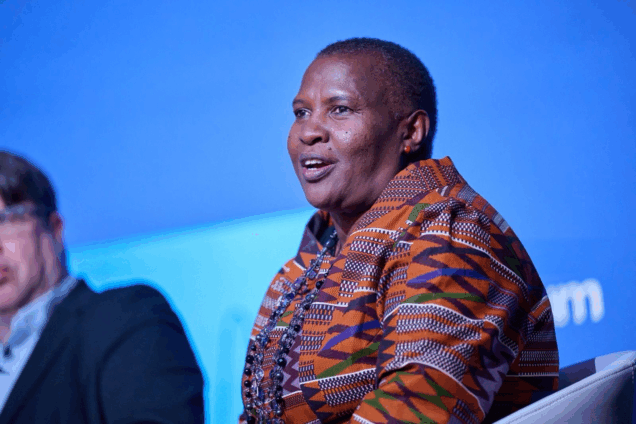
AGRA President Alice Ruhweza says artificial intelligence (AI) is a defining force that is already reshaping the future of the agricultural sector, and Africa must be at the forefront of that.
Speaking on the sidelines of the World Economic Forum in Davos, Switzerland, she said, “AI is the big subject. And AI for agriculture and AI for food have been in many discussions. I think the future of food systems will be very much technology- and data-driven.
In many panels I attended, we kept talking about the need to embrace this. It is coming,’ she said.
Ms Ruhweza, however, cautioned that while AI will transform food systems, its value will ultimately depend on how equitably and practically it is applied.
“We need to make sure that when it comes, the benefits are spread. And that everybody understands it. But importantly, it solves the problem. Because we don’t want farmers to adopt AI unless it solves a problem,” she said.
The AGRA president identified access to financing and decision-making information as two areas of the food system where AI could help improve. “We want to make sure AI makes access to information easier. It makes credit scoring easier for women farmers who need access to finance,” she said.
“We need to make sure that the regenerative agriculture that we want to introduce, that we are getting the data that we need that tells us these are the farming practices that we need to do.
"So, I think the future of food systems will be data-driven. But that future is in Africa,” the AGRA President added.
The World Economic Forum's Annual Meeting 2026 in Davos, Switzerland, was under the theme “A Spirit of Dialogue.”
World leaders from government, business, civil society and academia convened to engage in forward-looking discussions to address global issues and set priorities.
The conversations about artificial intelligence gained traction at the meeting. The world’s richest man and Tesla CEO, Elon Musk, argues that if AI, robotics, and solar power are deployed more broadly, they could unlock an era of unprecedented global abundance.
“If you have ubiquitous AI that is essentially free or close to it and ubiquitous robotics, you will have an explosion in the global economy that is truly beyond all precedent,” he said.
He said robots could perform industrial tasks, care for ageing populations and support families, addressing labour shortages while lowering costs.
Latest Stories
-
Sammi Awuku urges NPP Germany to unite ahead of 2028 elections
26 minutes -
The Inconvenient Truth: We cannot pray for the cure while protecting the disease
1 hour -
MTN Ghana trains civil society organisations on artificial intelligence
2 hours -
GoldBod FX framework aims to make dollar supply predictable – Acheampong
2 hours -
How does a Ghanaian team make it to the BAL?
2 hours -
Ghana’s investment climate presents opportunities for industrial growth and job creation.
2 hours -
‘I paid thousands to a company for jobs that never came’
3 hours -
SSNIT intensifies informal sector enrolment drive with Techiman float
3 hours -
Ghana seeks long-term mining investments that benefit local communities – Armah-Kofi Buah
3 hours -
GHATOF demands compensation for 85 businesses affected by La Pleasure Beach demolition
3 hours -
Bono Regional Minister calls for investor education to drive economic growth
3 hours -
Ghana’s Ambassador to China, Kojo Bonsu, presents credentials to Nepalese President
3 hours -
Fairtrade Africa’s Cocoa Hubs Project strengthens rural service centres in cocoa-growing communities
3 hours -
MPs are not development officers – Edem Kpotosu
3 hours -
SEC cautions investors against fraudulent investment schemes
3 hours