


Audio By Carbonatix
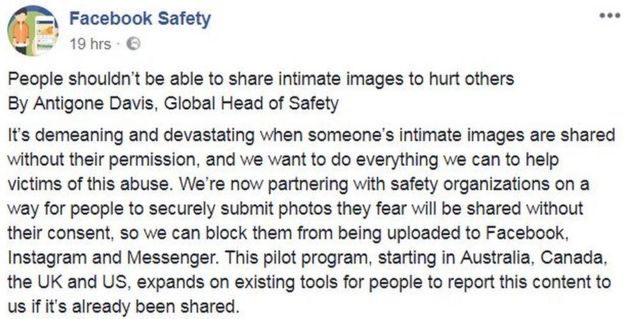
Facebook is asking British users to send naked photos of themselves to the social network, to try to stop revenge porn.
If you're worried an intimate photo of you could be shared by someone else, the idea is to get it blocked before it appears online.
Similar technology is used to try to stop the spread of child abuse images.
Facebook's been testing the system in Australia and is extending the trial to the UK, the USA and Canada.
A spokesman told Newsbeat the idea is open to people in the UK now.
Facebook hasn't revealed any details about how the trial in Australia went - but obviously, the idea requires a huge leap of faith.
Would you send sexually explicit photos of yourself to Facebook?
Could you be certain the image would be handled sensitively - and crucially, not shared?
How it works
If there's an image you're worried about, Facebook says you should contact its partner for the trial. In the UK, it's the Revenge Porn Helpline.
Staff there will then get in touch with Facebook and you'll get sent a link to upload the photo.
Who will see my naked photo?
Facebook's Global Head of Safety Antigone Davis told Newsbeat that photos will only be seen by "a very small group of about five specially trained reviewers".
They'll give the photo a unique digital fingerprint - something called hashing.
That code will then be stored on a database. If anyone else tries to upload the same photo, the code will be recognised and it'll be blocked before it appears on Facebook, Instagram and Messenger.
The original photos will not be stored.
Will the idea definitely work?
Antigone Davis admits there's "no 100% guarantee when it comes to photo-matching technologies".
That's because it's possible to manipulate images so they're different to the original. But she says they are getting better at it.
This whole system only works if you actually have the image you're worried about.
If, for example, your ex took a load of photos on their phone and you don't have them, this idea doesn't help.
The UK's Revenge Porn Helpline has seen huge year-on-year increases in reported incidents since it was launched in 2015.
The hotline received just over 500 reports in 2015 and more than 1,000 in 2017.
Latest Stories
-
Mr President, Ghana was mentioned at the UN; why aren’t we talking about it?
46 minutes -
Accra to convene Africa’s regulators and markets on tokenisation at AVAS 2026
49 minutes -
The Paradox of Plenty — When every smartphone becomes a newsroom
1 hour -
GTA sensitises taxi drivers in ‘Know Ghana’ tourism campaign
3 hours -
Archbishop Agyinasare calls for responsible speech amid growing social media abuse
3 hours -
‘It will be inexcusable for gov’t not to honour payment of teachers’ arrears by 30th October’ – Haruna Iddrisu
3 hours -
Forbes’ World’s Best Employers 2026: No Ghanaian firm ranked among 900 companies
3 hours -
Electronic processing of teachers’ data: ‘The decision is the Controller’s’ – GES boss
3 hours -
Teachers’ Strike: Haruna Iddrisu questions paper-based processing of promoted teachers’ data
3 hours -
Savannah Region: Kunfusi bridge collapses again, leaving nearly 4,000 residents cut off
3 hours -
Teachers’ strike: GES targets Monday deadline to submit promotion data to Controller
3 hours -
Inflation to average 11.3% in 2027 – Fitch Solutions
4 hours -
‘I didn’t campaign for NDC to come and do this nonsense’ – Kpebu on EOCO’s conduct
4 hours -
Fitch Solutions maintains policy rate forecast of 14% by December 2026
4 hours -
Diaspora Nasara Caucus congratulates Mohammed Ali Suraj, new NPP executives
6 hours