

Audio By Carbonatix
Finance Minister, Ken Ofori-Atta, says the National Development Bank which will take off from the end of July will be a game changer that will transform the country’s economy through industrialization and create more job opportunities.
This is because it will provide long term funding of up to 15 years repayment period to businesses, at relatively cheaper cost.
According to him, the bank will provide cheap credit for industries to grow, expand and offer jobs for Ghanaians.
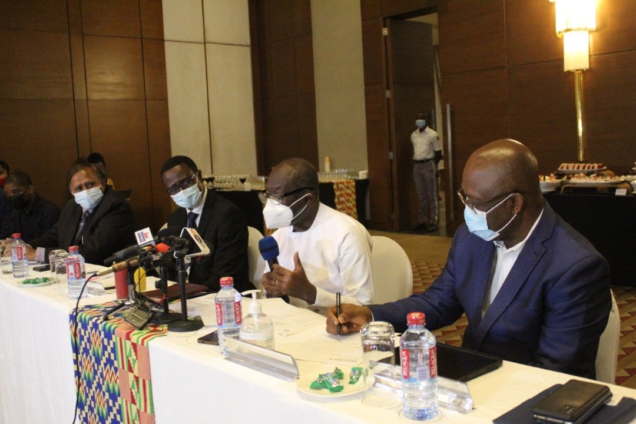
Speaking at the Corporate Dinner Series for CEOs of Large Corporates organized by the Association of Ghana Industries, Mr. Ofori-Atta said the National Development Bank is part of the ‘Ghana Beyond Aid’ agenda which hinges on three pillars, and will be different from that of the Agricultural Development Bank and the National Investment Bank.
“There are rigidities that we hope that the development bank will be able to cure, provide loans of up to 15 years, find ways of providing financial support, agreement and guarantees etc, to facilitate banking in a different way without the moral hazards.”
“We’re going to get a much more excited environment [banking] going forward, which we will seek to address some of these things [inadequate access and cost of credit]. And you can see really a gradual progress from the courage to attack the problems of the banking sector, the beginning to think through the development bank as an intervention that is required. We also look at the capital market master plan which we put together to also see how we can really bring live to our stock market which should be a viable option for industry and also support green and brown financing as we see young people getting entrepreneurial going forward’, Mr. Ofori-Atta said.
“So we will continue with the issue of macro stability because it’s something we cannot put aside if we are able to forecast and feel confident about the future and reforms, to continue to strengthen the financial sector and stronger national support for the private sector and entrepreneurship going forward. We’ll also keep an eye on the competitiveness along the region in areas such as energy so that more people will cut out smuggling etc. So that we will be more effective”, he added.
The President of the AGI, Dr. Yaw Adu Gyamfi told Joy Business, businesses have been recovery albeit slowly after covid-19 restrictions eased.
However, he expects some further reliefs from government in the Mid-Year Review Budget that is expected to be tabled before Parliament latest by August this year.
“Of course, when the budget was read for 2021, many companies were affected with the increase of taxes that came and as a result also affected us in terms of our revenue. So weare expecting this [tax/levy reviews] to happen in the mid-year review budget”.
On the National Development Bank, Dr. Adu Gymafi said “from the discussion that we've had with the ministry, they have done a lot of work in terms of going to kfw [German Development Bank] that he [Ken Ofori-Atta] mentioned. This is a development bank, this is not a depository bank, nobody has asked us to go and put money there; that is the major difference. In in terms of governance, the policy, a whole law that has been passed by Parliament for its implementation. This should not be the same as NIB or ADB and we are hoping for the best. We will ensure this bank survives, so we have long term funding for businesses.”
CEOs expressed concern about the 50% Benchmark Port Value
The Corporate Dinner Series brought together captains of industry, from manufacturing, agro processing and pharmaceutical.
The players however expressed worry about the reduction in Benchmark Port Value by 50%, which they say is making them to lose market, because of influx of imports.
Some claimed they’ve been forced to reduce their operations and thereby staff strength because of high import.
Government in 2019 announced drastic reduction in the benchmark values against which duties paid by importers at Ghana’s ports are calculated.
With the exception of vehicles, goods were reduced by 50 percent, while that for vehicles was reduced by 30%.
The move was to reduce the cost of imports at the ports.
Latest Stories
-
We can tackle multiple priorities – Sam George defends Anti-LGBTQ Bill push
2 minutes -
Statement: Ghana Chamber of Mines’ Response to Claims in Joe Jackson’s “Ananse Stories about the Economy of Ghana”
4 minutes -
GES opens 2026 teacher recruitment for licensed B.Ed graduates
6 minutes -
Ghana must value skilled trades, build resilient learners — Ibn Chambas
14 minutes -
Ghana must rethink education around relevance, resilience and responsibility — Ibn Chambas
17 minutes -
Prince Harry faces defamation lawsuit from charity he co-founded
19 minutes -
South Korea deploys thermal cameras to track escaped zoo wolf
20 minutes -
Calls for royal meeting with Epstein survivors grow ahead of US visit
24 minutes -
Ibn Chambas advocates blend of technology and human values in education
25 minutes -
UMA improves healthcare access in Asutifi North with GH₵700k ‘Kim Taylor Legacy’ Walkway
30 minutes -
Scholarships Authority and Fanaka University offer sponsorship for procurement and supply chain studies
33 minutes -
Bisa Kdei drops new single ‘Go N Look’ featuring Medikal
40 minutes -
Benin facing rising terrorism in north as French military presence faces growing criticism
41 minutes -
UEW Public Lecture Series 2026: Education debate ‘about the soul of Ghana’s future’ — Dr Ibn Chambas
42 minutes -
EU fingerprint and photo travel rules come into force from today
1 hour