

Audio By Carbonatix
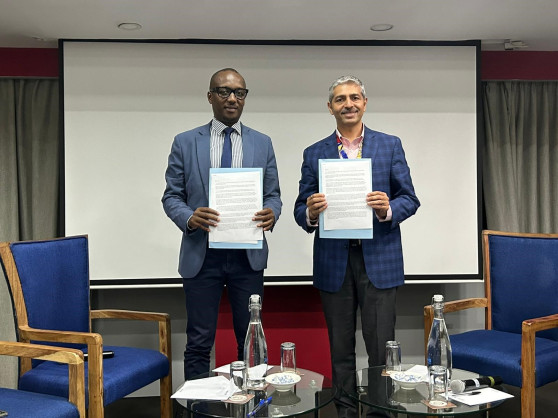
A Collaboration Agreement has been signed between FIND (www.FINDdx.org) and the Rwanda Biomedical Centre to accelerate diagnostic innovation, strengthen regional manufacturing, and boost disease surveillance capabilities.
FIND and the Rwanda Biomedical Centre (RBC) announced today that the organizations have signed a Collaboration Agreement that includes several areas of collaboration linked to the implementation of the Resolution on diagnostics adopted by the World Health Assembly earlier this year.
Diagnostics are critical to sustainable, resilient health systems. Yet nearly half the world’s population lacks access to essential tests, putting universal health coverage at risk, and jeopardizing preparedness to avert future pandemic threats. Diagnostic gaps must be urgently addressed, especially at primary care level where need is greatest. Rwanda has made significant progress in strengthening primary care services, and was recently recognized (https://apo-opa.co/3uInJwA) by the World Health Organization as a well-performing country on the path to universal health coverage.
The agreement between FIND and RBC outlines strategic initiatives planned jointly to accelerate diagnostic innovation, including clinical evaluations of new tests and AI-based tools, strengthen regional manufacturing, and boost disease surveillance capabilities, including genomic sequencing.
RBC and FIND are already in the process of kicking off some of these initiatives towards enabling digitally powered, integrated screening at a community healthcare level, and understanding values and preferences towards non-invasive malaria diagnostic tests. The organizations are collaborating to develop, evaluate and implement an MoH-led roll out of national community health information systems, which will provide process and data management support for community health worker activities, as well as ensure that an integrated, standardized approach to screening and diagnosis is built into healthcare systems from the ground up – including expanded involvement of community health workers in diagnosis. This is expected to improve the quality and coverage of diagnostic services at community level, in support of universal health coverage.
Prof Claude Mambo Muvunyi, Director General of RBC, said: “Rwanda Biomedical Centre is committed to accelerate healthcare coverage towards reaching 90% of care provided at the primary care level. We are grateful for this collaboration which is aligned with our priorities to lead the community heath interventions with evidence, through developing diagnostics, empowering the community health care through digital transformation and use of the data science across health programmes.”
Dr Marta Fernández Suárez, Chief Technology Officer at FIND, said: “Rwanda is reaping the rewards of putting a focus on primary healthcare, with individuals and communities at the heart of services. We are excited to help strengthen these efforts and support the ongoing digital transformation in Rwanda though a partnership that will firmly embed diagnostic testing into health systems across the country, so that testing can be accessible to everyone who needs it, wherever they seek care.”
Distributed by APO Group on behalf of FIND.
Media contacts:
RBC:
Julien Niyingabira Mahoro
M: +250 788 606 072
julien.niyingabira@rbc.gov.rw
FIND:
Sarah-Jane Loveday
Director, Communications
M: +41 79 431 62 44
media@finddx.org
About Rwanda Biomedical Centre:
Rwanda Biomedical Centre (RBC) is the nation's central health implementation agency for the ministry of Health in Rwanda. RBC was established in 2011 with a mission to promotes high quality, affordable, and sustainable health care services to the population through evidence-based interventions and practices guided by ethics and professionalism. RBC strives to improve the health of the Rwandan population by providing high quality, affordable and sustainable health care services. This is accomplished through the implementation of preventative, rehabilitative, and curative health interventions. RBC conducts scientific research, provides diagnostics services, and implements innovative health interventions to protect the nation against diseases and other health threats.
About FIND:
FIND accelerates equitable access to reliable diagnosis around the world. We are working to close critical testing gaps that leave people at risk from preventable and treatable illnesses, enable effective disease surveillance, and build sustainable, resilient health systems. In partnership with countries, WHO and other global health agencies, we are driving progress towards global health security and universal health coverage. We are a WHO Collaborating Centre for Laboratory Strengthening and Diagnostic Technology Evaluation. For more information, please visit www.FINDdx.org
Latest Stories
-
GES urges government agencies to end blame game over teacher payments
2 hours -
GES sets Oct. 5 deadline to resolve teachers’ payment dispute
3 hours -
GES working around the clock to get teachers back to class, says Daniel Fenyi
3 hours -
French PM warns against escalation of school protests after 164 arrested
3 hours -
UK tries to stop Trump’s diesel export ban
4 hours -
Late Olise goal gives France win over Belgium
4 hours -
Mancini enjoys first win since return as Italy boss
4 hours -
Interest payments to average a high 20% of government revenue over next 4 years
4 hours -
Anthropic warns AI may pose ‘existential risks to humanity’ in IPO filing
4 hours -
Joe Hart trusts Man City chair Al Mubarak over ruling
4 hours -
Strategy of accumulating foreign reserves, gold carries high fiscal cost – S&P Global
4 hours -
Weak institutional arrangements, high debt servicing constrain Ghana’s rating – S&P
4 hours -
Man City CEO defiant over Premier League charges
4 hours -
Infantino makes bigger cash pledge to Fifa members
5 hours -
Bond market: Turnover declined by 28% to GH¢1.56bn
5 hours