

Audio By Carbonatix
Valeria Mensah is an economist with the International Monetary Fund (IMF) in Washington, DC, where she blends her curiosity and problem-solving skills with a keen interest in global economic development.
She tells us about her journey from a small mining town in Ghana to studying for her MPhil in Development Studies at Queens’ College – supported by Cambridge Trust funding – to shaping economic policies which address the distinctive challenges facing developing economies.
Tell us about your background and life before coming to the University of Cambridge
I grew up in Obuasi in Ghana. My father was an economics teacher who went on to work for the central government in the capital, Accra, and my mother was a teacher. They both saw the value and transformative opportunities of education.

Val, with her parents, at home in Obuasi (circa 1986)
After starting out at a local government school, I went to a boarding school in Kumasi that offered more academic rigour and started to discover which subjects interested me most. Science felt like home because of the way it helped explain the world to me; with maths, it was the ability to solve problems that was the biggest appeal.
I was never quite sure what I wanted to do when I was older, but I do remember thinking that I’d probably become a scientist.
However, life ultimately guided me down a different path.
How did you discover the opportunity to study at Cambridge?
After my undergraduate degree, I spent a lot of time during my year of national service exploring postgraduate programmes around the world. It was Professor Eric Danquah of the University of Ghana – an alum of the University of Cambridge himself – who encouraged me to apply to Cambridge.
Were there any barriers in your way?
The biggest challenge was always going to be funding. I had been offered admission to Cambridge and was earnestly praying and hoping to receive financial support. With my parents’ public service salaries, and three younger siblings to support, there was absolutely no way my family could afford to pay.
Receiving the Cambridge Trust grant drove home a new reality to me – that dreams could come true.

Interacting with His Majesty at the Cambridge Trust Reception for Scholars in 2008
What were your first impressions of Cambridge?
Bicycles! The sheer number of bicycles, and the fact I didn’t know how to ride one!
How did you spend your time here?
As I settled in, I really began to make the most of the opportunity the funding had given me.
I took on a volunteer role with CAMFED, joined the Cambridge Commonwealth Society and became an active member of the Cambridge Union of Ghanaian Students. One of my fondest memories is being the Master of Ceremonies at a local event celebrating the 51st anniversary of Ghana’s independence.
And following my year in Cambridge I sought out other opportunities so I could gain as much experience as possible while on my student visa.
Roles with the Research Services Division at the University of Cambridge and the Legal Services Commission in Cambridge gave me valuable experience which was so helpful in my job hunting when I returned to Ghana.

How did your course at Cambridge prepare you for your career?
I knew early on that I wanted to pursue international economics, and my MPhil significantly deepened that interest through rigorous engagement with the literature and close exposure to leading scholars in the field.
The programme also sparked an enduring intellectual curiosity such that, by the time I completed it, I was clear about my ambition to pursue a PhD focused on economic policy in developing countries – which I did later on in Tax Policy with the University of Pretoria.
Taken together, the experience helped shape my understanding of the distinctive challenges facing developing economies in an increasingly globalised world. Over the course of my 17‑year career across various multilateral institutions, this foundation has proved invaluable, particularly as my work has centred on tailoring economic policy solutions to the diverse contexts of developing countries.

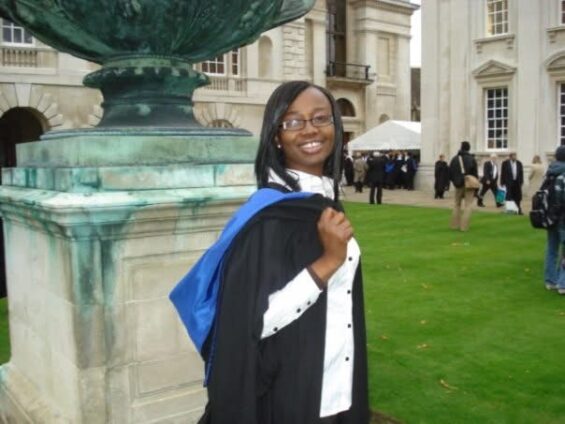
At the Matriculation Dinner at Queens’ College, 2007
How has your time at Cambridge changed your life? What has it enabled you to do on a personal level or as part of your community?
I truly recognise the importance of a helping hand and the value of a good education. Both have been transformative to me. And I now commit as much time and energy as I can to help others find their own path.
Over the years, I have used personal resources and my own networks to support a number of students in Ghana, and worked with other Cambridge alumni to establish the Oxford-Cambridge Alumni Group in Ghana, which I co-chaired for a few years.
Having a Cambridge degree has undoubtedly provided me many opportunities, and I can safely say it would not have been possible without the generosity of the Trust.
How are you contributing back to society now through your work?
In the nearly two decades of working in the international development space, I have had the opportunity to contribute to the design and implementation of economic and development policies, development financing frameworks, and technical capacity‑building efforts across developing countries.
As a Mo Ibrahim Leadership Fellow at the United Nations Economic Commission for Africa (2018), I contributed to several flagship initiatives aimed at fostering sustainable economic transformation on the continent. These included analytical support and advocacy for the African Continental Free Trade Area (AfCFTA) in the lead up to its ratification, strengthening domestic resource mobilisation in African countries, as well as efforts to leverage the potential of digital identification systems across the region.
At the IMF, my work to date has spanned shaping and supporting the implementation of the Fund’s Capacity Development Strategy for its member countries, as well as providing fiscal and debt sustainability analysis and delivering macroeconomic technical assistance to Small Island States in the Asia and Pacific region.
Through my work at the IMF, I have seen how analytical clarity can meaningfully influence outcomes when it is well calibrated to country-specific realities.
What are your aspirations for the future?
My long-term hope is to help bridge the gap between technically sound macroeconomic analysis and the lived economic realities of developing countries – where informality, limited fiscal space, and institutional constraints shape how policies are experienced on the ground.
I also aspire to play a role in shaping global economic governance – helping international institutions adapt their tools, advice, and engagement to a world characterised by greater uncertainty, fragmentation, and inequality.
Can you sum up your time in Cambridge in three words?
‘Life. Changing. Experience.’
What advice would you give to anyone considering applying to Cambridge with support from the Cambridge Trust?
Cambridge is well worth considering, and for many applicants the Cambridge Trust can make the decisive difference between attending and not. If you have a strong academic record and clear motivation, you belong in the applicant pool.
Too often, strong candidates assume they are “not competitive enough” and self‑select out. In reality, the Trust supports scholars from diverse backgrounds, disciplines, and paths. Give it your best shot!
Latest Stories
-
Gold edges lower with focus on Fed minutes, rate path clues
1 hour -
Oil prices rise as storms and air strikes threaten supply
1 hour -
Nigeria nears 2,000 repatriations from South Africa after latest evacuation flight
1 hour -
‘I never gave up’ – Abanga Fusani reflects on journey to NPP Youth Organiser victory
2 hours -
World Bank maintains Ghana’s growth rate forecast at 4.8% in 2026
2 hours -
Cedi was worst African currency in quarter 2, 2026 – World Bank
3 hours -
US death row inmate Christa Pike awake and speaking after failed execution, lawyers say
3 hours -
AI gains can lift three times as many people out of poverty in Ghana – World Bank
3 hours -
Scammers target ECG customers with fake meter sales and MoMo payment calls
4 hours -
Abanga Fusani credits hard work and consistency for NPP Youth Organiser victory
4 hours -
We did not take security issues seriously – Abanga Fusani reflects on NPP’s 2024 election loss
5 hours -
Nigeria’s Dangote refinery aims to draw more retail investors than Aramco IPO, CEO says
5 hours -
Banker in court for allegedly stealing GH¢1 million
5 hours -
Police arrest suspect over jewellery theft during fire outbreak
5 hours -
EOCO returns Hanan’s £6,700, GH¢2,750 and devices after defence challenge
6 hours