

Audio By Carbonatix
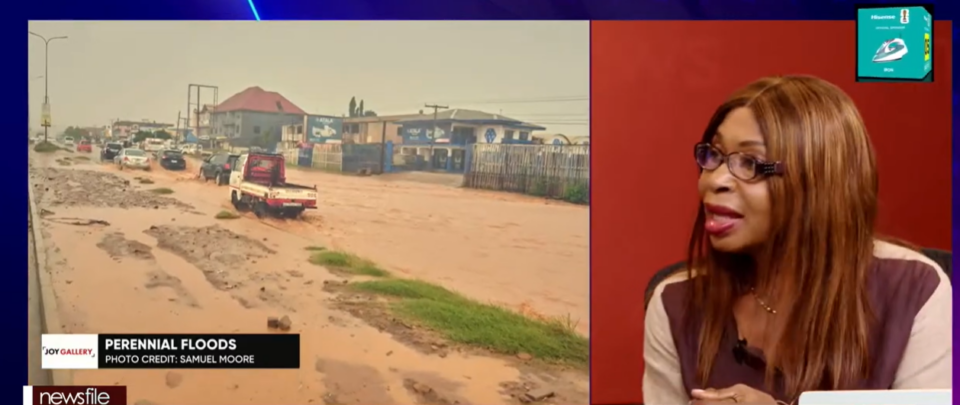
Entrepreneur and private legal practitioner Victoria Bright has blamed Ghana's recurring June floods on institutional and governance failures, saying that weak enforcement of planning regulations and a lack of accountability continue to put lives at risk.
Speaking on JoyNews' Newsfile on Saturday, June 6, Ms Bright said the annual flooding crisis should no longer come as a surprise because the causes are well known and largely preventable.
"I think for me it's an institutional failure. You should still hold the state accountable. And it's a governance failure," she said.
According to her, authorities have consistently failed to stop the construction of buildings on waterways and flood-prone areas, despite existing planning laws and approval processes.
"We always hear that people have built in waterways, but nobody ever looks at who approved these developments or who issued the permits," she said.
"Somebody somewhere is doing these things. Who failed to enforce our planning regulations? Who allowed these structures to remain after warnings were issued?"
Ms Bright said that illegal developments do not appear overnight but go through several stages that require approvals and inspections.
"I don't think that building on waterways can just emerge overnight," she said.
"You don't just get up and build a house. There's a process, and at every stage along that process, someone has probably been bribed or whatever."
She described the country's response to flooding as repetitive and predictable, saying governments continue to offer excuses instead of lasting solutions.
"The greatest tragedy in all of this is that we continue to be surprised every year by the consequences, and it's all predictable," she said.
"We know where the flood-prone areas are in this country."
She said that other countries experience even more severe weather conditions but have managed to reduce the impact of floods through effective planning and strong institutions.
"Because of planning, because of institutions that work, and because of good governance, they are able to circumvent the kinds of disasters that we keep seeing here," she stated.
Ms Bright also expressed frustration with what she described as the repeated use of excuses after every major flood incident.
"The rhetoric is too much. We are tired of it," she said.
"I'm tired of hearing 'heavy rainfall'. I'm tired of hearing 'it's an act of God'. I'm tired of hearing 'it's extreme weather'."
She pointed out that the same communities flood every year, the same drains overflow, and the same waterways remain blocked, stretching emergency services beyond their limits.
"We know rain is natural. We know government can't stop the rain," she said.
"But they are expected to reduce predictable risks, and these are predictable risks."
Reflecting on the June 3, 2015, flood and fire disaster, which claimed more than 150 lives, Ms Bright said the tragedy should have transformed the country's approach to disaster prevention.
"The tragedy of June 3 was supposed to be a turning point in our history," she said.
"I mean, we were all shocked, and then we got the usual rhetoric and promises about major reforms, drain infrastructure, urban planning, flood prevention, emergency preparedness, and enforcement against illegal construction."
She said that a committee was established after the disaster and made several recommendations, but little appears to have changed more than a decade later.
"Eleven years later, this is where we are. So what has changed?" she asked.
"We establish committees, prepare reports, and see the recommendations, officials express concern, and then the attention quickly shifts elsewhere."
Ms Bright called for stronger accountability measures, including sanctions against public officials who fail to carry out their responsibilities.
"We need sanctions. We need dismissals," she said.
"There are people responsible for making sure these things work. There are budgets allocated to people to do things. What are they doing with that money?"
She also called for criminal prosecutions where negligence contributes to disasters.
"We need prosecutions for criminal negligence," she said.
"I have never heard of anyone being prosecuted because they failed to follow through with their responsibilities in relation to any of these disasters."
According to Ms Bright, Ghana continues to repeat the same mistakes because recommendations are rarely implemented.
"We're just going around in cycles," she said.
"The lessons come, we seem to learn them, then we find out that we haven't really learned them, and it keeps going round and round."
Latest Stories
-
US seeks changes to rejected $109m health compact with Ghana – Mahama
15 minutes -
Nine dead in mass shooting at Pennsylvania home
32 minutes -
‘Time for Ukraine to get new president,’ says Trump after Zelensky condemns diesel deal
35 minutes -
Hincapie injury adds to Arsenal issues after Guimaraes rescue act
44 minutes -
Henderson scores twice as Chelsea thumb Bournemouth
53 minutes -
Photos: Mentapulse Africa convenes health and labour summit to address talent retention
1 hour -
Mahama inspects Nkokɔ Nketenkete plant, eyes Bechem as chicken capital
1 hour -
Ghana not seeking full BRICS membership, applying as Partner Country – Ablakwa
1 hour -
Woman injures three people in third Poland school knife attack in a week
1 hour -
Ghana should join BRICS as partner, not member – NPP Bono East Regional Secretary
1 hour -
Ghana High Commission warns nationals in South Africa over protests in Johannesburg, Durban
1 hour -
Mahama praises Roads Minister for keeping Big Push contractors on their toes
1 hour -
World Cup Visa Scandal: ‘My client has not collected money for visas’ – Ampofo Ankrah’s lawyer
2 hours -
US immigration officials defend ICE agents who shot man in same car as child
2 hours -
Commentator Katie Zacharia picked as new White House press secretary
2 hours