

Audio By Carbonatix
Spear Institute has called for a major overhaul of Ghana’s flood management approach, urging authorities to shift from responding to disasters after they occur to investing in long-term prevention and climate resilience.
The research firm made the call during a virtual media briefing on Friday, August 7, 2026, where it examined the country’s recurring flood crisis and proposed measures to reduce its impact.
The session, themed “Flooding in Ghana: Paddling to Safety or Avoiding a Repeat,” analysed the causes and consequences of flooding through four areas: socioeconomic conditions, governance, engineering and infrastructure, and project management.
According to Spear Institute, flooding has been a recurring challenge in Ghana for decades, but the growing impact on lives, businesses, infrastructure and livelihoods requires a more coordinated national response.
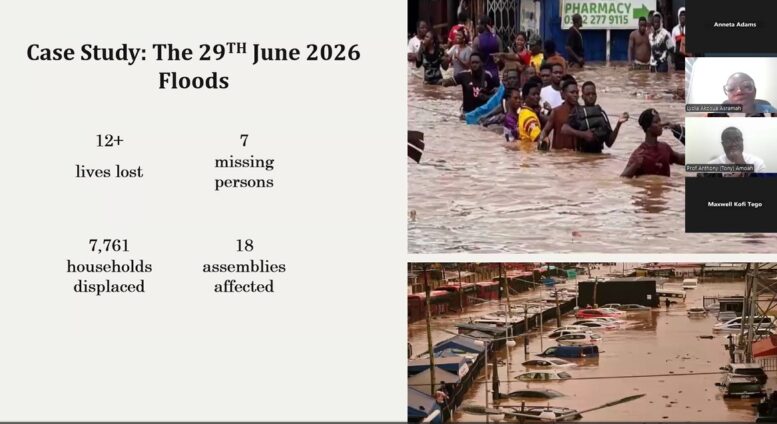
Using the June 29, 2026 floods in Accra as a case study, the institute said the disaster exposed weaknesses in drainage systems, land-use planning and disaster preparedness.
It said the floods led to major disruptions, including impassable roads, flooded homes and businesses, and interruptions to transport and commercial activities.
The institute reported that more than 12 people lost their lives, seven were missing, and 7,761 households were displaced across 18 affected assemblies following the incident.
Spear Institute identified climate change, rapid urbanisation and the destruction of natural flood-control systems such as wetlands as key factors worsening the impact and frequency of floods.
It noted that increasing population growth and unplanned development are placing additional pressure on vulnerable areas.
The research firm stressed that flooding is a complex challenge that cannot be addressed by one sector alone, requiring coordinated action across government, communities and private stakeholders.
On the social and economic dimensions of flooding, Spear Institute said poverty and inequality often increase exposure to flood risks.
It explained that some low-income households occupy flood-prone areas due to limited access to affordable and safer housing options.
The institute also warned that households and small businesses without insurance, savings or access to credit often struggle to recover after losing property, equipment and sources of income.
While identifying indiscriminate waste disposal as a contributor to blocked drains and waterways, the institute cautioned against placing the entire responsibility on citizens.
It called for stronger waste management systems, including reliable collection services, accessible disposal facilities, enforcement and sustained public education.
Spear Institute’s engineering and infrastructure team argued that Accra’s drainage systems must be reassessed and redesigned to reflect current population levels, urban expansion and changing rainfall patterns.
It said the city recorded about 169.23 millimetres of rainfall during the June 29 floods, a volume that exceeded the capacity of some existing drainage infrastructure.
The institute noted that several drains, culverts and bridges were constructed decades ago and no longer adequately serve today’s urban environment.
It also raised concerns about the narrowing of waterways, including the Koli Lagoon and Odora River, due to encroachment, land reclamation and waste disposal.
“When water loses its path, it creates another path,” one of the presenters said, highlighting the consequences of obstructed waterways.
The institute further called for improved waste management, arguing that investments in drainage infrastructure would have limited impact if drains remain clogged with waste.
Spear Institute also criticised weaknesses in project management, including inadequate attention to sustainability, quality control and stakeholder involvement.
It argued that infrastructure projects should not be judged only by whether they are completed on time and within budget.
Instead, projects must also be assessed on their ability to withstand future climate conditions and protect communities over time.
The research firm criticised Ghana’s largely reactive approach to flooding, citing emergency interventions such as relief funding and nationwide de-silting exercises as responses that come after disasters occur.
While acknowledging the importance of such interventions, Spear Institute said they do not address the underlying causes of flooding.
It is calling for greater investment in proactive measures, including improved urban planning, restoration of wetlands, sustainable drainage systems and stronger flood-resilience strategies.
The institute believes Ghana’s flood challenge requires an integrated national approach that combines engineering solutions with social protection, effective governance and better project management.
It said the goal should be to develop systems capable of withstanding changing environmental conditions rather than repeatedly responding after floods strike.
For Ghana, Spear Institute argues, the priority must now move from managing the aftermath of floods to preparing communities and cities before the next rainfall disaster occurs.
Latest Stories
-
Ballon d’Or Power Rankings: Lamine Yamal leads race for Golden Ball ahead of Rodri and Kane
58 minutes -
‘Nothing worked for us’ – Gideon Mensah takes responsibility for Gambia defeat
1 hour -
2026 Women’s Super Cup: FC Savannah beat Epiphany Warriors to win trophy for first time
3 hours -
AFCON 2027Q: ‘The last time Ghana won was eight games ago’ – Carlos Queiroz
3 hours -
AFCON 2027Q: Gambia defeat doesn’t make me a loser – Carlos Queiroz
3 hours -
2027 AFCONQ: Late goals seal 2-0 for Côte d’Ivoire against Somalia
3 hours -
AFCON 2027Q: My resignation won’t solve Ghana football issues – Queiroz
4 hours -
Morocco call off Ghana friendly after Black Stars’ AFCON setback
4 hours -
‘We have to say sorry’ – Queiroz apologises after Ghana’s humiliating defeat to Gambia
4 hours -
New Yorker identified as Yaw Boahene, 57, killed after bag was caught in subway train doors
4 hours -
Former American Idol contestant and pastor found guilty of murdering wife
4 hours -
Trump rules out joint US-China venture to develop AI
4 hours -
‘Beating Ghana did not surprise me’ – Gambia boss
4 hours -
OpenAI agents get rebrand – as ‘dots’ – while safety worries delay new model
4 hours -
US ban on Canadian alcohol and dairy takes effect as trade war drags on
5 hours