

Audio By Carbonatix
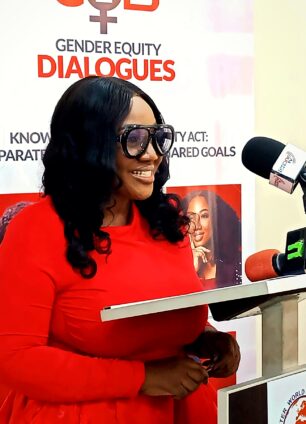
The Gender Equity Dialogues (GED) was officially launched on Friday, 11 September 2026, at Child Rights International in Accra, bringing together more than 30 participants.
The maiden edition of the planned biannual series was convened by gender advocate and media consultant Sangmorkie Tetteh.
It coincided with the second anniversary of the President’s assent to the Affirmative Action (Gender Equity) Act, 2024 (Act 1121).
Welcoming guests, Ms Tetteh described the initiative as a platform built on a simple premise: a law cannot work for the people it is meant to protect until they know it exists, understand its provisions, and know how to use it.
She linked her commitment to gender equity to her time as only the second female SRC President in her university’s history, when she was often treated as an exception rather than the norm.
The keynote address was delivered by Her Eminence Mrs Joana Adzoa Opare, a pioneer of the Affirmative Action Act and former Chairperson of the National Technical Committee on the Affirmative Action Bill.
Mercy Catherine Adjabeng, a communications and gender-and-development expert and Convenor of the Alliance for Women in Media Africa (AWMA), also spoke. She praised the Dialogues for deliberately bridging a generational gap in conversations on gender equality.
Speakers noted that Act 1121 followed more than two decades of advocacy and sets clear targets for women’s representation in decision-making positions — 30% by 2026, 35% by 2028, and 50% by 2034.
While the Gender Equity Committee has been constituted and a Legislative Instrument is being prepared, participants were told that implementation remains slow and underfunded.
They were urged to treat the law as a practical tool rather than a symbolic achievement. Section 28 of the Act, which criminalises intimidation, victimisation and gender-based hate speech against women, including online, was highlighted as one of its important protections.
Strategy consultant and lecturer Dr Tetteh linked the law’s potential to individual action. Drawing on the tendency of women in student politics to seek secretarial or deputy roles rather than the presidency, she told participants:
“What is wrong is not running at all — because if no woman contests, no woman can win, and the pattern simply repeats itself for another generation.”
She added that while women are well represented in gender studies research, they remain underrepresented in conversations on security and governance.
Deliberately positioning oneself in such spaces, rather than waiting to be invited, is what intentionality looks like in practice, she said.
The Dialogues were organised in partnership with the Affirmative Action Law Coalition and the Alliance for Women in Media Africa (AWMA), with support from Child Rights International. Dromi Investments Limited and Ace Insurance sponsored the inaugural edition.
The Ghana Journalists Association (GJA), led by President Albert Kwabena Dwumfour, and Women of Valor, led by Nana Aba Anamoah, endorsed the initiative.
Convenor Sangmorkie Tetteh said the Gender Equity Dialogues will continue as a recurring series, with the next editions planned for the coming year.
Latest Stories
-
Ghana’s Alice Banaaza spotlights fugu weaving at 2026 CHAN Festival in UK
14 minutes -
Russia’s Youth Festival could unlock business partnerships and scholarships for Ghanaian youth – John Aggrey
15 minutes -
The 21st Century Gold Standard was piloted in Ghana under Bawumia – Gideon Boako
18 minutes -
Ahafo NDC Vice Chairman pays nomination fees for 168 constituency executives ahead of 2026 internal reorganisation
19 minutes -
Upper West receives GH¢101.9m DACF for development projects
19 minutes -
Ghana must use gold to reduce overdependence on dollar – Gideon Boako
1 hour -
Refreshed PMP certification reflects evolving demands of project delivery and the skills employers need
1 hour -
Iran war reshapes Brics ties but also exposes divisions
2 hours -
Mahama to oversee handover of right-of-way clearance for Accra-Kumasi Expressway
2 hours -
Moroccan teenager joins 1,000 young people for IFY 2026 Children’s Programme in Russia
2 hours -
ISS cooperation offers lessons for resolving conflicts on earth – Russian cosmonaut
2 hours -
Laboma demolition: 48 Engineer Regiment denies claims of no prior notice
2 hours -
Photos: Young Africans join global delegates in Russia for 2026 IYF
2 hours -
100 young journalists lead coverage of International Festival of Youth in Russia
2 hours -
Business owners, residents pack up belongings amid demolition at Laboma
2 hours