

Audio By Carbonatix
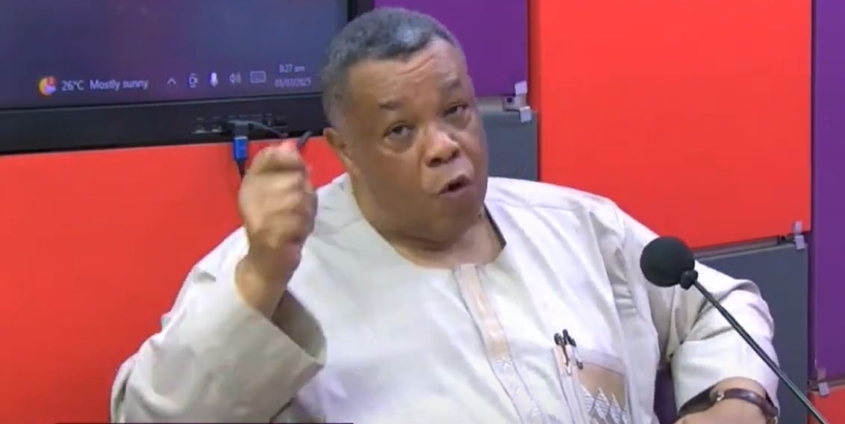
The Volta River will play a critical role in Ghana’s 'Grow 24' strategy under the broader 24-Hour Economy policy, according to Presidential Advisor on the 24-Hour Economy, Mr Goosie Tanoh.
Speaking on Joy FM’s Super Morning Show on Wednesday, July 3, Mr Tanoh said the river was chosen deliberately because of its potential to drive agricultural transformation and reduce the high cost of logistics in the country.
“If you look at the end product of most of our food, what you eat at your table or what goes to the factory as raw material or for export, about 60% of the cost is from logistics,” Mr Tanoh explained. “That's even more than the material you are basically transporting.”
He noted that globally, the average logistics cost as part of total production is around 15%, meaning Ghana is operating at a 45% disadvantage in efficiency.
“If we are able to improve the supply chain, we’re basically bringing down the cost of food, potentially reducing it by 45% just to reach the global average,” he added.
Mr Tanoh explained that using the Volta River for transport is not just environmentally friendly but also economically smarter.
Water transport, he said, has historically been the backbone of industrial and agricultural growth in many countries.
“Look at the Mississippi River, the Thames, the Danube, the Nile, and even the Congo, with all its challenges. Water transport supports both agriculture and industry because it offers power and connectivity,” he said.
According to Mr Tanoh, Ghana’s Volta River has a shoreline of about 3,283 miles, offering a vast natural transport corridor that can connect regions from north to south and east to west at a fraction of the cost of road transport.
“It costs one-eighth of what it takes to transport goods by road. One barge with a tugboat can carry 700 tonnes. To move the same amount from Accra to Tamale by road, you’d need about 15 trucks all emitting fossil fuels and worsening our carbon footprint as a country,” he explained.
He stressed that water transport through the Volta will not only lower logistics costs but also unlock access to fertile arable lands, creating opportunities for both commercial and smallholder farmers.
“We are building an organisational framework that supports large-scale farming but also integrates smallholders through a formalised crop system,” Mr Tanoh said.
Latest Stories
-
Trump administration seeks $200bn in military funding in wake of Iran war
17 minutes -
Precious International School and God Reigns Academy secure semifinal spots in 2026 Luv FM VitaMilk primary schools quiz
32 minutes -
Parliament ratifies Ghana–Barari DV lithium deal amid minority rejection
50 minutes -
Decency, modesty, and legality: National Chief Imam issues Eid-Al-Fitr 2026 guidance
1 hour -
No more extravagant funerals: Tema Traditional Council sets tough new rules
1 hour -
World Cup 2026: Litina Travels secures Sports Ministry endorsement to facilitate Ghanaian fan travel
1 hour -
Perform or be dissolved: Gov’t bans bonuses for loss-making SOEs
1 hour -
Photos: Mahama cuts sod for 24-hour economy market at Dormaa Ahenkro
2 hours -
Vera Couch partners with Opokua Ahwenee Foundation to donate food items to Awoshie orphanage
2 hours -
Mahama defends new SIM card registration
2 hours -
Tragedy at Effutu A.M.E Zion Girls: Final-year student killed in campus bee attack
2 hours -
DR Congo and Rwanda agree to ease tensions after talks in US
2 hours -
GCNM holds first induction by examination, urges shift towards specialist-led healthcare delivery
2 hours -
Government to interrogate Burkina Faso tomato export ban further – Dumelo
2 hours -
Lancaster University calls for reforms to Ghana School of Law admission system
2 hours