

Audio By Carbonatix
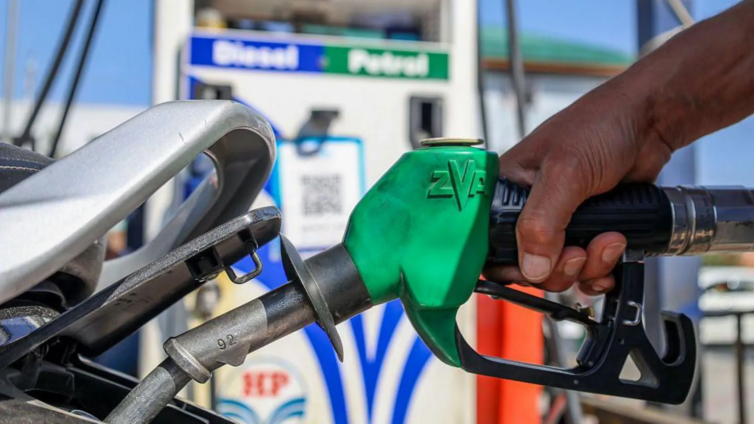
India's decision to increase the share of biofuels blended with petrol is facing ire from motorists who question its viability in a market where a majority of vehicles are not yet designed for it.
The world's largest two-wheeler market and third-largest car market is trying to reduce its dependence on imported oil and cut carbon emissions. It began blending ethanol - made from crops such as sugarcane and maize - into petrol in the mid-2000s and has steadily increased the proportion ever since.
Complaints intensified in April this year when India made E20 - petrol blended with 20% ethanol - the standard fuel at every pump, replacing the 10% blend that most vehicles are designed to use.
Although unblended petrol is still available, it is often 40-50% more expensive than E20, depending on the state, and many motorists are unaware they can ask for it.
Over the past few months, consumers have flooded social media with complaints of engine wear, lower fuel efficiency and reduced performance.
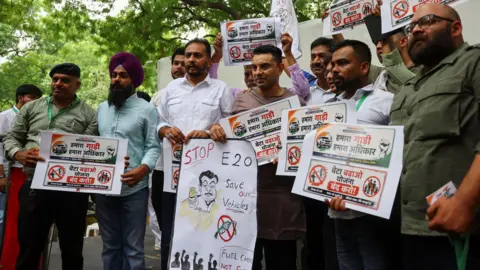
Last week, several motorists joined a protest in Delhi, organised by an entrepreneur who often backs the opposition Congress party in TV debates, accusing the government of unilaterally imposing E20 and leaving them with higher servicing costs and little choice at fuel stations.
Prime Minister Narendra Modi's government has dismissed the complaints as "misleading" and "social media misinformation".
In a statement last month, the government said the fuel was rolled out after extensive testing and does not damage engines. It has also issued statements on the benefits of E20 and to bust what it called the "more colourful myths that have circulated on social media".
The government has also enlisted experts and automakers to defend E20.
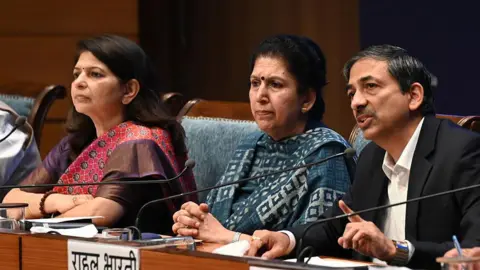
Last weekend, in an unusual show of unity, six automakers joined a government press conference to say that years of testing and service data showed no evidence of widespread vehicle damage from the mandatory 20% ethanol blend.
Rahul Bharti, senior executive officer for corporate affairs at Maruti Suzuki, said that India's largest carmaker had serviced more than 15 million older vehicles that were not E20-compliant but found no fuel-related faults.
The automakers admitted that using E20 led to a 3-3.5% drop in fuel efficiency due to ethanol's lower energy content. Some estimates, however, say the actual drop in efficiency could be higher, between 4-12%.
From a broader perspective, the government's biofuel push aims to cut India's oil import bill, support farmers and reduce emissions, as ethanol burns cleaner than petrol and is produced domestically from crops such as sugarcane and maize.
Government data suggests it has largely delivered on those goals.
India imports most of the crude oil it consumes, and the disruption to global oil markets during the Iran conflict has strengthened the case for producing more fuel at home. Other oil-importing Asian countries, including Indonesia and Vietnam, are also accelerating plans to expand ethanol-blended and flex-fuel programmes.
Brazil, the model Indian officials often cite, built its ethanol-ready vehicle fleet gradually over four decades before mandating higher blends. Consumers there can choose between E27 petrol and 100% ethanol, with pump prices often making ethanol the cheaper option.
India compressed a similar transition into just three years, moving from 10% ethanol in 2022 to a mandatory 20% blend by 2025 - five years ahead of schedule. Critics say it skipped the step every other major market took first: giving vehicles time to adapt before raising ethanol levels.
More than 75% of vehicles on Indian streets are not E20 compliant, said Puneet Gupta, director of auto research firm Mobility Global. An analysis by Thomson Reuters Foundation last year came to a similar conclusion, finding that only some 20% of new petrol vehicles sold in past 15 years were E20-compliant.
The rapid transition has fuelled concerns, especially among owners of pre-2023 vehicles designed for lower ethanol blends, who fear engine corrosion and reduced performance.
Complaints have mounted in recent months, with protesters at last week's Delhi demonstration describing problems they said emerged after using E20.
The BBC spoke to several car and two-wheeler service centres and mechanics in Mumbai. While some said they had seen no issues so far, others reported cases they believed were linked to the higher ethanol blend.
Mohammed Arif, who repairs motorcycle engines at a workshop, said he has serviced several older bikes over the past year for fuel residue build-up in carburettors, which he attributes to the higher ethanol content.
The deposits reduce performance and require more frequent cleaning, he said, increasing servicing costs for customers.
Basil Jacob, who runs a car servicing centre, said customers are reporting lower fuel efficiency, forcing them to fill up more often. Although ethanol is cheaper to produce, those savings have not been passed on at the pump, with E20 retailing at the same price as before.
"They're paying the same per litre but getting fewer kilometres," he said.
Some experts say potential risks may not show up immediately, but after months of E20 use - in the form of accelerated wear and tear of components.
"It will be a slow-burn impact. There could be corrosion in fuel delivery systems after 10,000-20,000 km of use. But if you maintain your car well, there may not be a problem," Hormazd Sorabjee, editor of Autocar India, told the BBC, adding that some social media concerns are overblown.
Ethanol attracts moisture, which can separate from the fuel over time and cause corrosion, he said.
It can also loosen old engine deposits, sometimes clogging fuel pumps and injectors. The result could be faster wear, more frequent servicing and additional part replacements, although Sorabjee said the long-term costs are unlikely to be significant.
A survey done by online community platform LocalCircles of more than 44,000 people who bought petrol vehicles before 2023 found a jump in those who reported "an unusual increase in wear and tear or need for repairs".
But no scientific studies are publicly available to support either the claims of damage or the government's and automakers' assurances that extensive testing found none. That evidence gap is fuelling the confusion.
"If you're going to force this on the public, you should be able to prove it's safe," said a senior industry expert who spoke on condition of anonymity.
What's most certain is the loss in fuel efficiency, so the fuel should have been cheaper and optional, he added.
The issue is further complicated by uncertainty over warranties and insurance. It remains unclear whether fuel-related faults in vehicles not designed for E20 would be covered.
Gupta questions whether automakers that have publicly backed E20 would honour warranty claims if fuel pumps or fuel lines fail after prolonged use of the blend.
The confusion deepened last month when private insurer ICICI Lombard first suggested in a blog post that using E20 in non-compliant vehicles could amount to "negligence" and lead to claim rejection.
It later reversed its position, saying motor policies "remain fully valid" with E20 use. Even so, experts note that motor insurance typically covers accidental damage, not wear and tear caused by fuel.
It's a big question for those who own vehicles in India, a highly cost-sensitive market.
Latest Stories
-
Mr President, Ghana was mentioned at the UN; why aren’t we talking about it?
2 hours -
Accra to convene Africa’s regulators and markets on tokenisation at AVAS 2026
2 hours -
The Paradox of Plenty — When every smartphone becomes a newsroom
2 hours -
GTA sensitises taxi drivers in ‘Know Ghana’ tourism campaign
4 hours -
Archbishop Agyinasare calls for responsible speech amid growing social media abuse
4 hours -
‘It will be inexcusable for gov’t not to honour payment of teachers’ arrears by 30th October’ – Haruna Iddrisu
4 hours -
Forbes’ World’s Best Employers 2026: No Ghanaian firm ranked among 900 companies
4 hours -
Electronic processing of teachers’ data: ‘The decision is the Controller’s’ – GES boss
4 hours -
Teachers’ Strike: Haruna Iddrisu questions paper-based processing of promoted teachers’ data
4 hours -
Savannah Region: Kunfusi bridge collapses again, leaving nearly 4,000 residents cut off
4 hours -
Teachers’ strike: GES targets Monday deadline to submit promotion data to Controller
4 hours -
Inflation to average 11.3% in 2027 – Fitch Solutions
5 hours -
‘I didn’t campaign for NDC to come and do this nonsense’ – Kpebu on EOCO’s conduct
5 hours -
Fitch Solutions maintains policy rate forecast of 14% by December 2026
5 hours -
Diaspora Nasara Caucus congratulates Mohammed Ali Suraj, new NPP executives
6 hours