

Audio By Carbonatix
People found guilty over a deadly rail accident in eastern India will be "punished stringently", the country's Prime Minister Narendra Modi has said.
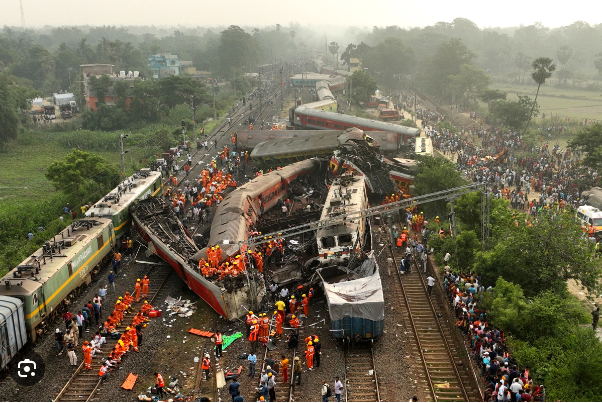
At least 288 people were killed and more than 800 injured in Friday's incident in Odisha state, involving two passenger trains and a goods train.
Rescue efforts have concluded, with officials saying all trapped and injured passengers have been retrieved.
Mr Modi has visited the scene, labelling the incident a "painful" one.
He also met victims of the disaster in hospital, and vowed that his government would leave "no stone unturned for the treatment of those injured".
It is still not clear what caused the multi-train collision in Balasore district, which has been described as India's worst rail accident this century.
A full investigation has been launched, but a preliminary report indicates that the accident was the result of signal failure, said KS Anand, chief public relations officer of the South Eastern Railway.
Some 2,000 passengers are thought to have been on board the two passenger trains involved.
The exact sequence of events has been the subject of conflicting accounts.
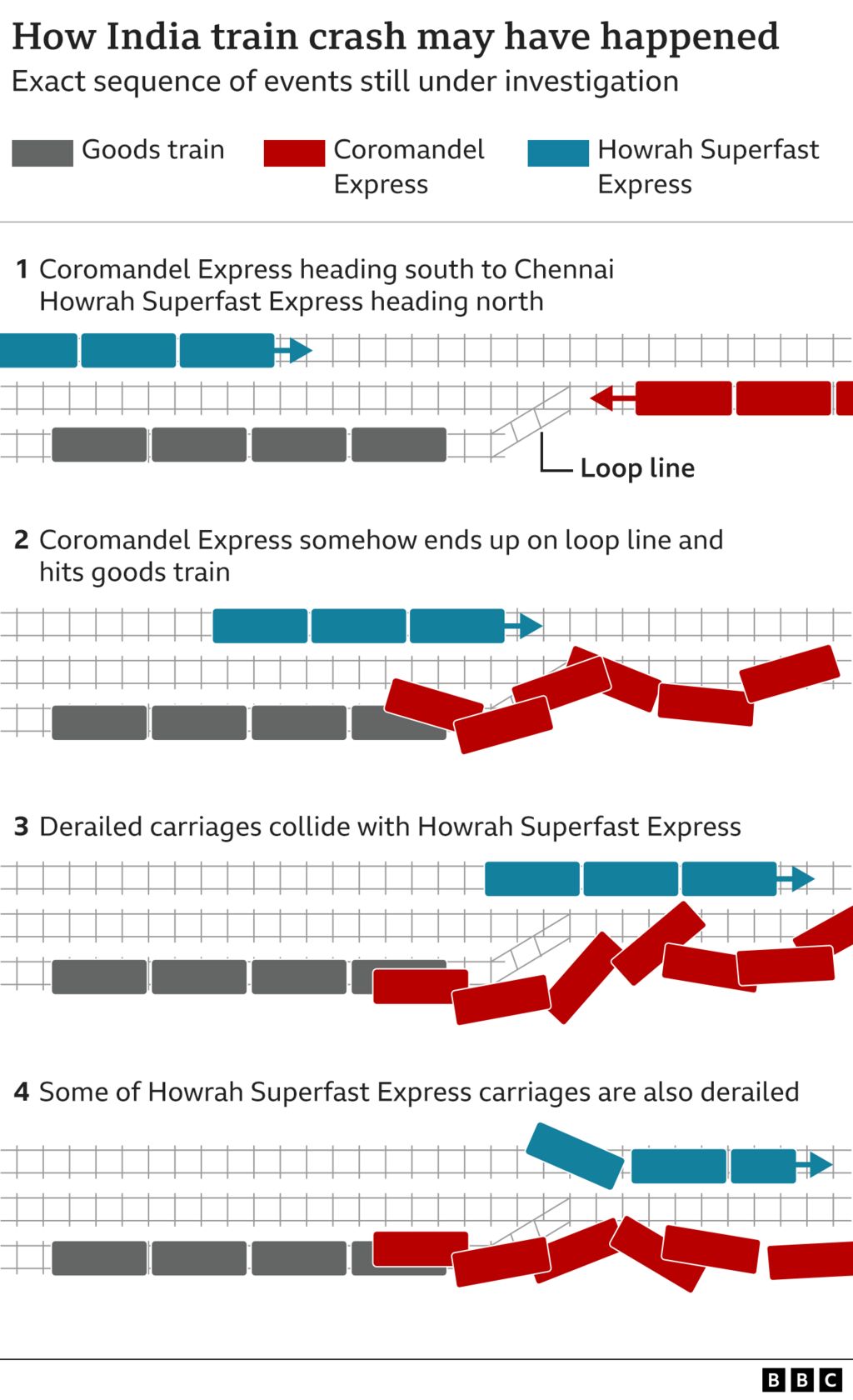
Officials say several carriages from the Coromandel Express, travelling between Kolkata (formerly Calcutta) and Chennai (formerly Madras), derailed at about 19:00 (13:30 GMT) after hitting a stationary goods train. It remains unclear how the Express ended up on the same track as the goods train.
Several of the Coromandel Express's coaches then ended up on the opposite track. Another train travelling in the opposite direction - the Howrah Superfast Express travelling from Yesvantpur to Howrah - collided with derailed carriages.
"The Coromandel Express was supposed to travel on the main line, but a signal was given for the loop line instead, and the train rammed into a goods train already parked over there," Mr Anand said.
"Its coaches then fell on to the tracks on either side, also derailing the Howrah Superfast Express," he said.
Sounds of ambulance sirens have been going off every 30 minutes outside the trauma centre in the SCB hospital in the city of Cuttack - where critically injured passengers have been wheeled in.
So far, close to 200 passengers from the train accident site have been brought in, and the numbers continue to rise.
The hospital is the largest in the state of Odisha, but is still three hours' drive from the accident site.
The hospital staff - from junior doctors to nurses and ward boys - have been lined up and waiting in groups to assist patients as they are brought in. Wards have been expanded to handle the numbers coming in.
The constant sounds of whistles and announcements by hospital authorities interrupt the chaos.
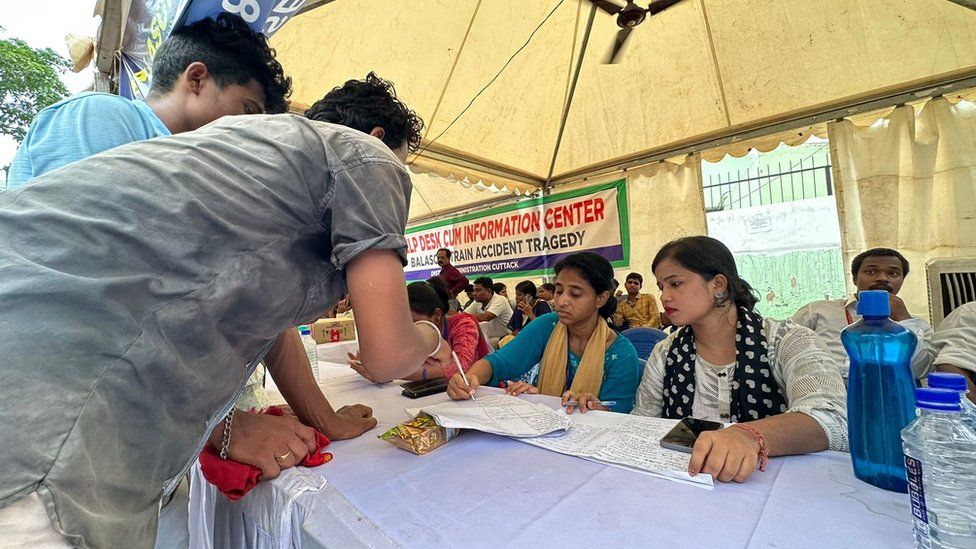
Family members of the injured are waiting anxiously outside praying for their relatives' wellbeing. But many are still looking for their loved ones, not knowing their whereabouts.
There is a counter set up to assist people who cannot locate their family members. It is crowded, and the lists run long.
Some people met by the BBC ran from the accident site to nearby hospitals before coming to the facility in Cuttack - searching for their families who were on board the trains.
Announcing the conclusion of rescue efforts on Saturday, the railway ministry said work to restore the crash site had begun.
Survivors and eyewitnesses earlier described chaotic scenes and the heroic efforts of people from nearby villages to save trapped passengers.
Mukesh Pandit, who was trapped for half an hour before being rescued, told the BBC he heard a "thunderous sound" shortly before the carriage overturned.
"Four passengers who were travelling from my village have survived, but a lot of people are injured or still missing. A lot of people died in the coach I was travelling in," he added.
Residents of the neighbouring villages were among the first to reach the site of the accident and start the rescue operation.
India has one of the largest train networks in the world with millions of passengers using it daily, but a lot of the railway infrastructure needs improving.
Trains can get very packed at this time of year, with a growing number of people travelling during school holidays.
Both passenger trains involved in the crash were full and had many more people on the waiting list, according to passenger lists on the Indian rail ministry website reviewed by the BBC.
India's worst train disaster was in 1981, when an overcrowded passenger train was blown off the tracks and into a river during a cyclone in Bihar state, killing about 800 people.
Latest Stories
-
Credit Risk Management Directive: BoG to begin implementation for banks, others from July 1, 2027
5 minutes -
Ghana Brands Awards 2026: Leading brands, business trailblazers to shine on November 20
21 minutes -
T-bills auction: Demand improves as government exceeds target by about 76%; interest rates soften
27 minutes -
Ziope undertakes initiative to build a technologically inclined community, commissions self-help ICT lab
52 minutes -
ECG announces power outage in parts of Tema, Central Region due to network fault, maintenance
1 hour -
When the Gospel Becomes a Weapon: The church, blackmail and the abuse of faith
2 hours -
JoyNews’ Jacqueline Ansomah Yeboah selected for UK Media Excellence for Emerging Technology Fellowship
2 hours -
Mental Health Alliance urges government to operationalise Mental Health Fund
2 hours -
Ghana–Holy See agreement heads to Parliament after Cabinet approval
2 hours -
Luv FM Corporate Games 2026: Kumasi Central Prisons, Amanfiman Bank win big amid fun
3 hours -
WAFU B U17: Ghana top Group A after win over Togo
3 hours -
Ho Central Mosque reopens amid unresolved leadership dispute that led to closure
4 hours -
Minority caucus questions GH¢16.4m in Ablakwa’s SA evacuation spending, demands independent audit
4 hours -
Gender Ministry meets Nana Akua Addo’s husband over domestic violence after hospital discharge
5 hours -
UG Vice-Chancellor urges swift operationalisation of National Research Fund
6 hours