

Audio By Carbonatix
A lecturer at Duke University, Professor Felwine Sarr, has called on the governments on the continent to invest in knowledge and innovation production within the education system as a crucial solution to address the social and economic challenges facing Africa.
The Senegalese writer and academician emphasized that many African governments tend to focus more on resolving immediate social and economic issues rather than prioritising long-term investments in knowledge production.

He highlighted the significance of such investment, stating that it would contribute to generating more intellectuals from tertiary institutions who could devise effective measures to tackle economic and social problems.
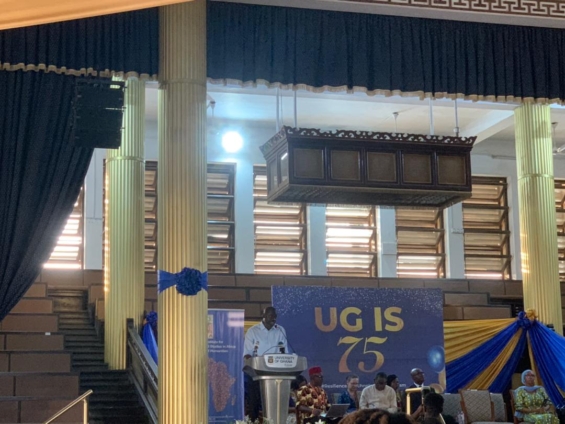
Speaking at the Anton Wilhelm Arno Lecture organised by the Department of Philosophy and Classics at the University of Ghana, Professor Felwine Sarr urged African leaders to recognise the importance of investing in knowledge production.
"The government has an important role to play in the pluralism of African knowledge. Africa has a lot of challenges, including education, health, and others, so most of the time they think that investing in knowledge is not urgent, so they respond to the needs, and knowledge comes later. It's a mistake because the investment in knowledge will allow them to respond to the needs appropriately," he said on Tuesday.

Prof Sarr further stressed that knowledge, particularly in areas such as innovation, technology, and material forms of knowledge, forms the foundation of economies.
He also highlighted the need for a broad understanding of knowledge, extending beyond traditional university and scientific domains.
He said, "They must know that the spheres of knowledge are the most important ones because economies are based on knowledge, innovation, technology, and material forms of knowledge. Also, the knowledge they have to consider should be wider than those in the universities and sciences. For instance, there is an ecological crisis that requires knowledge to adapt and respond to the African farmers and agriculture."
The lecturer also urged stakeholders in the education sector to integrate African knowledge across various domains into the curriculum of educational institutions.
"There is a lot of knowledge in different domains, which is psychological, environmental, and techniques that Africa has produced, and we need to put this knowledge in the curriculum, in courses like Maths, Sciences, humanities, and social science courses."
Latest Stories
-
Nigerian Goodnews Aina crowned J30 Accra champion as Ghana’s Gwendolyn Duvor Klu retires in final
43 minutes -
WACCE urges gov’t to declare state of emergency in galamsey-prone areas
1 hour -
NACOC boss calls for practical cross-border action against drug trafficking
2 hours -
Ghana calls for stronger regional cooperation to combat drug trafficking
2 hours -
Ablakwa presents bicycles to 100 North Tongu day students
2 hours -
Ablakwa supports 2,269 North Tongu SHS students with essential items
2 hours -
Dr Bawumia expresses sympathy with farmers over their inability to sell their produce even at reduced prices
2 hours -
Constitutional review: Govt must keep discussions open – Dr Tandoh
2 hours -
GPL 2026/27: David Gyamfi hat-trick fires Ashantigold to historic first victory
2 hours -
Ericsson celebrates 150 years of global innovation, 30 years of partnership and digital transformation in Ghana
3 hours -
Ghana’s Ambassador to Serbia hosts African ambassadors’ September meeting in Belgrade
3 hours -
Ghana closer to terrorism threat than ever before – WACCE
3 hours -
Gov’t must focus on quality everywhere, not categorisation of public schools – Ben Boakye
4 hours -
Tanko Computer backs comprehensive review of 1992 Constitution
4 hours -
2026 SHS placement crisis was caused by changes to established model – Former Dept. GES Director
4 hours