

Audio By Carbonatix
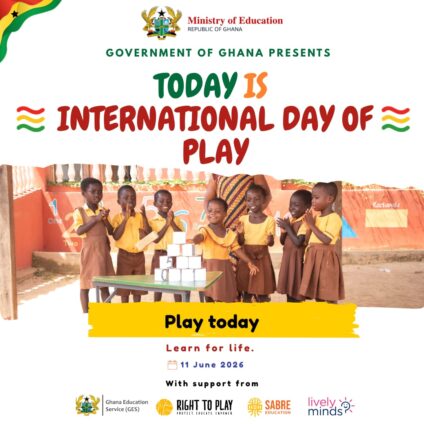
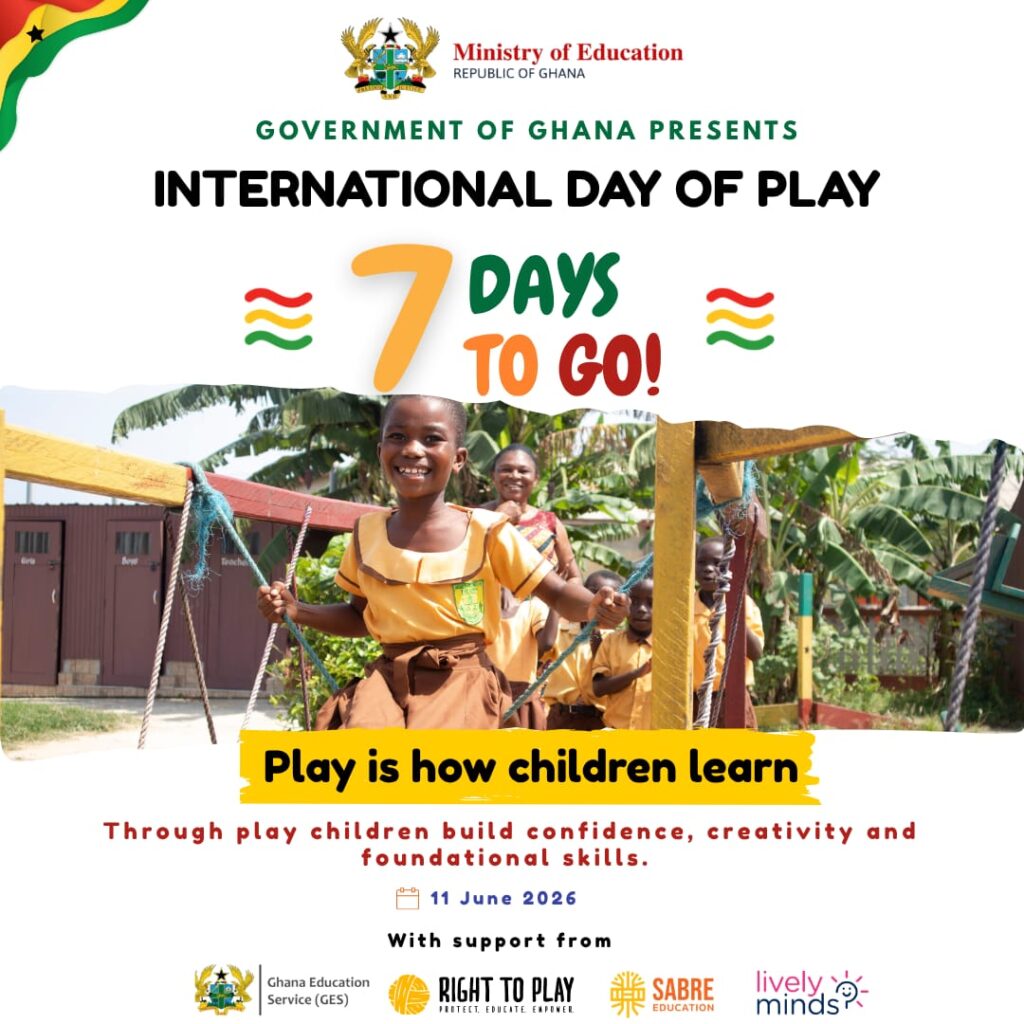
The Ministry of Education, Ghana, together with development partners Sabre Education, Lively Minds, and Right to Play, has reaffirmed its commitment to strengthening early childhood education through play-based learning as the country marks the International Day of Play on June 11.
In a joint statement, the partners emphasised that play is not separate from learning, but a core part of how young children develop foundational skills in their early years.
According to the Ministry, Ghana is currently scaling up Play-Based Learning (PBL) across all public kindergartens nationwide to improve teaching and learning outcomes at the early childhood level.
Play-Based Learning allows children to learn through exploration, storytelling, games, movement, creativity, and interaction, rather than rote memorisation. The approach is designed to help children actively develop key competencies such as early literacy, numeracy, communication, creativity, and problem-solving skills.
The Ministry noted that research consistently shows that play-based approaches improve both academic performance and overall child development, while also building confidence, curiosity, resilience, and teamwork skills.
It stressed that early childhood development remains a national priority, given that brain development is most rapid during the early years, making quality early education critical for long-term learning success.
As part of the national rollout, Ghana is training approximately 30,000 kindergarten teachers to deliver play-based lessons in line with the national curriculum. The initiative is expected to ensure that all children, regardless of location, have access to engaging and inclusive learning environments.
The Ministry is also expanding a parental engagement model aimed at strengthening learning at home. It highlighted that parents and caregivers play a key role in early learning through simple daily activities such as storytelling, singing, counting objects, drawing, and conversation.
Officials say these activities help improve children’s language development, confidence, and school readiness, and reinforce classroom learning in a practical and accessible way.
The statement further called on parents and communities to support schools by actively engaging with teachers, attending PTA meetings, and reinforcing play-based learning at home.
Communities were also encouraged to support schools with low-cost or no-cost learning materials such as bottle tops, cardboard, fabric, sticks, clay, containers, and simple furniture, which can be used to enhance interactive learning in classrooms.
The Ministry of Education said the successful implementation of early childhood education reforms requires collaboration between government, schools, parents, and communities.
It reaffirmed its commitment to ensuring that every child in Ghana receives a strong educational foundation through joyful, inclusive, and play-based learning.
On the International Day of Play, Ghana joins global partners in celebrating efforts to embed play at the heart of early childhood education and to ensure every child gets the strongest possible start in life.
Latest Stories
-
“US Embassy introduced TRIBE Culture Fest to NSA, GTA” – Kofi Adams
36 minutes -
“NSA did not tell us of any embassy arrangement” – Kofi Adams
1 hour -
Glasner suffers loss on Selhurst return as Palace beat Forest
3 hours -
WAFU B U17: ‘We won but I expected more from my boys’ – Kassim Ocansey
3 hours -
Man City cruise to statement win over 10-man Liverpool
3 hours -
Be careful with cross-border lending, foreign currency exposures – BoG to financial institutions
5 hours -
GPL 2026/27: Medeama go three clear as Hearts of Oak recover and Bechem stage stunning comeback
5 hours -
Ntiamoah Foundation launches “BEYOND 20” anniversary campaign
6 hours -
Credit Risk Management Directive: BoG to begin implementation for banks, others from July 1, 2027
6 hours -
Ghana Brands Awards 2026: Leading brands, business trailblazers to shine on November 20
6 hours -
T-bills auction: Demand improves as government exceeds target by about 76%; interest rates soften
6 hours -
Ziope undertakes initiative to build a technologically inclined community, commissions self-help ICT lab
7 hours -
ECG announces power outage in parts of Tema, Central Region due to network fault, maintenance
7 hours -
When the Gospel Becomes a Weapon: The church, blackmail and the abuse of faith
8 hours -
JoyNews’ Jacqueline Ansomah Yeboah selected for UK Media Excellence for Emerging Technologies Fellowship
8 hours