

Audio By Carbonatix
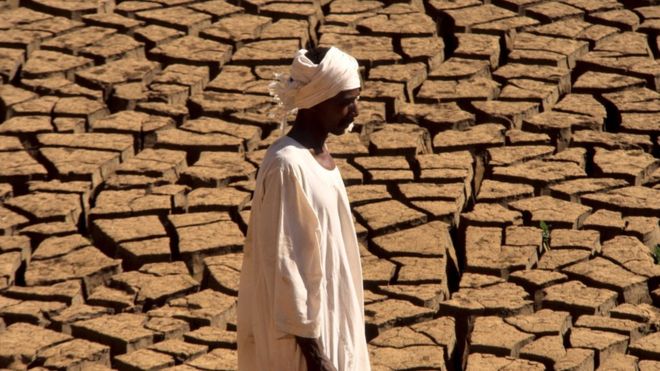
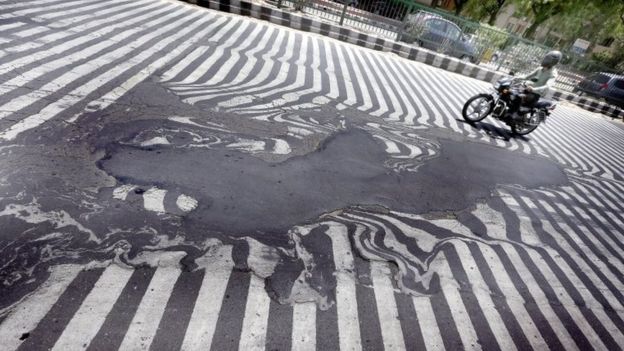
More than three billion people will be living in places with "near un-liveable" temperatures by 2070, according to a new study.
Unless greenhouse gas emissions fall, large numbers of people will experience average temperatures hotter than 29C.
This is considered outside the climate "niche" in which humans have thrived for the past 6,000 years.
Co-author of the study Tim Lenton told the BBC: "The study hopefully puts climate change in a more human terms".
Researchers used data from United Nations population projections and a 3C warming scenario based on the expected global rise in temperature. A UN report found that even with countries keeping to the Paris climate agreement, the world was on course for a 3C rise.
According to the study, human populations are concentrated into narrow climate bands with most people residing in places where the average temperature is about 11-15C. A smaller number of people live in areas with an average temperature of 20-25C.
People have mostly lived in these climate conditions for thousands of years.
However should, global warming cause temperatures to rise by three degrees, a vast number of people are going to be living in temperatures considered outside the "climate niche".
Mr Lenton, climate specialist and director of the global Systems Institute at the University of Exeter, conducted the study with scientists from China, the US and Europe.
He told the BBC: "The land warms up faster than the ocean so the land is warming more than three degrees. Population growth is projected to be in already hot places, mostly sub-Saharan Africa, so that shifts the average person to a hotter temperature.
"It's shifting the whole distribution of people to hotter places which themselves are getting hotter and that's why we find the average person on the planet is living in about 7C warmer conditions in the 3C warmer world."
Areas projected to be affected include northern Australia, India, Africa, South America and parts of the Middle East.
The study raises concerns about those in poorer areas who will be unable to shelter from the heat.
"For me, the study is not about the rich who can just get inside an air-conditioned building and insulate themselves from anything. We have to be concerned with those who don't have the means to isolate themselves from the weather and the climate around them," Mr Lenton said.
Mr Lenton says the main message from the team's findings is that "limiting climate change could have huge benefits in terms of reducing the number of people projected to fall outside of the climate niche.
"It's about roughly a billion people for each degree of warming beyond the present. So for every degree of warming, we could be saving a huge amount of change in people's livelihoods."
Latest Stories
-
AGI commends government’s move to resolve the power crisis in Volta and Oti Regions
26 minutes -
IBAG president alleges political interference driving kickbacks in insurance sector
1 hour -
Trump agrees to two-week ceasefire, Iran says safe passage through Hormuz possible
1 hour -
Dozens killed as Angola flood death toll rises
2 hours -
Russia confirms deaths of 16 Cameroonians fighting in Ukraine war, Yaounde says
2 hours -
Plan to scrap presidential elections puts Zimbabweans at loggerheads
2 hours -
Guinea-Bissau transporters strike over higher fuel prices
2 hours -
Iran ceasefire deal a partial win for Trump – but at a high cost
2 hours -
Oil slides below $100 after Trump announces two-week ceasefire
2 hours -
Madagascar declares state of emergency over energy situation due to Iran war
3 hours -
Ex-Meta worker investigated for downloading 30,000 private Facebook photos
3 hours -
World Bank says Nigerian economy to grow in 2026 but Iran war lifts inflation
3 hours -
Ringleader of suspected human trafficking network arrested in Ethiopia
3 hours -
Alexander-Arnold fails to ease Tuchel concerns as Kane stars
3 hours -
Amad backs Carrick for Manchester United job
3 hours