


Audio By Carbonatix
Asylum seekers must not be subjected to psychological tests to determine whether they are homosexual, EU's top court has ruled.
Tests to determine sexual orientation are controversial, but are sometimes used when assessing asylum claims.
The European Court of Justice (ECJ) ruling is binding in all 28 EU states.
The ECJ case relates to a Nigerian man who submitted an asylum application in Hungary in April 2015. He feared persecution in Nigeria for being gay.
Hundreds of homosexuals fearing persecution in Africa, the Middle East and Chechnya have sought asylum in the EU, the EU Agency for Fundamental Rights reports.
The Nigerian's claim was rejected after a psychologist's report failed to confirm his homosexuality.
A court in Szeged, Hungary, must now reconsider his case in light of the ECJ ruling.
What about similar gay rights cases?
In December 2014 the ECJ ruled on a similar case in the Netherlands and found that sexuality tests violated asylum seekers' human rights.
In the new ruling, the ECJ said "certain forms of expert reports may prove useful" in such cases, but added that such reports interfered with a person's privacy. Authorities must also determine the reliability of a claimant's statements, the judges said.
In 2013 the ECJ ruled that asylum could be granted in cases where people were actually jailed for homosexuality in their home country.
Homosexual acts are illegal in most African countries, including key Western allies such as Uganda, Nigeria, Kenya and Botswana.
What happens next in this case?
The Hungarian court cannot appeal against the ECJ ruling, so the Nigerian man - identified only as "F" - now has a stronger claim for asylum.
The ruling means that EU countries now have no legal right to impose psychological tests to determine an asylum seeker's sexuality.
What did Hungary originally decide?
The ECJ says Hungarian officials had not found F's statements to be fundamentally contradictory, but had still concluded that F lacked credibility.
Their decision was based on a psychologist's report, which included:
- An exploratory examination
- An examination of personality
- Personality tests (Draw-A-Person-In-The-Rain, Rorschach and Szondi tests)
The report "concluded that it was not possible to confirm F's assertion relating to his sexual orientation".
Psychologists have long held that personality traits can be revealed by tests such as "draw a person in the rain" and the Rorschach test, which relies on an individual's interpretation of inkblots.
What sort of tests were at issue here?
They were quite general psychological tests, aimed at identifying F's personality type and emotional characteristics.
F said the tests had violated his fundamental rights and they had not provided any assessment of "the plausibility of his sexual orientation", the ECJ said.
It also said any indication of sexual orientation provided by such tests could only be "approximate in nature". They were "of only limited interest for the purpose of assessing the statements of an applicant for international protection".
In 2010 the EU's Fundamental Rights Agency condemned the Czech authorities for using "phallometric" sexual arousal tests on some asylum seekers to determine whether they were gay. Czech officials said the tests had been used in fewer than 10 cases, with the individuals' consent.
The Hungarian court handling F's case quoted him as saying that he had not undergone any physical examination and had not been required to view pornographic photographs or videos.
Is Hungary a special case?
No - other EU countries also conduct psychological tests on asylum seekers, to assess whether their statements can be believed.
The UK Home Office has detailed guidance on asylum claims based on sexual orientation.
The gay rights group ILGA-Europe says there is a huge diversity in the EU in the way asylum authorities assess someone's sexual orientation.
In F's case tests were imposed on him - unlike the Dutch asylum case of 2014, when several Africans offered evidence of their homosexuality.
In the Dutch case, the ECJ ruled that it was wrong to conduct "detailed questioning as to the sexual practices of an applicant for asylum".
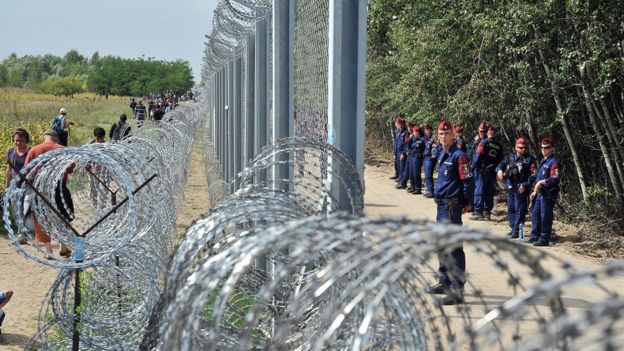
F's asylum claim in 2015 came during a migrant crisis for Hungary. The country faced a huge influx of migrants - many of them Syrians, Iraqis and Afghans fleeing war. Most of them moved to Germany, via Austria, and Hungary then built a formidable border fence to keep migrants out.
Latest Stories
-
David Beckles claims second J60 Accra title
7 minutes -
No France cocaine suspect linked to Mahama, Vice President’s security details – NACOC
14 minutes -
Anwelle Foundation launched in Jirapa to tackle poverty, youth unemployment
35 minutes -
Joy Sports Editor Fentuo Tahiru Fentuo to moderate inaugural Music Meets Football Summit in Zambia
40 minutes -
Court premises too volatile for Baffour Awuah’s attempted arrest by EOCO – Inusah Fuseini
47 minutes -
Drug bust: Under no circumstances will NACOC leadership be compromised – Twum-Barimah
48 minutes -
VIDEO: EOCO’s attempted arrest of Baffour Awuah was flawed beyond saving – Law Lecturer
48 minutes -
Genuine Ghanaian exporters may face heightened foreign inspections over drug busts – Lawyer
48 minutes -
Stakeholders demand action against foreign-led illegal mining in Ahafo Region
2 hours -
Ghana handed tricky draw at 2026 Amputee World Cup
3 hours -
2024 Nyankpala election violence: Youth group petitions authorities over slow probe
3 hours -
Ghana, UNICEF strengthen partnership to advance child protection
3 hours -
Day Two of 3rd Republic Bank-JoyNews Habitat Fair ends with great homeownership offers and financing solutions
3 hours -
Guinness Ghana DJ Awards 2026 Pub Fest celebrates Ghana’s DJ culture as Accra turns up the energy
3 hours -
10th woman found dead in South Africa’s string of killings
3 hours