

Audio By Carbonatix
When Ghana was gripped by the “no-bed syndrome” crisis in 2018, the nation’s healthcare system stood at a crossroads. Hospitals were overcrowded, patients were being turned away, and despair filled the headlines.
One story in particular, 70-year-old Prince Anthony Opoku Acheampong, who died in his car after 7 hospitals turned him away over claims that there were no beds, captured national attention. Many citizens were irate that, in the midst of this, the newly constructed University of Ghana Medical Centre still stood empty and unused. There were protests and demonstrations over the non-operation of the hospital.
Government had to act quickly; there was a need to find a capable leader to operationalise the hospital. One name that quietly emerged behind the scenes, Dr. Darius Kofi Osei, a medical doctor and hospital manager known more for results than for rhetoric.
He had established a track record as an astute hospital manager. At Kwahu Government Hospital in Atibie, where he had his first post as a medical doctor, he rose to become Medical Superintendent at a young age and turned a struggling rural facility into one of the most efficient hospitals in the Eastern Region.
Before his tenure, the hospital had become notorious for high maternal mortality, low attendance, poor staff morale, bushy surroundings and generally poor public perception. Many doctors did not want to be posted there. Through his leadership, the facility turned around and was awarded the best hospital in the Eastern Region. Many leading hospitals, such as Korle Bu, Komfo Anokye, and Trust Hospital, came for study tours to observe the transformation that had taken place.
After his resounding success at Atibie, he was posted to Interbeton, officially known as the Central Regional Hospital, at Cape Coast. Again, he went to work and leveraged management principles, a knack for data analysis and systems thinking, and built the hospital into a top-notch institution that raised both service quality and staff morale. Perhaps, what had become his most remarkable accomplishment at the time was the hiving off, restructuring and rebranding of the SSNIT Hospital to Trust Hospitals.
In July 2006, Dr. Osei was appointed General Manager of the medical arm of SSNIT to take over leadership of the SSNIT Hospital. He met an institution that was in disarray, struggling financially and constantly seeking support from the mother organization. He professionalised operations, improved governance structures, modernised management systems, and turned around the financial position of the hospital so that it became independent of SSNIT.
He presented a new business plan that led to the rebranding of the hospital and the eventual establishment of satellite clinics in various locations under the Trust Clinic brand. By the end of his tenure, he had successfully positioned the hospital as one of the most respected private healthcare providers in the country.
It was this achiever who was appointed as the founding CEO to operationalise the University of Ghana Medical Centre (UGMC). When he took office as Interim CEO in July 2018, the facility had no operational budget. Not a cedi had been allocated to start operations.
The government, straining under immense political pressure, had put him at the helm with no budget, no staff, no equipment, just empty buildings. But within months, systems began to take shape. Recruitment was done transparently, departments were structured, and governance frameworks were built from the ground up.
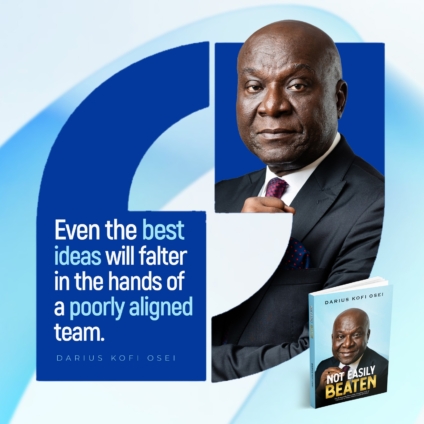
Under Dr. Osei’s leadership, UGMC became a hub of medical excellence, blending clinical care, training, and research. When the COVID-19 pandemic struck, the hospital played a crucial national role as a treatment and research center. Its “Covid Connect” telemedicine platform allowed patients to consult doctors remotely, demonstrating how technology and preparedness can save lives. This amazing story of a lifetime of achievement, leadership and transformation has been documented in his upcoming memoir titled Not Easily Beaten.
In it, Dr. Osei describes the exciting highs and lows of his life and the remarkable impact he has had on the institutions he has led. He details the processes and approaches he used in leading and transforming some of Ghana’s leading medical institutions.
“Leadership,” he writes, “is not about comfort. It is about staying calm in the storm and finding solutions when others see impossibilities.” It’s a book not only for medical doctors or hospital managers, but for every person who desires a life of leadership, impact or transformation. Its lessons will spur you on to dream and design a compelling future for yourself. No challenge is too great, and no system too broken to be rebuilt.
Latest Stories
-
Tyson Fury dominates Makhmudov, calls out Joshua next
17 minutes -
I have supported highway authority financially to fix roads in my constituency – A Plus
1 hour -
US, Iran fail to reach peace agreement after marathon talks in Pakistan
2 hours -
ECG kicks off Phase Two of transformer upgrades at Lashibi; brief outages expected
2 hours -
Port crises loom as 11,000 drivers threaten four-day strike
3 hours -
A source of excellence across generations – Vice President Opoku-Agyemang lauds Mfantsipim
4 hours -
(Photos) Mfantsipim School launches historic 150th anniversary
4 hours -
Knights and Ladies of Marshall group backs Catholic Bishops’ stance on anti-LGBTQ+
5 hours -
Bright Simons writes: All the Filla in the Ibrahim Mahama/E&P – Gold Fields Saga
6 hours -
Monetise Idiocy In Ghana
6 hours -
The Ghanaian prophet and the mysterious death of his scottish wife Charmain Speirs
7 hours -
Nearly 400 sentenced in Nigeria for links to militant Islamists
7 hours -
Ghana’s recovery supported by gold strength despite global oil price pressures – Standard Bank Research
7 hours -
Methodist Church hails Mfantsipim@150; calls for “fresh consecration” to excellence
7 hours -
‘Excellence is our inheritance’ – Nana Sam Brew-Butler hails Mfantsipim’s 150-year reign in leadership
8 hours