

Audio By Carbonatix
A youth climate advocate is calling on policymakers to strengthen engagement with grassroots communities in designing and implementing climate policies, warning that many interventions fail because they do not reflect local realities.
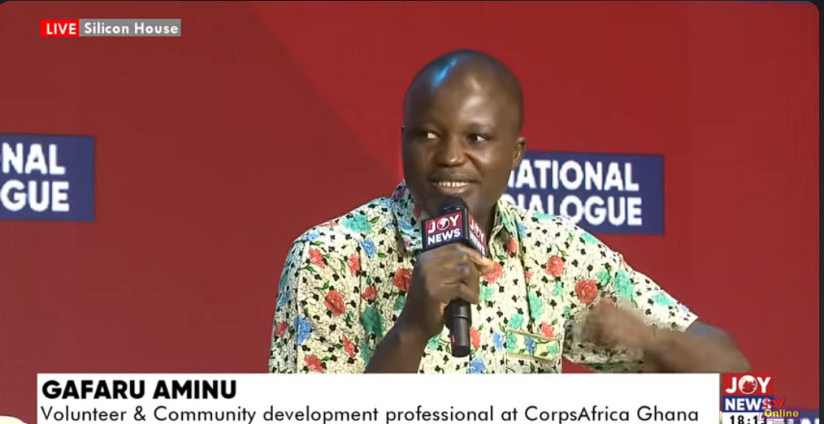
Gafaru Aminu, a volunteer and community development professional with CorpsAfrica Ghana, said climate action will be more effective if communities are placed at the centre of decision-making and implementation.
Speaking during a JoyNews National Dialogue on “Ghana’s Youth and Climate Change,”he said policymakers often design climate interventions that overlook lived experiences at the community level, creating gaps that weaken impact.
“If given the opportunity to meet a policymaker today, the message would be very simple: come back to us at the grassroots level. We need you, we need one another. When making policies, we don’t want to see gaps. We want the realities of communities to reflect in those policies,” he said.
He also urged government and development actors to rethink climate financing strategies, arguing that over-reliance on large global funding mechanisms risks overlooking local capacities and solutions already emerging within communities.
He cited a community-led initiative he supported as a volunteer, where 17 households mobilised about GH¢35,000 in cash and in-kind contributions within six months to implement a local climate adaptation project.
“To tell you that a 17-household community has raised GH¢35,000 within six months for a project, it shows the strength we are not paying attention to,” he noted.
He explained that when communities are empowered and given the right capacity, they can generate internal resources to address climate vulnerabilities without depending solely on external funding.
“Sometimes we focus too much on big global climate finance, but we have not even begun to explore the internal strengths within our communities,” he added.
Gafaru Aminu stressed that strengthening community-led adaptation strategies can significantly reduce climate vulnerability, especially in hard-hit areas, if properly supported by policy and technical guidance.
He concluded that meaningful climate action must be rooted in trust, participation, and shared responsibility between policymakers and local communities.
Latest Stories
-
PZ Cussons Ghana promotes hand washing among schoolchildren through Camel campaign
17 minutes -
30 NDC aspirants file nominations in Upper West as regional election approaches
31 minutes -
UPSA launches laptop assembly plant, requiring new students to assemble their own devices
37 minutes -
UCC sociologist calls for action on gender inequality to end child marriage
38 minutes -
LSN questions Ghana’s proposed five-year presidential term and DCE election reforms
39 minutes -
AFCON 2027Q: Bjorkegren to lead Black Stars for Somalia doubleheader with Tanko and Attram as assistants
41 minutes -
AMA completes road repairs on Kwame Nkrumah Avenue
47 minutes -
Law Students’ Network warns executive dominance could undermine constitutional review
50 minutes -
Mahama to meet relevant stakeholders over concerns about the new Customs Act
57 minutes -
CHASS demands a 20% increase in SHS funding and payment of outstanding debts
59 minutes -
Investigation launched after male body found in County Cork
1 hour -
We have been scammed by NDC, government is only doing PR – Abanga Fuseini
1 hour -
Tamale Teaching Hospital records 44 new breast cancer cases in six months
1 hour -
GES declares October 30 CPD day for private school teachers; learners to observe holiday
1 hour -
South Korea to support Ghana’s forts and castles restoration with $4.5m over five years
1 hour