

Audio By Carbonatix
The Teachers and Educational Workers Union (TEWU) of the Trades Union Congress (TUC) has called on the government to urgently recruit more non-teaching staff in education support personnel (ESP) to cater for the increasing number of students in the various educational institutions.
It said the current number of ESP was being overburdened with extra duties, which had health implications, among other things.
Aside that, it said about 600 non-teaching staff were due to go on retirement this year, hence the need for the government to put in place measures to recruit more staff.
World ESP Day
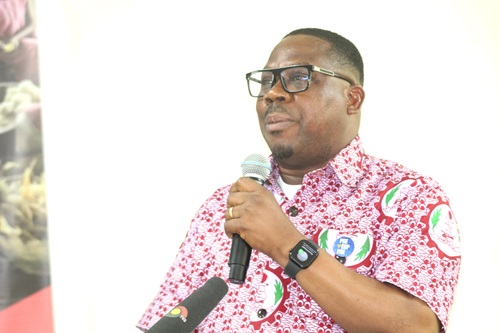
The Secretary General of TEWU of TUC, King James Azortibah, said this during a news conference in Accra yesterday to mark this year’s World ESP Day held on the theme: "Go Public! Invest in Education Support Personnel: Ensure inclusive education."
The day, which is celebrated annually on May 16, acknowledges the vital role of various education support staff, including school nurses, cafeteria workers and maintenance crew in ensuring a quality and safe learning environment, according to Education International (EI).
Mr Azortibah said at the inaugural event in the country that non-teaching staff were critical in education delivery.
"It is worth noting that without the ESP such as accountants, administrators, auditors, storekeepers, domestic bursars, human resource personnel, librarians, museums and monuments education officers, laboratory technicians, technicians, drivers, matrons, security personnel, stenographers, kitchen staff, office assistants, house keeping staff, among others, our schools simply cannot function effectively”.
He said based on TEWU’s membership data for the past 10 years, quite a number of ESP had exited through either retirement, resignation or death.
On a monthly average basis, Mr Azortibah said about 200 ESP (TEWU members) exited through retirement, resignation or death, yet no serious recruitment policies were in place to replace them.
"Per our calculations based on TEWU’s membership, we anticipate about 600 ESP to retire.
If this is the projected figure for May-December 2025, then one can imagine the situation by the end of the year, in terms of those exiting, through resignation or death," he said.
Again, he said there was a decline in public education budgets, leading to low salaries and decreased morale and motivation, and that overworked ESP/TEWU members were also denied their annual leave, part of their conditions of service.
Mr Azortibah urged the government to acknowledge ESP as essential education workers and involve them in policymaking.
“Imagine the kitchen staff serving breakfast, lunch and supper to over 5,000 students averagely, and daily using firewood for cooking and its health risks on these ESP in the senior high schools?” he asked.
The Coordinator for Gender Equality Programme at EI, Anais Dayamba, said despite the importance of education support personnel, they often lacked the recognition and the resources they deserved.
“It is time the education communities and the government threw the spotlight on their invaluable work and advocated for the support they need to excel,” she said.
She said EI recognised the vital role ESP played in delivering quality education and ensuring safe, positive learning environment and the achievement of Sustainable Development Goal Four.
“EI believes that ESP must be recognised for the work and enjoy the same status, rights and conditions as other education personnel with similar qualification and experience.
EI has adopted a declaration on the rights and status of education support personnel, which calls for its application worldwide and reaffirms education as a human right and a public good guaranteed by the state.
“It also highlights the challenges faced by ESP due to increasing privatisation and funding cuts in public education, leading to exploitation, poor working conditions and violation of human and labour rights,” she said.
The Chairperson of TEWU, Salamatu Braimah Mahamah, who chaired the event, said without the non-teaching staff, education delivery could not go on.
“If the cleaner does not clean, the teacher cannot work.
The student cannot sit in the dirty environment.
If the sanitary labourer does not clean, the atmosphere will not be conducive for teaching and learning,” she said.
Latest Stories
-
Gov’t to open enrolment for affordable homes under National Homeownership Fund
3 minutes -
Cashew farmers remind Mahama to fulfil promise to establish Cashew Development Board
10 minutes -
National Ambulance Service moves to acquire 400 new ambulances and 500 motorbikes
16 minutes -
Gov’t urges Ghanaian pilgrims to defer travel over Middle East tensions
22 minutes -
Ghana to create the largest converging centre for mineral discussions
28 minutes -
11 foreigners face trial over counterfeit dollar operation in Ga South
34 minutes -
GRIDCo chief leads team to inspect Genser’s Prestea Gas facility
41 minutes -
Minority Leader links push for cocoa price review to J.B. Danquah’s legacy
47 minutes -
Koforidua: Woman found guilty of manslaughter after pouring acid on boyfriend
53 minutes -
Ayawaso East voters to elect a new MP today
57 minutes -
Fire destroys shops at Kasoa Market as officers attacked during response
1 hour -
Minority introduces bill to tighten fiscal discipline in Ghana
1 hour -
NCCE calls for peaceful conduct of Ayawaso East by-election on Tuesday
1 hour -
Ghana’s nuclear projects in limbo; face delays over funding gap for critical studies
1 hour -
Mahama urges African countries to deepen commitment to African Court on Human and Peoples’ Rights
1 hour