

Audio By Carbonatix
When everything goes south, don’t try to fix your whole life at once. Fix the next problem.
Ghana’s future is sitting in our classrooms, quietly, patiently waiting for adults to stop playing with destiny.
A nation does not collapse first in Parliament. It collapses first in primary school, when a child stops understanding, stops believing, stops trying. And long before a country becomes poor in money, it becomes poor in meaning: respect becomes noise, discipline becomes punishment, learning becomes “chew and pour,” and the sacred work of shaping a human mind becomes an ordinary job.
Yet in the middle of this storm, Ghana keeps making one costly mistake: we are throwing away our strongest rescue team.
At 60, we stamp a teacher’s file “retired” and treat it like a goodbye. But retirement is not a goodbye—it is a transfer of wisdom. It is not disposal; it is deployment in a new form. The hands may drop the chalk, but the eyes still carry decades of classroom truth: how to wake up a slow learner, how to calm a troubled child, how to correct without crushing, how to build discipline without violence, how to make a lesson enter a stubborn mind like rain entering dry soil.
When everything feels like it is going south, standards, morals, learning outcomes, parenting, school culture, wisdom says: don’t try to fix Ghana all at once. Fix the next problem.
So what is the next problem Ghana can fix—quickly, practically, and with dignity—without waiting for a miracle budget?
Here it is: we are discarding our retired teachers like “used items,” when they are one of Ghana’s strongest national assets. And every time we do that, we weaken learning outcomes, weaken our communities’ moral fibre, and quietly damage family dignity beyond today.
The dignity crisis hiding inside “retirement”
In Ghana, retirement is legally defined: public officers retire at 60 years old. But retirement should never mean disposal.
A teacher does not stop being a teacher because their birthday has changed. The chalk may leave their fingers, but the wisdom stays. Their eyes have seen decades of children’s struggles—poverty, broken homes, teenage pregnancy, learning difficulties, trauma, disability stigma, and the silent hunger that makes a child sleep in class.
When Ghana treats retired teachers as “finished,” we lose more than manpower. We lose:
memory (what worked in the past and why it worked),
craft (how to teach, not just what to teach),
mentorship (how to shape a young teacher’s judgement),
values (respect, responsibility, discipline, truth), and
community authority (the voice that can correct without insulting).
In Akan, we say: Se wo were fi na wosan kofa a, yenkyi. If you forget and go back to fetch it, it is not wrong. Ghana has forgotten something important. Let us go back and fetch it.
The empirical truth: learning is not where we want it
This conversation is not sentimental. It is evidence-based.
Ghana’s own education indicators show real pressure at the foundation. For example, the Ghana Statistical Service reports that at the primary level, the pupil-teacher ratio rose to about 38 pupils per teacher in 2022/23 (from about 33 in 2001/02).
Even when trained-teacher ratios improved over time, classroom reality still demands strong instruction and coaching—especially in literacy and numeracy.
On learning outcomes, UNICEF’s Innocenti research drawing on Ghana’s National Education Assessment (NEA) notes that in 2018, only 19% of Grade 4 pupils met the proficiency cut point for mathematics, and large proportions did not achieve minimum competency levels.
So yes, things feel like they are going south because some key learning foundations are weak. And if we try to fix everything at once, we will fix nothing. But if we fix the next problem—teacher mentorship and instructional support—we can begin to turn the wheel.
Why retired teachers are the “next problem” solution
Look at the scale of Ghana’s education system. Ministry of Education budget estimates indicate millions of learners, tens of thousands of public schools, and large teacher numbers across levels.
The need is massive. The resources are never enough. That is exactly why we must stop wasting what we already have—experienced human capital sitting in our homes and communities.
Retired teachers can strengthen Ghana’s education system in ways that are fast, affordable, and culturally aligned—without replacing younger teachers.
They can serve as:
mentor-coaches for newly posted teachers (especially in rural and hard-to-staff communities),
reading and numeracy champions supporting foundational learning,
discipline and child protection advisors (supporting safe-school culture),
assessment literacy guides (helping teachers teach for understanding, not “chew and pour”),
community engagement anchors (restoring respect between school and home).
And this is not against public service rules. Ghana’s public service HR policy framework allows re-engagement on limited terms (post-retirement contract) under conditions, including service needs and medical fitness.
So the question is not “can we?” The question is: will we design it well and do it with dignity?
A practical national model: “Retired Teacher Mentor Pools” in every district.
If Ghana wants a fixable next step, here is one: Create District Retired Teacher Mentor Pools—a structured, screened, trained group of retired teachers who support learning outcomes and professional culture, without administrative confusion.
How it works (simple and Ghana-ready):
1.District registration & vetting
- Retired teachers opt in through the District Education Directorate.
- Verify service history, conduct record, and health fitness.
- Clear role boundaries and safeguarding rules.
2. Deployment by need
- Prioritise schools with low learning outcomes, high teacher turnover, large classes, or weak supervision structures.
- Focus on KG–Primary–JHS foundation skills first.
3.Work design (part-time, not burdensome)
- 2–3 days a week, or a few hours per day.
- Coaching cycles: lesson planning support, classroom observation, feedback, demonstration teaching.
- Community reading clubs and remedial support.
4. Incentives that preserve dignity
- Not “handout.” A professional stipend/honorarium, transport support, and recognition.
- Annual district honour awards for mentor-retirees.
5. Clear accountability
- Simple reporting: number of coaching sessions, teacher growth goals, pupil progress indicators.
- No interference with headteacher authority—retirees support, not compete.
This is the “next problem” fix: instructional mentorship and moral authority inside schools—quickly and sustainably.
Wellness support: if we honour teachers, we honour families
Let’s be honest: retirement in Ghana can be emotionally heavy. The salary stops. The routine changes. Some people feel forgotten. Others battle health challenges quietly. When a retired teacher is left to struggle alone, it not only affects them—it affects their spouse, their children, and the dignity of the family name.
That is why any serious retired-teacher strategy must include wellness support:
- annual health screening partnerships at the district level,
- psychosocial support groups (retired teachers counselling retired teachers),
- fast-tracked pension processing advocacy (where systems delay),
- community appreciation events (not only funerals—celebrations while alive).
A society that only honours teachers at their funeral has failed. Honour must arrive before the grave.
Alumni-led honour systems: restore dignity through gratitude.
Old students' associations, PTAs, traditional authorities, faith leaders, and local businesses can help. Not with speeches only—but with structure:
- Adopt-a-retired-teacher wellness package (quarterly check-ins + small support)
- Community “Teacher Appreciation Month” (district-level, non-political)
- School heritage projects where retirees tell the school’s story to current pupils
- Scholarships named after retired teachers who served with integrity
This restores something Ghana is losing: public gratitude and moral continuity.
Advisory councils: stop reinventing the wheel every decade
Every district can form a Retired Educators Advisory Council—not to “run the system,” but to advise on:
-local discipline culture and prevention strategies,
-school-community relations and conflict resolution,
- teacher ethics and professional identity,
- contextual solutions for persistent learning gaps.
When policy meets reality, elders help translate it into practice.
This is also a values conversation. Ghana’s erosion of values is not only about politicians. It begins in everyday life: shortcuts, dishonesty, disrespect, and “I don’t care” attitudes. Children copy what they see.
Retired teachers carry something priceless: the ability to correct with authority and love. They understand the difference between punishment and character formation. They know that a society survives not by noise, but by standards.
If we bring them back—strategically—we not only improve English and Maths. We improve honour: how we speak, how we treat elders, how we respect work, how we protect family dignity beyond today.
Final word: fix the next problem—then the next
Ghana does not need to fix everything tomorrow. But Ghana must stop bleeding what it already has.
Retirement is not disposal. It is a transition.
Let us start with the next problem: build a national system that keeps using the wisdom of retired teachers—through mentor pools, wellness support, honour systems, and advisory councils—so learning improves and dignity returns.
If we can do that, we will not only rescue the classroom. We will rescue something deeper: the continuity of values that protects families, communities, and the Ghanaian name.
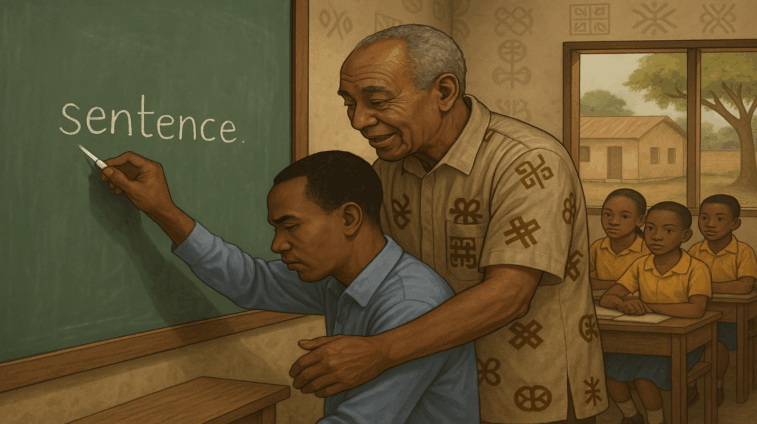
A retired teacher is guiding a younger teacher at a chalkboard in a classroom, while pupils sit behind them watching attentively. The scene suggests mentorship, respect, and passing wisdom from one generation of teachers to the next.
-
The writer, James Faraday Odoom Ocran, is a Ghanaian educational administrator, HR management and development practitioner, writer, and AI and intelligent orchestrator trainer & education consultant. He works in public education administration and writes on leadership, integrity, family legacy, and values-based national development.
Latest Stories
-
GPRTU in Savannah Region to protest alleged eviction in Damongo
8 minutes -
Re: Reinsurance does not replace process — A response to the SIGA–SIC defence
23 minutes -
Gender Ministry supports Harriet Amuzu in ongoing abuse case
36 minutes -
AG joins plaintiff to scrap OSP ?: We should be mindful of the mischief in this – Bobby Banson
42 minutes -
Samson Lardy Anyenini questions willingness of Attorneys-General to prosecute political colleagues
45 minutes -
It is only fair the OSP is heard in Supreme Court case – Bobby Banson
50 minutes -
Asiedu Nketia resumes Ashanti tour, second leg kicks off on Sunday
59 minutes -
NLA denies salary cut claims, threatens legal action over reports
1 hour -
BoG Governor honoured for stabilising cedi, improve inflation
1 hour -
Kyebi Easter Homecoming 2026: A resounding success!
2 hours -
Trade Minister applauds GUTA as a pillar of economic growth; Prez Mahama honoured
2 hours -
President’s brother’s takeover of Damang Mines is ‘untidy’ – Alhassan Tampuli
2 hours -
It’s not true that gov’t decided not to renew the lease for Gold Fields – Bobby Banson
2 hours -
Ghana to boost tomato production with 60-hectare irrigated farms and processing initiatives
3 hours -
E&P’s takeover process of Damang Mines was very clean – Inusah Fuseini
3 hours