

Audio By Carbonatix
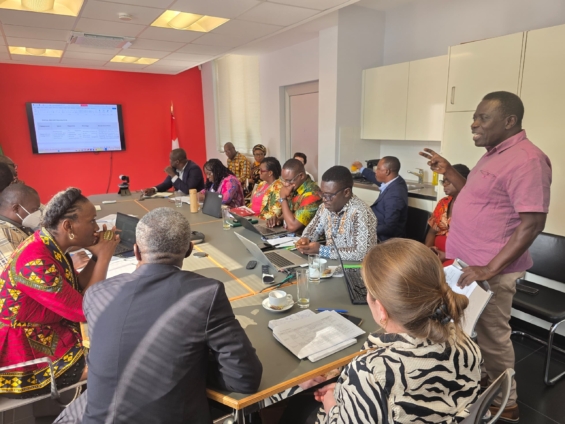
In a key step toward the formulation of the National Decentralisation Policy and Strategy (NDPS 2026–2030), the Executive Secretary of the Inter-Ministerial Coordinating Committee on Decentralisation (IMCC), Dr. Gameli Kewuribe Hoedoafia, led a team of experts to engage Development Partners.
The meeting held at the Embassy of Switzerland formed part of stakeholder consultations and provided a timely opportunity to take on board DP perspectives on the decentralisation reforms, align development assistance with national priorities towards the sector-wide approach to decentralisation
Welcoming the delegation, Janine Walz, Head of Cooperation at SECO and Deputy Head of Mission, praised Ghana’s government for “walking the talk” in rallying diverse stakeholders behind meaningful policy dialogue. She noted that the new NDPS provides Development Partners (DPs) and international NGOs an opportunity to shape Ghana’s next phase of decentralisation reforms.
“The policy being developed presently offers all DPs and INGOs the chance to shape this successor policy,” she said, urging continued collaboration to achieve a consensus-driven, reform-oriented, and practical framework for local governance.
Dr. Gameli highlighted that the draft policy had undergone extensive consultations nationwide, gathering input from four zonal sub-national meetings and a national stakeholder forum with Ministries, Departments, and Agencies, CSOs. He also underscored the importance of DP feedback to align with the aspirations and to finalise the policy that truly reflects local needs.
Decentralisation remains a key pillar of Ghana’s governance, aimed at empowering local authorities to deliver essential services and development closer to communities.
The session was attended by representatives from the following institutions; KfW Development Bank, Agence Française de Développement (AFD), Deutsche Gesellschaft für Internationale Zusammenarbeit (GIZ), the United Kingdom’s Foreign, Commonwealth & Development Office (FCDO), the United Nations Capital Development Fund (UNCDF), the Federation of Canadian Municipalities, the World Bank, the Embassy of the Federal Republic of Germany, Expertise France, the United Nations Development Programme (UNDP), the European Union, the Government of Canada, the Ministry of Foreign Affairs of Denmark, and other development partners.
The IMCC is expected to integrate Development Partners' feedback before submitting the draft policy to Cabinet for approval in August.
Latest Stories
-
Ghana’s hospital bed ratio stands at 0.9 per 1,000, below WHO standard- Titus Beyuo
10 minutes -
Fitch Solutions revises Ghana’s GDP growth to 5.5% due to Middle-East conflict
21 minutes -
Over 7,000 Korle Bu staff must be trained before new national patient system begins — Board Chair
24 minutes -
Korle-Bu Board Chairman cites under-investment as cause of ‘no bed syndrome’
39 minutes -
Ghana to establish national command centre for real-time emergency patient redirection
41 minutes -
New bed allocation system coming to Korle Bu but rollout will be gradual – Prof Beyuo
53 minutes -
Sammy Gyamfi rebuts claims of inflated contracts, accuses critics of misrepresentation
59 minutes -
‘Celebratory, unapologetic, and built to stand out’ – PUMA on Black Stars World Cup kits
1 hour -
TVET workers lay down tools as union declares nationwide strike over unresolved concerns
2 hours -
Black Stars begin Austria friendly preparation with 21 players
2 hours -
Today’s Front pages: Tuesday, March 24, 2026
2 hours -
Ghanaian citizen drags Attorney-General to Supreme Court over Kotoka Airport renaming
2 hours -
GACC unveils 25th anniversary logo to mark silver jubilee
2 hours -
Cutting rates while draining liquidity: Is the BoG contradicting itself, or getting it right?
3 hours -
Pepsodent “Smile Ride” brings oral health education to the streets of Ghana
3 hours