

Audio By Carbonatix
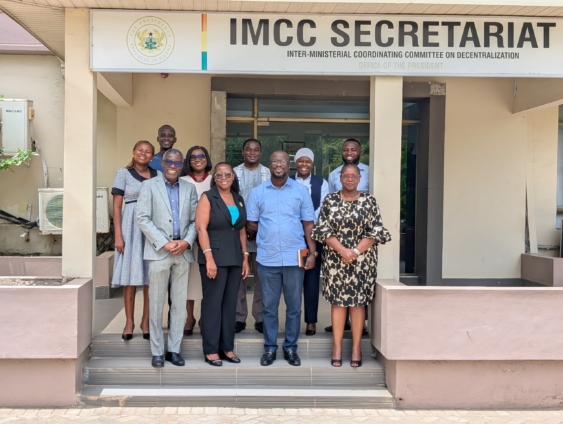
The Executive Secretary of the Inter-Ministerial Coordinating Committee (IMCC) on Decentralisation, Dr. Gameli Kewuribe Hoedoafia, welcomed a high-powered delegation from the National Development Planning Commission (NDPC) for a strategic dialogue at the IMCC Secretariat in Accra.
The meeting, themed “Mainstreaming Decentralisation Reforms into the Planning Guidelines,” brought together top technical experts and decision-makers from both institutions.
Leading the NDPC team was its Acting Director General, Dr. Audery Smock Amoah, who was joined by key staff, including Dr. Felix Addo-Yobo, Director of the Development Policy Division, and Dr. Sandra Kesse-Amankwa, Acting Head of the Plan Coordinating Division.
On the part of the IMCC, several core team members contributed to the discussions, including Dr. George Laryea (Director of Policy & Research Division), Tracy Cudjoe Edumadze (Finance), and Louis Ntem Adzato (Director of Administration).
In his welcome address, Dr. Hoedoafia emphasized the IMCC’s commitment to embedding decentralisation not just as a policy requirement, but as a working reality that enhances service delivery at the sub-national level.
He stressed that aligning decentralisation with national development plans is key to ensuring that every Ghanaian, no matter where they live, benefits from good governance and effective public services.
Dr. Amoah, on her part, reiterated the NDPC’s readiness to work closely with the IMCC to ensure that the 2026–2029 Medium-Term National Development Policy Framework (MTNDPF) reflects decentralisation more prominently, either as a standalone development area or a cross-cutting theme. “It’s time to close the gap between national policy and local impact,” she noted.
The team explored a range of practical options, including issuing clear directives to Ministries, Departments, and Agencies (MDAs) to prioritise decentralised service delivery in their planning and budgeting, as well as strengthening the role of Metropolitan, Municipal, and District Assemblies (MMDAs) in the implementation of national development policy at the local level.
There was a shared understanding that these reforms would not only improve coordination across governance levels but also enhance ownership, accountability, and results.
The meeting ended on a high note with a commitment to undertake further technical consultations and the development of a joint roadmap to mainstream decentralisation in all future national and local planning efforts.
Latest Stories
-
Enforce surcharges, modernise audits to curb GH¢100bn losses – Audit Service urged
41 seconds -
Six persons denied bail in 3.9-tonne alleged cocaine case
9 minutes -
Court jails man 25 months for setting three vehicles ablaze
18 minutes -
Miner jailed 24 months for stealing GH¢4,300
27 minutes -
Father jailed for defiling 13-year-old daughter in Tarkwa
36 minutes -
Prosperity Architecture: Drawing II – Organising institutions for shared prosperity
45 minutes -
First female prime minister named in Morocco after winning elections
54 minutes -
Burkina Faso’s junta leader opens major gold refinery to keep mining profits at home
1 hour -
Nigeria’s Ben Dancer completes 168-hour dance marathon, awaits Guinness verdict
1 hour -
I’m now a minister of God – Actress Jumoke Odetola announces
1 hour -
Banks accounted for 86% total enquiries for credit in 2025
1 hour -
‘I paused for my mom’ – Kizz Daniel opens up on music break
1 hour -
Habib Iddrisu rejects argument that court cases bar Parliament from investigating drug scandal
2 hours -
Over 25m enquiries conducted by financial institutions for credit appraisals, others in 2025
2 hours -
Venezuelan man shot by ICE in Texas is charged with assault
2 hours