

Audio By Carbonatix
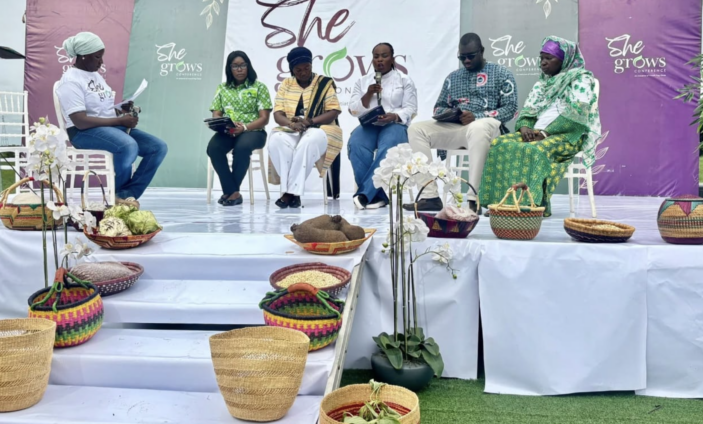
Stakeholders at a maiden conference to strengthen women in agriculture dubbed “She Grows Conference 2026” have called for a shift in narrative surrounding women in agricultural value chain.
They underscored need for policymakers, development partners and industry players to recognise women farmers as entrepreneurs, innovators and key drivers of economic growth.
The call was made at the two-day conference held at Pong-Tamale in the Savelugu Municipality of the Northern Region organised by Hajia Fatahiya Abdul Aziz, Member of Parliament for the Savelugu Constituency under her Yooyili Pag-Dede initiative.
It was organized under the theme: “Her Hands, Our Harvest – The Future is Fertile”.
The event brought together 500 women farmers, agribusiness entrepreneurs, traditional leaders, researchers, development partners and persons with disabilities to explore opportunities for advancing women’s participation in agriculture, agribusiness and entrepreneurship.
It featured interventions targeted at women with disabilities and livestock rearers including training in adaptive technologies, value addition, poultry management and digital entrepreneurship.
Hajia Abdul Aziz, speaking during the conference, said women had for generations sustained families, communities and local economies through their contributions to agriculture, yet their role remained largely undervalued.
She noted that while rural women were often portrayed as subsistence farmers struggling to survive, the reality was that they were innovators, business owners and economic actors contributing significantly to national development.
She said: “When I look around today, I do not simply see a gathering of women. I see the backbone of our local economy. I see resilience walking on two feet. I see determination wearing dusty boots and carrying baskets that have fed families, built communities and quietly sustained an entire nation.”
Hajia Abdul Aziz described the conference as a response to the United Nations’ declaration of 2026 as the International Year of the Woman Farmer, adding that the initiative sought to position women at the centre of agricultural transformation and economic development.
She said through the Yooyili Pag-Dede Foundation, organisers intended to redefine perceptions about women farmers and promote their role as entrepreneurs capable of competing in local and international markets.
She said: “Our women are not charity cases. They are farmers, innovators, business owners and economic drivers. They are the architects of a green economy that the world is only just beginning to understand.”
She explained that the conference would provide participants with training in modern agricultural practices, digital literacy, branding and agribusiness management to improve productivity and enhance access to markets.
Hajia Abdul Aziz highlighted partnerships with academic and research institutions, agribusiness organisations and development agencies aimed at strengthening innovation, market access and sustainable agricultural practices among women farmers.
She further announced that the conference would focus on mental health, social resilience and community wellbeing through a dedicated safe-space platform supported by development partners.
She explained that empowering women was one of the most effective pathways to achieving sustainable development.
“When women grow, families grow. When women succeed, communities prosper. And when women are empowered, nations flourish,” she said.
Madam Patricia Appiagyei, the Deputy Minority Leader in Parliament, underscored the importance of investing in women farmers as a strategy for accelerating economic growth and food security.
She described women farmers as producers of wealth, protectors of the environment and builders of nations, whose contributions extended beyond food production.
She said: “If we empower women economically, equip them with technology and support them through sound policies, we will unlock one of the greatest development opportunities available to Ghana today.”
Madam Appiagyei called for increased investments in women-led agricultural enterprises and innovations, noting that the future of agriculture was “female, green, innovative and profitable.”
Chef Failatu Abdul-Razak, a renowned chef and agribusiness advocate, during a panel discussion, encouraged participants to leverage partnerships and explore opportunities within the hospitality and food service industries.
Participants visited The Fertile Hub exhibition, which showcased locally produced crops, livestock, processed products and agricultural innovations from across the region.
Latest Stories
-
GJA accepts Mahama’s request to organise national forum on hate speech
12 minutes -
Democratizing the judiciary: Why Judges in Ghana should engage “We the People” through social media platforms.
14 minutes -
Bond market: Turnover increases by 47% to GH¢4.07bn
26 minutes -
DVLA prepares electronic queue system to reduce congestion
32 minutes -
Hearts of Oak coach Kapor raises alarm over poor pitches in Ghana football
43 minutes -
Dorimon Traditional Council endorses policy to formalise female chieftaincy
47 minutes -
DVLA expands from 33 to 63 offices after opening 30 new service centres across Ghana
48 minutes -
State Housing Company offers 195 homes with a 5% discount; prices start at GH¢950,000
51 minutes -
Learn Deutsch opens German language examination centre in Accra
51 minutes -
Decline in external buffers complicates foreign exchange outlook – IC Insights
52 minutes -
Ghanaian filmmakers urged to tell local stories and take them to the world
57 minutes -
Educated but unable to communicate? The missing link in Ghana’s University education
1 hour -
Informant demanded $20 million from NACOC for information on major drug consignment – Muntaka
1 hour -
Gov’t introduces mental health and drug tests for security recruits amid suicide concerns – Interior Minister
1 hour -
DVLA generates GH¢27.14m from dealer plates between January and September 2026
1 hour