

Audio By Carbonatix
Victims of a deadly typhoon in the Philippines have filed a legal claim against oil and gas company Shell in the UK courts, seeking compensation for what they say is the company's role in making the storm more severe.
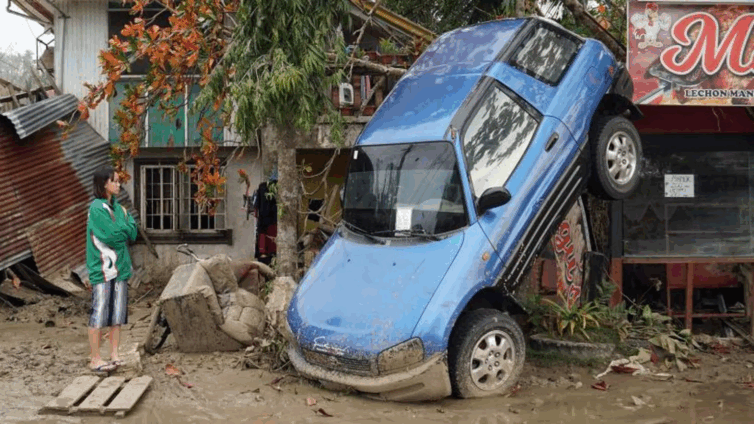
Around 400 people were killed, and millions of homes were damaged when Typhoon Rai slammed into parts of the Philippines just before Christmas in 2021.
Now, a group of survivors are for the first time taking legal action against the UK's largest oil company, arguing that it had a role in making the typhoon more likely and more damaging.
Shell says the claim is "baseless", as is a suggestion that the company had unique knowledge that carbon emissions drove climate change.
Typhoon Rai, known locally as Odette, was the most powerful storm to hit the Philippines in 2021.
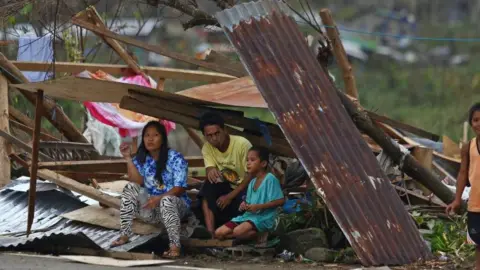
With winds gusting at up to 170mph (270km/h), it destroyed around 2,000 buildings, displaced hundreds of thousands of people, including Trixy Elle and her family.
She was a fish vendor on Batasan Island when the storm hit, forcing her from her home, barely escaping with her life.
"So we have to swim in the middle of big waves, heavy rains, strong winds," she told BBC News from the Philippines.
"That's why my father said that we will hold our hands together, if we survive, we survive, but if we will die, we will die together."
Trixy is now part of the group of 67 individuals that has filed a claim that's believed to be the first case of its kind against a UK major producer of oil and gas.
In a letter sent to Shell before the claim was filed at court, the legal team for the survivors says the case is being brought before the UK courts as that is where Shell is domiciled, but that it will apply the law of the Philippines as that is where the damage occurred.
The letter argues that Shell is responsible for 2% of historical global greenhouse gases, as calculated by the Carbon Majors database of oil and gas production.
The company has "materially contributed" to human-driven climate change, the letter says, which made the Typhoon more likely and more severe.
The survivors' group further claims that Shell has a "history of climate misinformation," and has known since 1965 that fossil fuels were the primary cause of climate change.
"Instead of changing their industry, they still do their business," said Trixy Elle.
"It's very clear that they choose profit over the people. They choose money over the planet."

Shell denies that their production of oil and gas contributed to this individual typhoon, and they also deny any unique knowledge of climate change that they kept to themselves.
"This is a baseless claim, and it will not help tackle climate change or reduce emissions," a Shell spokesperson said in a statement to BBC News.
"The suggestion that Shell had unique knowledge about climate change is simply not true. The issue and how to tackle it have been part of public discussion and scientific research for many decades."
The case is being supported by several environmental campaign groups who argue that developments in science make it now far easier to attribute individual extreme weather events to climate change and allow researchers to say how much of an influence emissions of warming gases had on a heatwave or storm.
But proving, to the satisfaction of a court, that damages done to individuals by extreme weather events are due to the actions of specific fossil fuel producers may be a challenge.
"It's traditionally a high bar, but both the science and the law have lowered that bar significantly in recent years," says Harj Narulla, a barrister specialising in climate law and litigation who is not connected with the case.
"This is certainly a test case, but it's not the first case of its kind. So this will be the first time that UK courts will be satisfying themselves about the nature of all of that attribution science from a factual perspective."
The experience in other jurisdictions is mixed.
In recent years, efforts to bring cases against major oil and gas producers in the United States have often failed.
In Europe, campaigners in the Netherlands won a major case against Shell in 2021, with the courts ordering Shell to cut its absolute carbon emissions by 45% by 2030, including those emissions that come from the use of its products.
But that ruling was overturned on appeal last year.
There was no legal basis for a specific cuts target, the court ruled, but it also reaffirmed Shell's duty to mitigate dangerous climate change through its policies.
The UK claim has now been filed at the Royal Courts of Justice, but this is just the first step in the case brought by the Filipino survivors, with more detailed particulars expected by the middle of next year.
Latest Stories
-
US seeks changes to rejected $109m health compact with Ghana – Mahama
3 minutes -
Nine dead in mass shooting at Pennsylvania home
20 minutes -
‘Time for Ukraine to get new president,’ says Trump after Zelensky condemns diesel deal
23 minutes -
Hincapie injury adds to Arsenal issues after Guimaraes rescue act
32 minutes -
Henderson scores twice as Chelsea thumb Bournemouth
41 minutes -
Photos: Mentapulse Africa convenes health and labour summit to address talent retention
53 minutes -
Mahama inspects Nkokɔ Nketenkete plant, eyes Bechem as chicken capital
60 minutes -
Ghana not seeking full BRICS membership, applying as Partner Country – Ablakwa
1 hour -
Woman injures three people in third Poland school knife attack in a week
1 hour -
Ghana should join BRICS as partner, not member – NPP Bono East Regional Secretary
1 hour -
Ghana High Commission warns nationals in South Africa over protests in Johannesburg, Durban
1 hour -
Mahama praises Roads Minister for keeping Big Push contractors on their toes
1 hour -
World Cup Visa Scandal: ‘My client has not collected money for visas’ – Ampofo Ankrah’s lawyer
1 hour -
US immigration officials defend ICE agents who shot man in same car as child
2 hours -
Commentator Katie Zacharia picked as new White House press secretary
2 hours