

Audio By Carbonatix
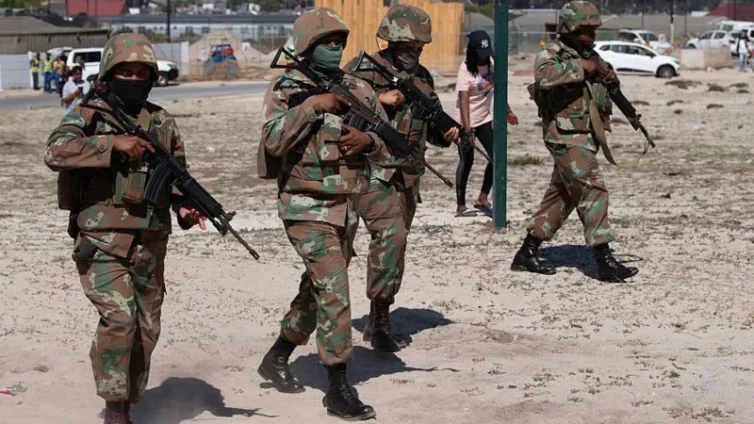
South Africa's army has officially been deployed to several parts of the country to help overwhelmed police clamp down on violent crimes, including illicit mining and gangs.
President Cyril Ramaphosa, earlier this year, announced the deployment of 2,200 soldiers to five of the country's nine provinces hardest hit by criminal activities.
Authorities say the deployment, set to run for a year, is aimed at restoring order to crime-ridden areas, but critics warn that using the military in civilian policing rarely delivers lasting results.
Illicit mining and gang violence are major problems in South Africa, which has one of the world's highest murder rates.
According to the latest crime statistics, covering the period between October and December 2025, around 71 people were killed each day.
An initial group of soldiers was deployed to several parts of Gauteng province, which includes Johannesburg, in March.
The second, and main cohort, will help with operations in the Eastern Cape, Free State, North West and Western Cape provinces from 1 April for a year.
The BBC spoke to several residents in a Johannesburg suburb, Eldorado Park, a few weeks after soldiers arrived in the area. It is one of the three Johannesburg suburbs targeted in the initial military deployment due to the high levels of gang violence there.
Some of those interviewed expressed scepticism about the soldiers' presence in their neighbourhood.
Leola Davies, a 74-year-old pensioner, described Eldorado Park as a "hell-hole to live in".
"Sodom and Gomorra have nothing on this place. I stay indoors all day because I just don't want to be the next victim. Things are getting worse," she said.
Elviena le Roux, a mother of three, told the BBC she doesn't believe having the military in the area will help, saying it will only "make the violence worse".
Ronald Rabie, 56, said that while seeing the army patrolling the streets makes some difference, as it creates a safer environment for families, this peace is short-lived.
"Once they leave, things return to chaos – they need to be here permanently," the father of three said.
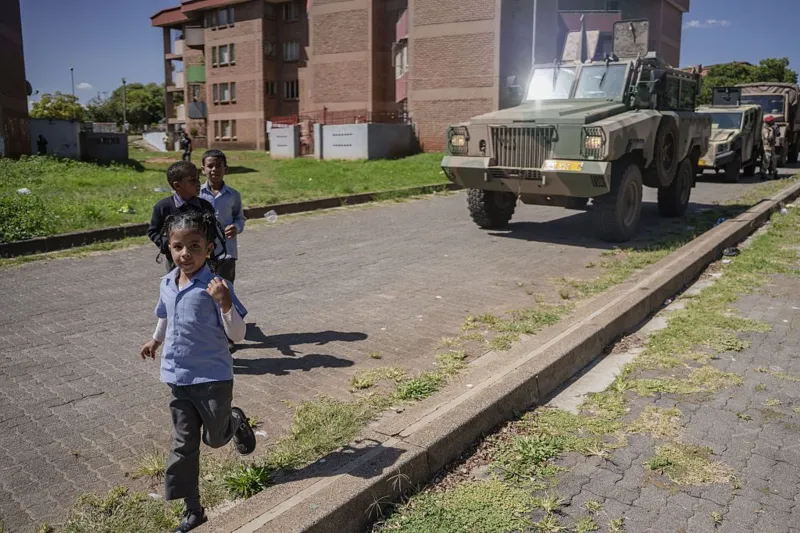
This is not the first time Ramaphosa has deployed troops to help bring down the country's high crime levels.
In 2023, over 3,000 soldiers were roped in to help tackle illicit mining across the country for six months.
In July 2021, the army was also deployed to help quell the deadly riots that had hit the country after the arrest of former South African President Jacob Zuma.
Under South African law, soldiers can only arrest civilians under rare circumstances and must then hand the suspect over to the police as soon as possible.
Security experts have repeatedly warned that the military is trained for combat - not for the kind of community-based policing needed to build trust.
And there is also history to contend with. The racist apartheid regime used the military to enforce their rule - a legacy that still shapes how some South Africans view soldiers on their streets today.
Criminologist Guy Lamb told the BBC he was not convinced the deployment would deliver lasting results, saying soldiers are "not designed to engage in policing" but rather to engage in combat and use maximum force.
"There's danger that they will escalate situations or respond very aggressively in... tense situations," he said.
He cited their conduct during the Covid-19 pandemic as an example. The army's deployment during that period, meant to help enforce the curfew and other restrictions, drew sharp criticism as reports came out of soldiers using excessive force, unlawfully detaining and harassing civilians.
Authorities have expressed optimism that the soldiers' presence will make a difference this time around but Lamb is not completely convinced.
He said that without "a dedicated plan... to try and address why crime is so violent in these sort of places", there was a strong likelihood it would flare up again once the soldiers leave.
"So we're likely to see this happening into the foreseeable future, because this plan of addressing what are the root causes of crime [in these] areas is not in place."
Latest Stories
-
New York Times executive fatally shot allegedly by elderly in-laws
2 hours -
Teacher Payment Crisis: GES races to protect academic calendar
2 hours -
US prosecutors reopen case of alleged gang rape at Cornell University
2 hours -
Journalist to be crowned king in Uganda after bitter succession dispute
2 hours -
OpenAI scraps rollout of new model over safety concerns
3 hours -
Nigerian attempts to break world record by dancing non-stop for seven days
3 hours -
GES urges government agencies to end blame game over teacher payments
4 hours -
GES sets Oct. 5 deadline to resolve teachers’ payment dispute
5 hours -
GES working around the clock to get teachers back to class, says Daniel Fenyi
5 hours -
French PM warns against escalation of school protests after 164 arrested
5 hours -
UK tries to stop Trump’s diesel export ban
6 hours -
Late Olise goal gives France win over Belgium
6 hours -
Mancini enjoys first win since return as Italy boss
6 hours -
Interest payments to average a high 20% of government revenue over next 4 years
6 hours -
Anthropic warns AI may pose ‘existential risks to humanity’ in IPO filing
6 hours