

Audio By Carbonatix
Stroke survivors and advocates have urged government to improve healthcare access and support systems to reduce disability.
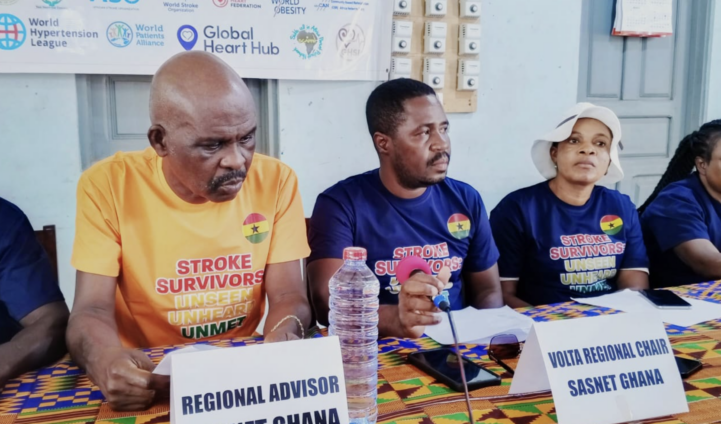
The call was made at a News conference in Ho to mark the National Stroke Survivors Day, observed annually on March 16.
The event, organised by Stroke Association SupportNetwork – Ghana (SASNET Ghana), brought together stroke survivors, caregivers, health professionals and stakeholders to highlight challenges confronting persons living with stroke.
Mr Callistus Edoh, Volta Regional Chairman of SASNET Ghana, said the day was set aside to raise awareness on stroke and advocate for improved care.
He explained that this year’s theme, “Stroke Survivors: Unseen, Unheard and Unmet,” reflected the invisible struggles, lack of representation and gaps in healthcare services.
“Many survivors face cognitive, emotional and financial challenges that are often overlooked, while access to rehabilitation and assistive technology remains limited,” he stated.
Mr Ebenezer Ad Adams, Executive Director of SASNET Ghana, said stroke survivors continued to struggle with unclear National Health Insurance Scheme (NHIS) coverage.
“Some pay for rehabilitation; others pay partially, while many cannot afford assistive devices like wheelchairs, which are essential for mobility,” he noted.
He called on the government to expedite action on the Assistive Technology Policy and expand support through the Livelihood Empowerment Against Poverty (LEAP) programme.
Mr Adams also urged authorities to clarify the provisions under the Ghana Medical Trust Fund, popularly known as “Mahama Care,” to ensure that stroke-related services are adequately covered.
He revealed that more than 16,000 stroke survivors were registered nationwide, with over 500 in the Volta Region alone, stressing that the actual figures could be higher.
Stakeholders noted that stroke remained a leading cause of disability and death in Ghana, with survivors often facing long-term physical and economic hardship.
They called for increased investment in healthcare infrastructure, including the provision of MRI and CT scan machines, and the training of more neurologists to improve diagnosis and treatment.
Mr Edoh cited a recent case, where a stroke patient was reportedly denied oxygen due to NHIS coverage issues, describing the situation as unacceptable.
Mr Samuel Sedodo, Vice President, SASNET GHANA, also emphasised the need for intensified public education on stroke prevention, early detection and management, urging the government to act swiftly to save lives.
Latest Stories
-
OSP under threat from political interference — Kissi Agyebeng calls for constitutional protection
4 minutes -
T.I. Ahmadiyya SHS, Kumasi, celebrates 75 years of excellence
12 minutes -
Court orders SHS students to pay compensation for assault on teacher
14 minutes -
Students of Nkwantanang M.A 6 Basic School benefit from ‘Break the Silence’ Menstrual Awareness Initiative
21 minutes -
Fuel price hike exposing NDCs’ deceitful politics—Mercer
23 minutes -
Farmers trained in snail rearing, beekeeping and mushroom cultivation under EMBRACE project
29 minutes -
Insurance contracts railroaded by unseen political hands – IMANI
35 minutes -
When Builders Are Broken: A nation’s conscience on trial
39 minutes -
Otto Addo: A pointless that failed spectacularly
39 minutes -
Bond market: Turnover declines by 59% to GH¢377.59m
51 minutes -
Touching children’s lives elevates me – James Kofi Annan
53 minutes -
Police arrest man over viral threats against High Court judge
54 minutes -
Parliament submits five bills to President Mahama for assent
58 minutes -
Otto Addo lacked credentials for Black Stars job – Ekow Asmah
1 hour -
74% of SMEs collapse within 5 years; experts call for urgent business structuring reforms
1 hour