


Audio By Carbonatix
Three major teacher unions have rejected a directive from the Ghana Education Service (GES) requiring public school staff to submit personal records as part of a nationwide job evaluation and staff validation exercise.
The unions — the Ghana National Association of Teachers (GNAT), the National Association of Graduate Teachers (NAGRAT) and PRETAG — say the directive is unnecessary and burdensome, and have called for its immediate withdrawal.
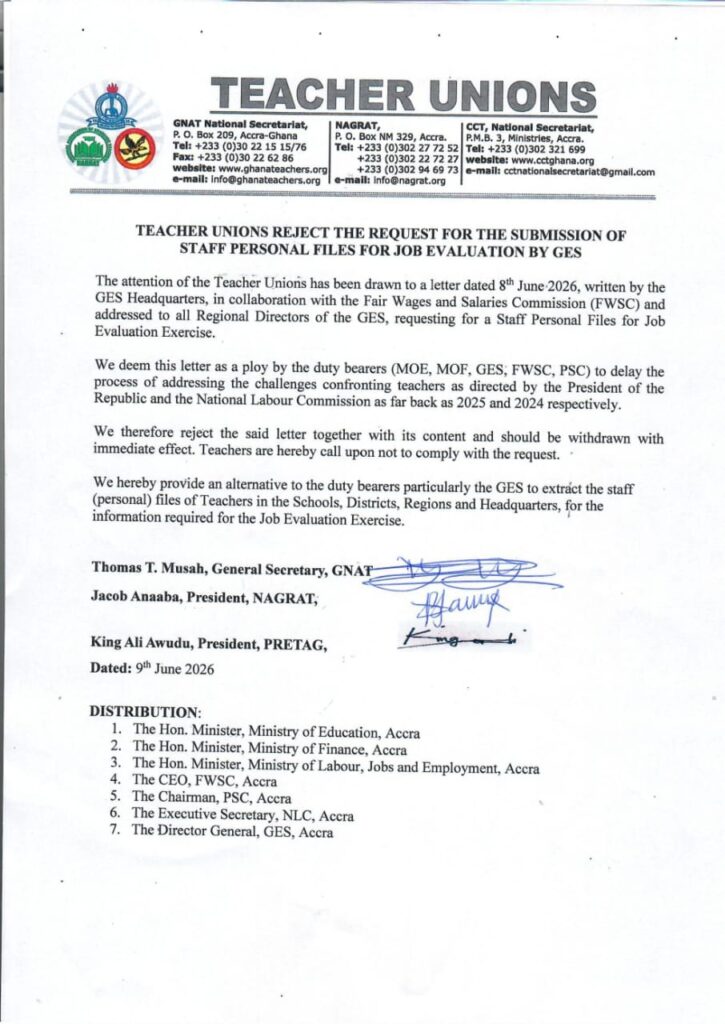
The GES directive, issued in a letter dated June 8, 2026 and signed by Deputy Director-General Prof. Smile Dzisi, is part of a joint exercise involving the GES, the Fair Wages and Salaries Commission (FWSC) and the Public Services Commission (PSC).
It is aimed at validating and updating staff records in connection with the implementation of a new scheme of service.
Under the directive, regional education directors were instructed to coordinate the collection of staff files, which include letters of appointment, completed personal record forms, certified academic and professional certificates, and promotion letters. The documents were to be forwarded to the Human Resource Management and Development (HRMD) Division at GES Headquarters.
However, the unions have described the move as unacceptable.
In a joint statement dated June 9, 2026, signed by GNAT General Secretary Thomas T. Musah, NAGRAT President Jacob Anaaba and PRETAG President King Ali Awudu, the unions questioned the motive behind the directive.
“We deem this letter as a ploy by the duty bearers (MOE, MOF, GES; FWSC, PSC) to delay the process of addressing the challenges confronting teachers as directed by the President of the Republic and the National Labour Commission as far back as 2025 and 2024, respectively,” the statement said.
The unions have instructed teachers nationwide not to comply with the directive, insisting that GES already holds sufficient personnel data and should rely on existing records instead of requesting fresh submissions.
They argue that the process places an unnecessary burden on teachers and could disrupt academic work if implemented at scale.
The unions are also urging GES and the relevant state institutions to withdraw the directive and engage stakeholders on a more efficient approach to staff verification.
The Ghana Education Service is yet to publicly respond to the unions’ position.
Latest Stories
-
Heritage Series notes: BoG promises more inclusive cedi with improved sizes, tactile features
10 minutes -
‘We want answers’ – Family seeks probe into 14-year-old’s death 12 days after starting SHS
20 minutes -
No preacher has the right to impose beliefs on bus passengers – Kwesi Pratt Jr backs preaching ban
24 minutes -
Africa Maritime Security Forum opens in Accra with call for stronger continental cooperation
25 minutes -
Techiman North MP fulfills promise with new CHPS Compound in Kokoago
35 minutes -
Enterprise Trustees, Sinapi Aba launch ‘Asetenapa Plan’ to promote retirement savings among informal workers
37 minutes -
Gov’t working to ensure GAUA strike is called off by October 16 – Haruna Iddrisu
42 minutes -
KAIPTC Commandant calls for continent-wide strategy to tackle Africa’s maritime security threats
54 minutes -
GRIDCo investigates Mallam substation fire as power restoration continues in Accra
54 minutes -
20% digital tax is not E-Levy – GRA boss
1 hour -
Defence Minister calls for intelligence-sharing and regional cooperation to tackle maritime insecurity
1 hour -
Afenyo-Markin failed to comply with procedural rules in defamation suit – Sammy Gyamfi’s lawyers
1 hour -
GRA recovered GH¢1.3bn out of about GH¢1.4 bn unpaid VAT from ECG – Anthony Sarpong
1 hour -
KMA to extend daily toll collection to nights and weekends
1 hour -
Ghana secures second consecutive term on UN Human Rights Council
1 hour