

Audio By Carbonatix
Just like Watergate in the US, South Africa's "Farmgate" scandal started with a break-in but has since spiralled into something that could threaten the future of the sitting president.
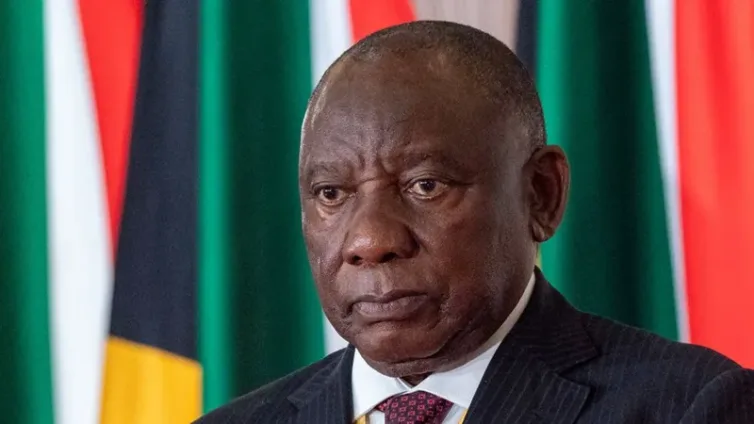
Cyril Ramaphosa now faces the possibility of being removed from office as MPs have taken the unprecedented step of setting up a committee that will recommend whether or not he should be impeached.
This issue first came up in parliament in 2022, but last month, the county's highest court ruled that MPs had violated the constitution by blocking moves to impeach Ramaphosa.
At that time, the president's African National Congress (ANC) controlled more than half the seats in parliament, but after the 2024 election, he no longer has that majority to rely on.
What is Ramaphosa actually accused of doing?
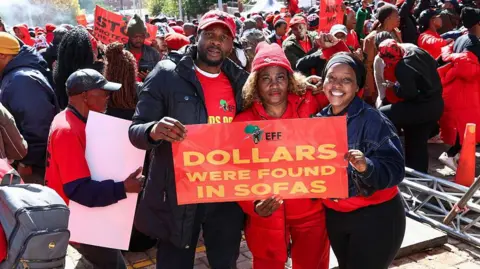
It all started back in 2020 with a robbery at the president's private farm in Phala Phala, Limpopo province. Thieves broke in and allegedly stole $580,000 (£430,000) in US dollar bills that had been stuffed into a sofa.
But details only came out two years later when the country's former spy chief, Arthur Fraser, highlighted the alleged theft in an explosive dossier that he sent to the police.
Fraser, a close ally of former President Jacob Zuma, who Ramaphosa replaced, accused the head of state of hiding the theft from the police and tax authorities.
At the time Ramaphosa said there was "no basis for the claims of criminal conduct".
As the stolen cash was in foreign currency, it meant that exchange control laws could also have been contravened.
The reserve bank looked into the issue and found that there were no violations of the exchange control act and the public protector, who investigates allegations of abuse of power, found no wrongdoing on the president's part.
But parliament also began an impeachment process and established an independent panel to investigate the allegations.
It came to some damning findings, including saying there was "substantial doubt about the legitimacy of the source of the currency that was stolen" and concluding that Ramaphosa "has a case to answer".
What did the president say?
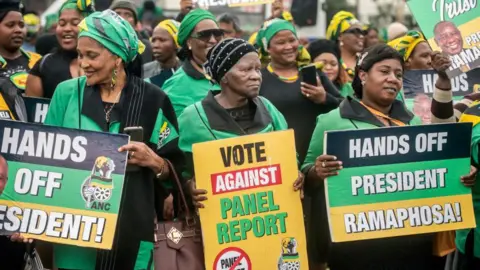
Ramaphosa has always been clear that he did not do anything wrong and resisted calls to resign.
In 2022, he confirmed that a robbery had taken place and that the money - he gave a figure of $580,000, though Fraser had mentioned $4m - had been from the legitimate sale of buffalo from his livestock business.
In response to the independent panel's report, he filed a legal application to have the report set aside.
That was dropped once parliament had voted against accepting the report but the president has since revived it, arguing that the independent panel had "misconceived its mandate, misjudged the information placed before it and misinterpreted the four charges advanced against me".
How does the impeachment process work?
According to South African law, the president can be removed for:
- violating the constitution or law
- serious misconduct or
- an inability to perform the functions of the job.
Ramaphosa is accused of violating the first two.
Parliamentary rules spell out the process followed for impeachment.
The independent panel's report is part of that process, but now a committee of MPs has been established to examine the charges against the president and make a recommendation.
If it recommends impeachment, the matter is put to a vote.
But according to the constitution, at least two-thirds of MPs must vote to remove the president.
Is Ramaphosa likely to be impeached?
The two-thirds rule may be what saves the president.
Ramaphosa needs at least 133 MPs to reject an impeachment motion and the ANC currently has 159 seats in the National Assembly.
Political analyst Sandile Swana told the BBC it was unlikely that the ANC MPs would turn on Ramaphosa if it came down to a vote.
"The ANC has made it clear that it is not in the business of impeaching its own president, regardless of the facts," he said.
What is less clear is which way the MPs from the other parties in the 10-party governing coalition will vote.
Ramaphosa has not always enjoyed smooth relations with the second-largest party in government - the Democratic Alliance (DA).
"The work of the committee must continue [and] … should not be unnecessarily delayed," DA leader Geordin Hill-Lewis was quoted as saying by local publication IOL News.
Makashule Gana, a member of another coalition partner Rise Mzansi, has been elected as chairperson of the impeachment committee. He said Ramaphosa's legal challenge to the report would "not stop the work of the committee".
Smaller parties in the coalition, like the Patriotic Alliance, have thrown their weight behind Ramaphosa and vowed to vote against impeachment.
Of course, the president's legal challenge to the 2022 report, which is due to be heard in September, may stop all this in its tracks.
Richard Calland, public law professor at the University of Cape Town, argued that there was a "good chance" the president would be successful. He believes the panel's report was "flawed" and riddled with "errors in law".
"It would make no sense to continue with the impeachment committee while that application is being dealt with," he said.
Ramaphosa has said he will not seek to prevent the committee from operating while it carries out preparatory work but will do so if it gets under way while legal proceedings are in place.
Has this ever happened before?
Ramaphosa is the first president to face impeachment proceedings under new rules introduced in 2018.
These introduced the creation of an independent panel and an impeachment committee.
In 2016, Zuma faced and survived an impeachment vote in parliament thanks to the ANC's large parliamentary majority.
He faced the vote after the Constitutional Court said he had breached the constitution by failing to repay public money used to upgrade his private home in KwaZulu-Natal.
What does this mean for Ramaphosa's political future, and the ANC?
According to Calland, if it gets to a vote in parliament, opposition parties most likely know the impeachment vote will fail because of the numbers, but "they want to harm the president and… the ANC through this process".
Ramaphosa's credibility and authority could well take a knock but as, under the two-term rule, he is unable to become president again after the 2029 election, he himself will not suffer at the ballot box.
The ANC, though, has removed two previous presidents as party leader - Zuma and Thabo Mbeki - once it felt they may be a liability and it could do that again in 2027 if it feels its electoral chances are taking a hit with Ramaphosa in charge.
Latest Stories
-
Nana B passport claims a diversionary tactic — Abu Jinapor
18 minutes -
Pope Leo diagnosed with cancer as doctors remove lobe of lung, Vatican says
18 minutes -
Legal Aid Commission takes free legal services to Techiman main lorry terminal
23 minutes -
Nana B denies seeking passport favour, accuses Ablakwa of failing to account for GH¢16.4m
28 minutes -
Young girls demand climate action, stronger protection against child marriage
39 minutes -
Ex-gang boss sentenced to 40 years for orchestrating Tupac Shakur’s murder
40 minutes -
From near-deferral to three awards: UMaT graduate’s academic journey
42 minutes -
Atta Akyea denies seeking presidential pardon for Wontumi in galamsey case
1 hour -
Photos: Mahama commissions 85-bed Police Hospital ward, donates two ambulances
1 hour -
GTEC directs Ghana’s public universities to reopen by October 16 and begin lectures on October 19
1 hour -
Star Oil donates GH¢1million towards construction of new CID facility
2 hours -
Court hands Adjetey Sowah, two others lifetime bans after Amputee Football legal dispute
2 hours -
NDC appoints Julius Kwame Anthony as a Deputy Communications Director
2 hours -
Ghana repatriates 120 Nigerians rescued from suspected cybercrime centres
2 hours -
NPP rejects Emelia Agbenyo’s appointment as Deputy EC Chair, demands withdrawal
2 hours