


Audio By Carbonatix
Ghana’s fight against corruption has reached a critical juncture, with calls for the removal of Special Prosecutor Kissi Agyebeng and the possible dissolution of the Office of the Special Prosecutor (OSP), prompting an urgent examination of the office’s performance and impact.
The primary objective of our research was to analyze corruption and corruption-related cases tried in Ghana’s courts and their conviction rates in the Fourth Republic (1992-2025).
This comes at a time when several notable individuals, including politicians from both sides, are calling for the removal of Kissi Agyebeng as Special Prosecutor and possible dissolution of the Office, claiming that the Office is not fit for purpose.
Our research revealed that, until the establishment of the Office of the Special Prosecutor (OSP), Ghana had not prosecuted any individual or entity specifically for corruption and corruption-related offences.
These offences are defined under various provisions of the Criminal Offences Act, 1960 (Act 29), including sections on bribery, extortion, misuse of public office, and electoral corruption, as well as Section 92(2) of the Public Procurement Act, 2003 (Act 663), which covers procurement-related offenses.
Prosecutions have occurred for offences such as causing financial loss to the state, misapplication of funds, stealing, and defrauding by false pretences.
In this context, the study classified these offences as part of the broader category of corruption and corruption-related cases prosecuted since the inception of the Fourth Republic.
Our analysis focused on concluded cases involving 47 individuals charged with corruption-related offences in Ghana from 1992 to the present (see Appendix).
It compared conviction rates during the period. The findings indicate that, since Kissi Agyebeng assumed office as Special Prosecutor in the last five years, he has achieved an 88% conviction rate (see Figure 1).
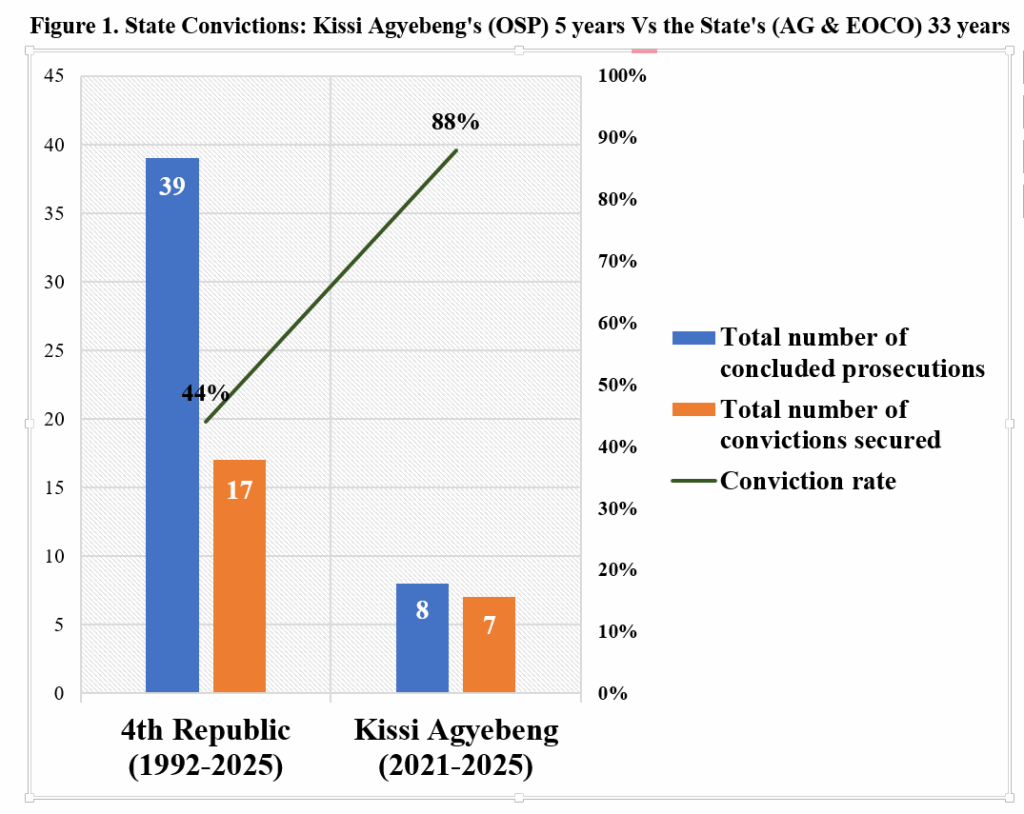
In contrast, over the past 33 years, the state (AG and EOCO combined) has achieved only a 44% conviction rate (Figure 1).
On average, the Kissi Agyebeng-led OSP has an annual conviction rate that is roughly 2.7 times higher than the entire State’s (AG and EOCO combined) conviction rate over the period. In other words, the Kissi Agyebeng-led OSP is securing convictions at a rate that is almost 3 times faster than the other state agencies.
Should Kissi Agyebeng be removed or should the OSP be scrapped? The numbers say NO.
“Throughout history, it has been the inaction of those who could have acted, the indifference of those who should have known better, the silence of the voice of justice when it mattered most, that has made it possible for evil to triumph.” - Haile Selassie
Writers' Email:
Latest Stories
-
Ghana repatriates 120 Nigerians rescued from suspected cybercrime centres
4 minutes -
NPP rejects Emelia Agbenyo’s appointment as Deputy EC Chair, demands withdrawal
8 minutes -
EOCO grants Suame MP John Darko enquiry bail in GH¢27m SIC investigation
12 minutes -
NPP cannot question EC appointment after appointing own people to Commission – Kwakye Ofosu
17 minutes -
BoG deepens public trust with regional stakeholder forum in Techiman
27 minutes -
‘We have turned the tide’ – Ato Forson says Ghana is ready to take off
32 minutes -
Police arrest man captured in viral video assaulting wife in Agona Nkwanta
34 minutes -
KATH Mother and Baby Unit construction stalled for 14 months over unpaid contractor arrears
48 minutes -
Government wanted to ‘tilt the balance’ with new EC appointments – Kwakye Ofosu
54 minutes -
Angry Tema Community 25 residents threaten to sleep at GWL over water shortage
1 hour -
BoG takes financial literacy drive to Techiman, vows to protect depositors
1 hour -
‘Stop the distractions’ – Akosua Manu demands answers over GH¢49.7m South Africa evacuation cost
1 hour -
Formula 1 to return to Africa with Rwanda Grand Prix in early 2030s
1 hour -
Mahama says Ghana is safer today as he commissions 85-bed ward at Police Hospital
1 hour -
LA 2028: Black Queens face Zambia in final Olympic qualifier
1 hour